Tokenmaxxing: OpenAI Invests $2M in Tokens to YC Startups — A New AI Startup Paradigm Emerges

OpenAI invests $2M in API Tokens per YC startup, launching the Tokenmaxxing era of AI entrepreneurship.
Tokenmaxxing is a new AI startup paradigm where companies maximize large model API Token usage as their core strategy. OpenAI's $2M Token investment to each YC batch startup marks a shift from cash-based to Token-based venture support. These startups feature tiny teams with massive Token consumption, focusing on Prompt engineering and Agent orchestration. While promising, the model carries risks including vendor lock-in, weak moats, and unsustainable unit economics once subsidies end.
What Is Tokenmaxxing?
A new term is gaining traction in Silicon Valley's startup circles — Tokenmaxxing. The concept refers to AI startups whose core strategy revolves around maximizing their use of large model API Tokens, treating Token consumption as the key metric for measuring business scale and technical depth.
First, let's understand the technical meaning of Tokens. In the context of large language models (LLMs), a Token is the smallest unit of text processing. It's not exactly equivalent to a word or character — rather, it's a subword fragment produced when the model splits text using tokenization algorithms (such as BPE, Byte Pair Encoding). For example, the English word "tokenization" might be split into "token" and "ization" as two Tokens, while a single Chinese character typically corresponds to 1-2 Tokens. API billing is based on the total number of input and output Tokens. Taking GPT-4o as an example, the price per million input Tokens is approximately $2.5-5, with output Tokens priced even higher. Therefore, Token consumption directly determines an AI startup's operating costs and the boundaries of its product capabilities.
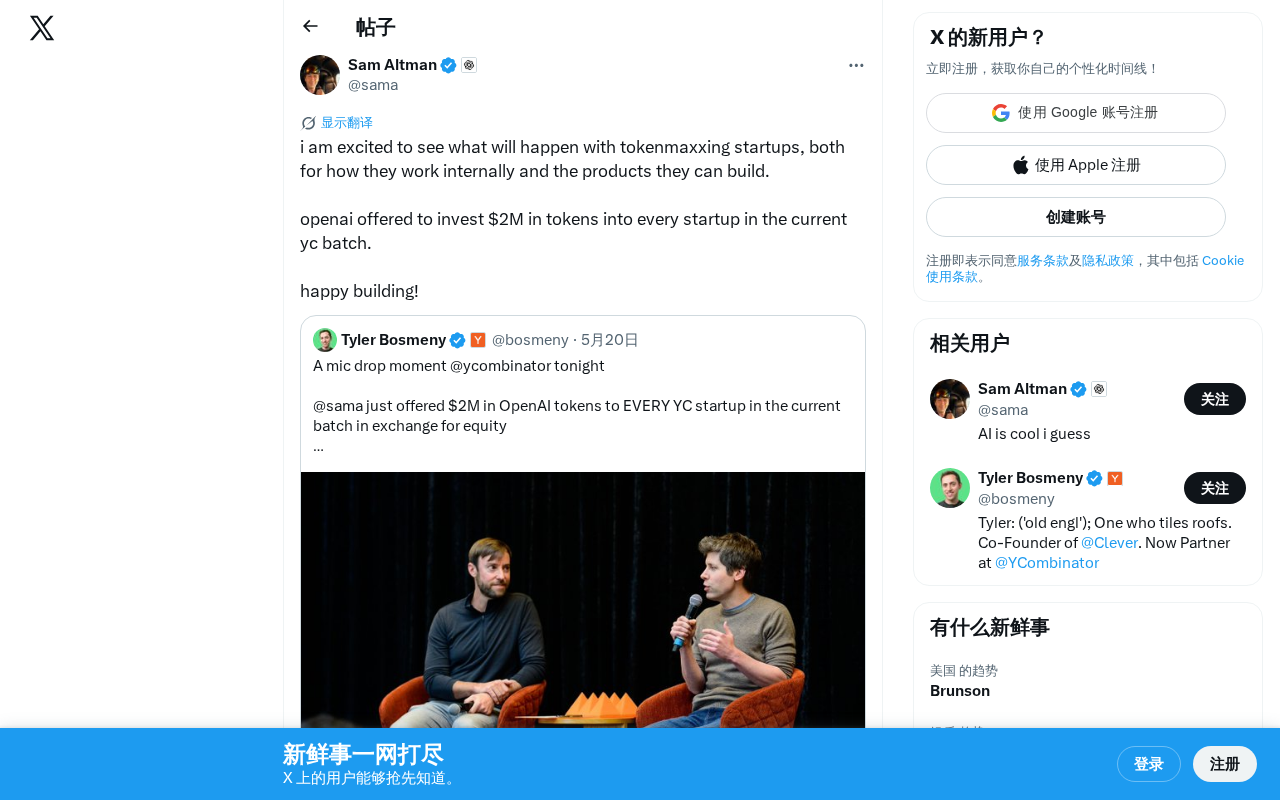
Recently, a tech observer shared exciting news on Twitter: OpenAI has provided each startup in the current Y Combinator (YC) batch with $2 million worth of Token investment. This isn't a traditional equity investment or cash injection — it's resource support delivered directly in the form of API call credits.
Y Combinator is the world's most influential startup accelerator, founded in 2005 and headquartered in Silicon Valley. It has incubated tech giants valued at over $10 billion, including Airbnb, Stripe, Dropbox, and Reddit. YC admits hundreds of startups in two batches per year, and in recent years, AI-related projects have accounted for over 60% of the cohort. OpenAI's choice of YC as the target for Token investment stems both from their deep historical ties — OpenAI co-founder Sam Altman previously served as YC president — and from the fact that YC startups represent the most cutting-edge directions in applied innovation. A $2 million Token credit means billions of Token processing capabilities, enough to support the development and testing of numerous complex application scenarios.
Token as Capital: A Profound Shift in AI Startup Investment Logic
This move marks a profound change in investment logic for the AI era. In the traditional startup ecosystem, investors provide capital, and founders use that capital to buy servers, hire talent, and acquire users. Under the Tokenmaxxing model, Tokens themselves are the means of production.
For an AI-native startup, $2 million in Token credits means:
- Massive model calling capacity: Enough to support the entire journey from prototype to scaled validation
- Dramatically lower barriers to entry: Founders don't need to worry about expensive API costs in the early stages and can focus their energy on product innovation
- Deep integration with the OpenAI ecosystem: Products built using OpenAI Tokens naturally become part of its ecosystem
Put simply, this is a strategic play by OpenAI — by providing Token subsidies to the most innovative YC startups, they're capturing the ecosystem entry point for next-generation AI applications. This strategy is identical to AWS offering free cloud computing credits to startups during the cloud computing era. At its core, both approaches lock in the developer ecosystem through infrastructure subsidies.
Two Key Aspects of Tokenmaxxing Startups
Revolutionary Internal Operations
The core assets of traditional software companies are code and engineers. The core assets of Tokenmaxxing startups may be Prompt engineering, Agent orchestration logic, and data pipelines.
Prompt engineering refers to the technical practice of carefully designing input prompts to guide large models toward desired outputs. It has evolved from simple instruction writing into a systematic discipline encompassing complex techniques such as Chain-of-Thought, Few-shot Learning, and role-setting. Agent orchestration is an even higher-level architectural design — encapsulating large models as autonomous intelligent agents with specific capabilities and coordinating collaboration between multiple Agents through workflow engines. Typical frameworks include LangChain, CrewAI, and AutoGen. Under this architecture, a complex task might be decomposed into subtasks by a planning Agent, then distributed to search Agents, code Agents, and analysis Agents for execution, with a summarization Agent integrating the final results.
These companies typically exhibit the following characteristics:
- Extremely small teams, but massive Token consumption
- Engineering focus shifts from "writing code" to "designing AI workflows"
- API call costs far exceed personnel costs in the cost structure
- Extremely fast product iteration — core logic changes require only Prompt and orchestration strategy adjustments
Entirely New AI Product Forms
When Token supply is no longer a bottleneck, founders can boldly explore product directions that were previously infeasible due to prohibitive costs:
- Real-time AI assistants: Continuously consuming Tokens for contextual understanding and proactive reasoning
- Large-scale content generation platforms: AI pipelines that batch-process massive amounts of data
- Multi-Agent collaboration systems: Complex interactions between multiple AI Agents, with Token consumption growing exponentially
Multi-Agent collaboration systems represent one of the most cutting-edge directions in the AI application layer today. Unlike single model calls, multi-Agent systems simulate human team collaboration patterns: each Agent has independent role definitions, tool-calling permissions, and memory systems, communicating and coordinating tasks through message passing. The reason Token consumption grows exponentially in this architecture is that each Agent's every thought and interaction requires independent model inference calls, and the number of dialogue rounds between Agents increases dramatically with task complexity. For example, a software development team composed of 5 Agents completing a feature module might require dozens of internal dialogue rounds, consuming hundreds of thousands of Tokens. This explains why abundant Token supply is critical for these types of startups.
Potential Risks of the Tokenmaxxing Model
However, the Tokenmaxxing model also carries risks worth watching.
First is ecosystem dependency. When your entire business is built on Tokens from a single model provider, any change in pricing strategy could upend your business model. This Vendor Lock-in risk has numerous precedents from the cloud computing era, but it may be even more severe in the AI domain — because different model providers have significant differences in API interfaces, capability characteristics, and output styles, making migration costs far higher than switching cloud providers.
Second is the moat problem. If a product's core value is merely a wrapper around large model calls, where exactly is the competitive barrier? Truly sustainable AI startups need to establish differentiated advantages through data flywheels, vertical domain knowledge, user network effects, or unique workflow orchestration capabilities.
Additionally, while $2 million in Token investment is generous, it may also create a "Token illusion" — founders sheltered by free Tokens may neglect the sustainability of their unit economics, and once subsidies end, products may face severe cost pressure. Unit Economics is the core metric for measuring a startup's commercial sustainability, focusing on the ratio of marginal cost to revenue for serving each user or completing each transaction. If a product needs to consume $0.50 worth of Tokens to process a single user request, but users are only willing to pay $0.10 for it, then the larger the scale, the greater the losses. Historically, similar subsidy-driven growth models have served as cautionary tales in the ride-hailing and food delivery industries. Therefore, even with $2 million in Token subsidies, smart founders should focus on Token efficiency optimization and pricing strategy design from day one.
Conclusion: How Tokenmaxxing Will Reshape the AI Startup Landscape
Tokenmaxxing isn't just a buzzword — it represents a fundamental shift in the AI startup paradigm. OpenAI's Token investment in the YC batch is both an empowerment of founders and a strategic positioning play for the entire AI application ecosystem. Over the next few years, we'll see a wave of startups rise whose core driver is Token consumption, and their success or failure will define the commercial logic of the AI application layer.
Notably, this model may also trigger a new round of reshuffling in the AI startup space. Companies that find the optimal balance between Token efficiency and product value will emerge victorious after subsidies recede; those that merely stack features on free Tokens without building genuine technical moats may quickly exit the stage when Token costs return to reality.
As that Twitter user said: Happy building!
Related articles
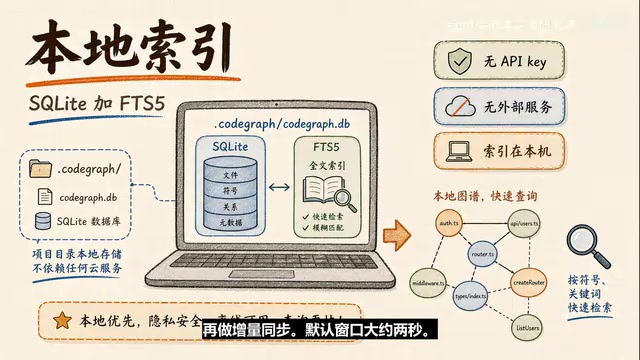
CodeGraph: Give Your Coding Agent a Code Map, Save 47% Tokens
CodeGraph is an open-source project with ~40K GitHub stars that uses Tree-sitter to build a local queryable code map, helping Claude Code and Cursor reduce 47% token usage and 58% tool calls.
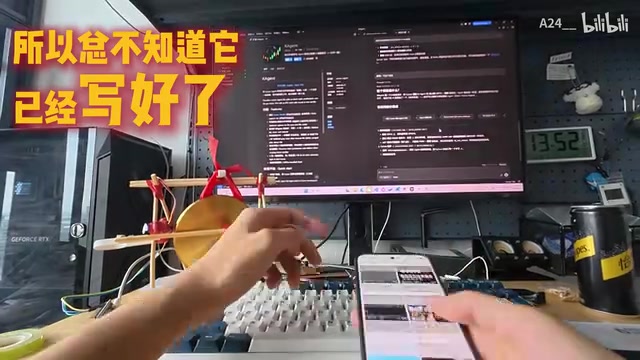
AI Finishes Writing Code, Automatically Strikes a Gong to Alert You: Open-Source Physical Feedback Tool DAgent
A developer built a physical feedback device with chopsticks and a small gong that auto-strikes when AI finishes coding. Now open-sourced as DAgent, it also simulates IPO bell-ringing when creating new files.

Level Up Claude Code: Building an Enhanced Plan Mode with Grill Me
Learn how to install and use the Grill Me Skill for Claude Code, replacing AI guesswork with structured questioning to clarify requirements before generating execution plans.