Vibe Coding in Practice: Driving AI Programming with Natural Language from Zero Experience
A practical guide to building apps with natural language using AI agents like Claude Code — no coding experience required.
This article breaks down the Vibe Coding methodology — a new programming paradigm where natural language replaces traditional coding. It covers tool selection (Claude Code as primary), cost-effective model options including DeepSeek V4 Pro, agentic engineering principles for effective AI collaboration, target learner profiles, and a complete learning path from zero experience to independently deploying web applications.
What Is Vibe Coding? A Completely New Programming Paradigm
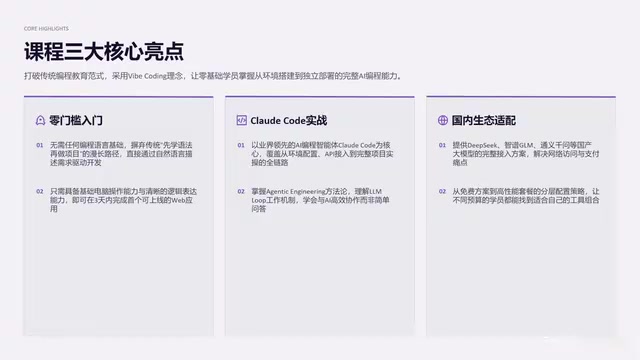
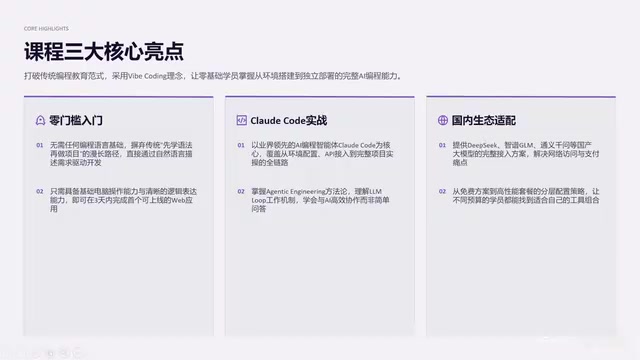
In the age of AI Agents, the barrier to programming is being fundamentally reshaped. Vibe Coding is a brand-new development philosophy — you no longer need to worry about code syntax. Instead, you immerse yourself entirely in the atmosphere of collaborating with AI, describing requirements in natural language while AI agents handle the code implementation.
This means: Someone with no programming background, as long as they can express their logic clearly, can ship a simple web application within 3 days. This isn't exaggerated marketing speak — it's a realistic reflection of what current AI programming tools can do.
Recently, Bilibili creator "Meng Ge" released a zero-to-hero AI Coding tutorial series that systematically explains how to use tools like Claude Code, Codex, and Cursor for Vibe Coding development. This article distills the core methodology and practical advice from that series.
Core Tool Selection: Claude Code as Primary, with Flexible Multi-Model Adaptation
Why Choose Claude Code as the Primary Tool?
The course uses Claude Code as its core programming tool — currently the industry-leading AI programming agent. Unlike simple code completion tools, Claude Code supports a complete LLM-Loop (Large Language Model Loop) working mechanism, capable of understanding context, iterating continuously, and debugging autonomously.
However, many users find Claude Code underperforming or overly expensive. The root cause is not following the officially recommended best practices, resulting in low cache hit rates. The course specifically emphasizes this point and provides targeted optimization strategies.
Multi-Model Options and Cost Comparison
For different budgets and use cases, the course provides detailed model selection guidance:
| Model | Recommended Plan | Cost Reference |
|---|---|---|
| Claude Sonnet 4.6 | Monthly subscription | $20-$100/month |
| GPT | Monthly subscription | $20-$100/month |
| Zhipu GLM 5.1 | Monthly subscription | ¥49/month |
| Tongyi Qianwen 3.7 Max | Monthly subscription | ¥100-200/month |
| DeepSeek V4 Pro | Pay-per-use API | ~¥3/day |
Among these, DeepSeek V4 Pro is rated as the best value option, achieving cache hit rates of 98%-99% at an average cost of only about 3 yuan per day. However, this requires proper configuration — if cache hit rates are low, costs can increase significantly.
Model Adaptation for Users in China
For domestic users who find it inconvenient to use overseas models, the course provides complete integration solutions for Chinese models including DeepSeek, Zhipu GLM, and Tongyi Qianwen. All of these can serve as the underlying engine for Claude Code, enabling the same Vibe Coding workflow.
Agentic Engineering: A Detailed Methodology
Shifting from Q&A to Continuous Collaboration
The core of Vibe Coding isn't "asking AI questions" — it's "collaborating with AI." The course emphasizes the Agentic Engineering methodology, with LLM-Loop as its central concept.
Put simply, the traditional way of using AI is a single question-and-answer exchange. Under the agentic paradigm, AI will:
- Understand the full context of your requirements
- Autonomously plan implementation steps
- Execute code writing and debugging
- Self-correct through iterative loops when encountering issues
- Deliver a complete, runnable result
Four Key Principles for Effective AI Collaboration
The course presents an interesting yet practical insight: The more humble and trusting you are when interacting with AI, the better the results. Specifically:
- Don't argue with the AI — This only wastes tokens and money
- Provide sufficient context — Let the AI understand your complete intent
- Let the AI confirm further — Allow it to ask questions and clarify requirements
- Follow official best practices — Ensure every step aligns with recommended guidelines to improve cache hit rates
Target Learner Profiles: Who Benefits Most from Vibe Coding?
Type 1: People with Business Experience but No Programming Skills
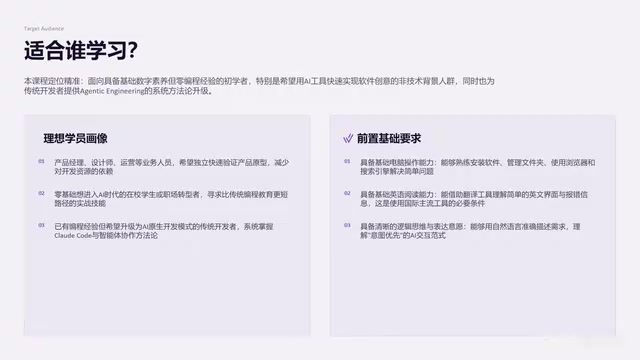
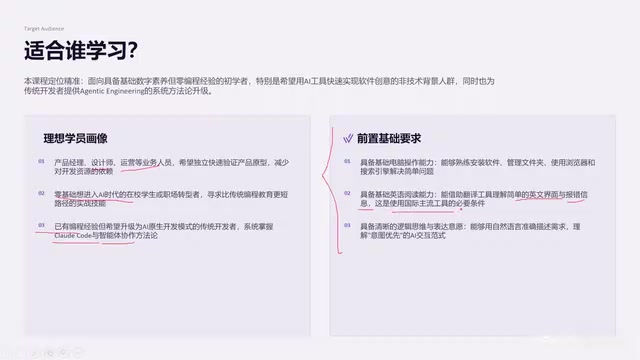
Product managers, designers, operations staff, and other business professionals who already have complete business logic mastery but lack programming ability. Through Vibe Coding, they can describe requirements to AI directly in natural language, reducing dependence on development resources and even completing projects independently.
Type 2: Students or Career Changers Starting from Zero
Traditional programming education requires starting from syntax, with a lengthy learning curve. In the AI era, with agent-assisted development, the learning curve is dramatically compressed. Vibe Coding provides these learners with a fast-track path to getting started.
Type 3: Existing Developers Who Want to Master AI Collaboration
Developers with programming experience who aren't yet familiar with AI Coding need to systematically learn the methodology of collaborating with Claude Code and AI agents to boost their daily development efficiency.
Learning Path and Expected Outcomes
The course covers the entire pipeline from environment setup and API integration to complete project implementation. After completion, learners can expect to:
- Theoretical understanding: Clearly explain the concepts and applicable scenarios of Vibe Coding, agentic paradigm programming, and the SSD paradigm
- Engineering capability: Master the full workflow of Claude Code environment configuration, model integration, project development, debugging, and deployment
- Practical ability: Independently build and deploy complete web applications, write PRD requirement documents, and perform code reviews and production deployment
- Tool proficiency: Skillfully use and customize SQL, and master System Prompt writing techniques
Final Thoughts: AI Won't Replace You, But People Who Use AI Will
"What replaces you is never AI itself, but another person who knows how to use AI." This statement is particularly apt in the context of Vibe Coding. When AI tools dramatically lower the barrier to programming, the real competitive advantage is no longer "whether you can write code" but "whether you can clearly express requirements and efficiently collaborate with AI."
As for prerequisites, the course sets an extremely low bar: basic computer literacy, the ability to understand simple English interfaces with translation tools, and most importantly — clear logical thinking ability. These three qualities are precisely the most essential "programming skills" of the Vibe Coding era.
Related articles
Five Common Claude Code Mistakes — How Many Are You Making?
Five common Claude Code mistakes developers make: copy-pasting code, skipping CLAUDE.md, inefficient prompting, ignoring docs, and poor context management — with fixes.
Andrew Ng's New Course Explained: A Practical Guide to Using OpenAI's O1 Reasoning Model
Deep dive into Andrew Ng and OpenAI's Reasoning with O1 course covering test-time scaling, new prompting paradigms, multi-model orchestration, and practical applications for developers.

Learning AI After College Entrance Exams: A Complete Path from Zero to Freelancing
How to efficiently learn AI skills during summer break after exams? A complete path from mastering prompts and hands-on projects to freelancing on platforms.