Vibe Jam 2026: AI Game Development Competition Surpasses 1 Million Players with Nearly 50 Million Impressions

Vibe Jam 2026 surpasses 1 million players and 50 million impressions, signaling AI game dev's mainstream breakthrough.
Vibe Jam 2026, a global AI-assisted game development jam, has achieved remarkable milestones with over 1 million total plays and nearly 50 million impressions on X. Built on the "Vibe Coding" concept where developers direct AI through natural language, the event demonstrates how AI tools are fundamentally lowering game creation barriers, enabling non-professionals to produce polished, entertaining games and accelerating the democratization of game development.
Vibe Jam 2026 Hits Stunning Milestones
Vibe Jam 2026—the global Game Jam centered on AI-assisted game development—recently announced a remarkable set of numbers: total plays across all submitted games have surpassed 1 million, while garnering nearly 50 million impressions on X (formerly Twitter).
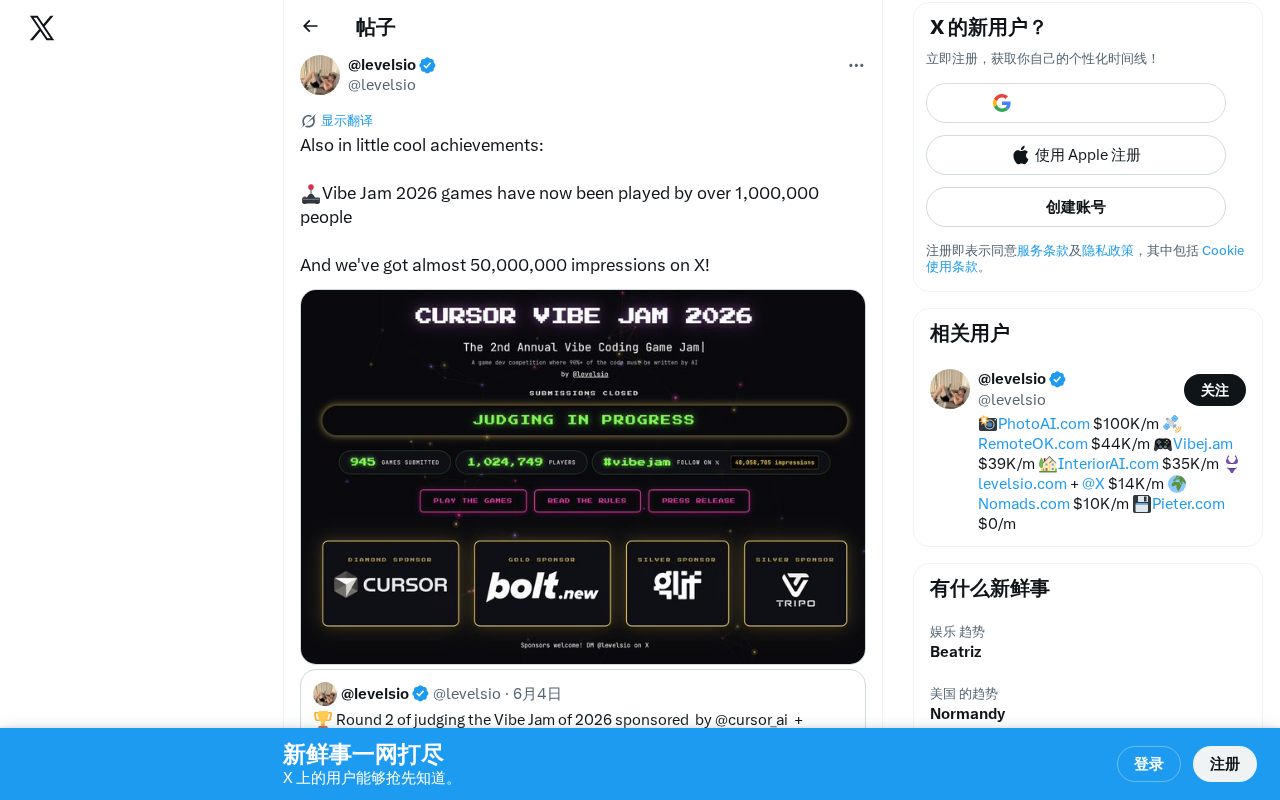
These figures represent more than just a successful event—they reflect how AI-driven game creation is moving from niche experimentation into the mainstream spotlight.
What Is Vibe Jam?
A Game Creation Celebration for the AI Era
Vibe Jam is a new type of Game Jam (time-limited game development challenge) built around the core concept of using AI tools—including code generation, art assistance, sound synthesis, and more—to rapidly build playable game prototypes.
Game Jams (game development marathons) are time-limited game creation events that originated in the early 2000s, where participants build a playable game from scratch within 24 to 72 hours. The most well-known Game Jams include Ludum Dare (since 2002) and Global Game Jam (since 2009), the latter attracting tens of thousands of developers worldwide each year. Traditional Game Jams emphasize creativity and rapid prototyping skills, with participants typically needing expertise in at least one of programming, art, or game design. These events have spawned the prototypes of many notable indie games—for example, both Superhot and Celeste were originally born at Game Jams.
The "Vibe" in the name comes from the concept of "Vibe Coding"—where developers describe their intent in natural language and let AI handle most of the technical implementation. Vibe Coding was coined by Andrej Karpathy in early 2025, referring to a development approach where developers describe desired functionality to AI in natural language, and large language models (such as GPT-4, Claude, etc.) generate the corresponding code. Under this paradigm, the developer's role shifts from "writing code" to "directing AI to write code"—more like a creative director than a programmer. This approach relies on the rapid advancement of AI code generation tools (such as GitHub Copilot, Cursor, Replit Agent, etc.), enabling creators without deep programming backgrounds to build fully functional applications and games.
The 2026 edition of Vibe Jam has clearly taken this model to new heights. Million-level player participation means these AI-assisted games are no longer just tech demos—they genuinely deliver entertainment value that attracts everyday players.
The Deeper Significance Behind the Numbers
A Fundamental Lowering of the Creative Barrier
Submissions to traditional Game Jams typically receive only hundreds to thousands of plays, and events that break through to a million total plays are extremely rare. Vibe Jam 2026 reaching this number points to several key trends:
- Massively expanded participation: AI tools enable more non-professional developers to participate in game creation, likely resulting in far more submissions than traditional Game Jams
- Significantly higher completion quality: A million players won't stick around for rough demos—AI assistance helps creators achieve a much higher level of polish
- Exceptional social virality: Nearly 50 million X platform impressions indicate that AI game development itself is a highly topical and shareable form of content
The current AI game development toolchain covers virtually every aspect of game production. At the code level, there are AI programming assistants like Cursor and Windsurf; for art, there are image generation tools like Midjourney, Stable Diffusion, and DALL-E, plus specialized game asset generators like Scenario.gg; for sound effects and music, there are AI music generation platforms like Suno and Udio; in 3D modeling, there are text-to-3D tools like Meshy and Tripo. The combined use of these tools makes it possible for a single person to accomplish in days what previously required a small team working for months. It's precisely this full-pipeline AI empowerment that supports the dual breakthrough in both quantity and quality of Vibe Jam submissions.
From Developer Experiment to Mass Cultural Phenomenon
50 million social media impressions is a signal worth contemplating. In the context of game industry marketing, this is a considerable number—many mid-tier indie games may struggle to achieve this level of social media reach across their entire marketing cycle. This data suggests that AI game development is not merely a technical topic but has become a form of content with "spectator appeal"—people don't just want to play these games, they want to watch and share the process of AI creating games. This "creation process as content" characteristic aligns perfectly with the content consumption logic of the short-video era.
This means Vibe Jam has transcended the boundaries of the developer community to become a cultural phenomenon capable of reaching the general public. When everyday users begin paying attention to, discussing, and actively playing these AI-created games, a new creator economy ecosystem is taking shape.
Implications for the Game Industry
Game Development Democratization Is Accelerating
Vibe Jam 2026's success validates a hypothesis: AI won't replace game developers, but it will make "everyone can be a game developer" a reality. Just as short-video platforms enabled everyone to become a content creator, AI game development tools are ushering in an entirely new era of UGC gaming.
UGC (User-Generated Content) gaming is not a new concept—from the early Warcraft III map editor spawning the MOBA genre, to Roblox and Minecraft building massive player-creation ecosystems, UGC has always been an important source of innovation in the game industry. The Roblox platform already hosts millions of user-created game experiences with over 70 million daily active users. However, these platforms still require creators to master specific scripting languages or editor operations. AI tools lower the UGC barrier further to the point where "all you need is an idea"—potentially spawning a creator population an order of magnitude larger than existing UGC platforms.
Developments Worth Watching
- Will any of these submissions evolve into commercially successful indie games?
- Will the AI game development toolchain continue to integrate and mature?
- How will traditional game publishers respond to this emerging force?
A million players is just the beginning. When AI compresses game development timelines from months to days or even hours, the supply side of the game industry will face an unprecedented transformation.
Key Takeaways
Related articles

Claude Code for Test Development in Practice: An AI Programming Workflow That Doubles Your Efficiency
A practical guide to Claude Code for test development: auto-generating test scripts, Plan Mode workflows, MCP + Playwright integration, and Subagent parallel tasks to build systematic AI-assisted workflows.
Hermes Agent Hands-On Review: An AI Efficiency Revolution for Indie Game Developers
Indie game developer reviews Hermes Agent vs OpenClaude: intelligent context compression, real-time Memory, remote control via Telegram, and practical use cases in game dev, social media, and email.
Vibe Coding Beginner's Guide: Tool Selection Across Three Categories with Practical Examples
A comprehensive guide to Vibe Coding's three tool categories: Agent frameworks, CLI Coding, and IDE tools, with practical examples including Snake game and data analysis workbench.