What Is Gemini Omni? A Deep Dive into Google's AI Story Creation Tool
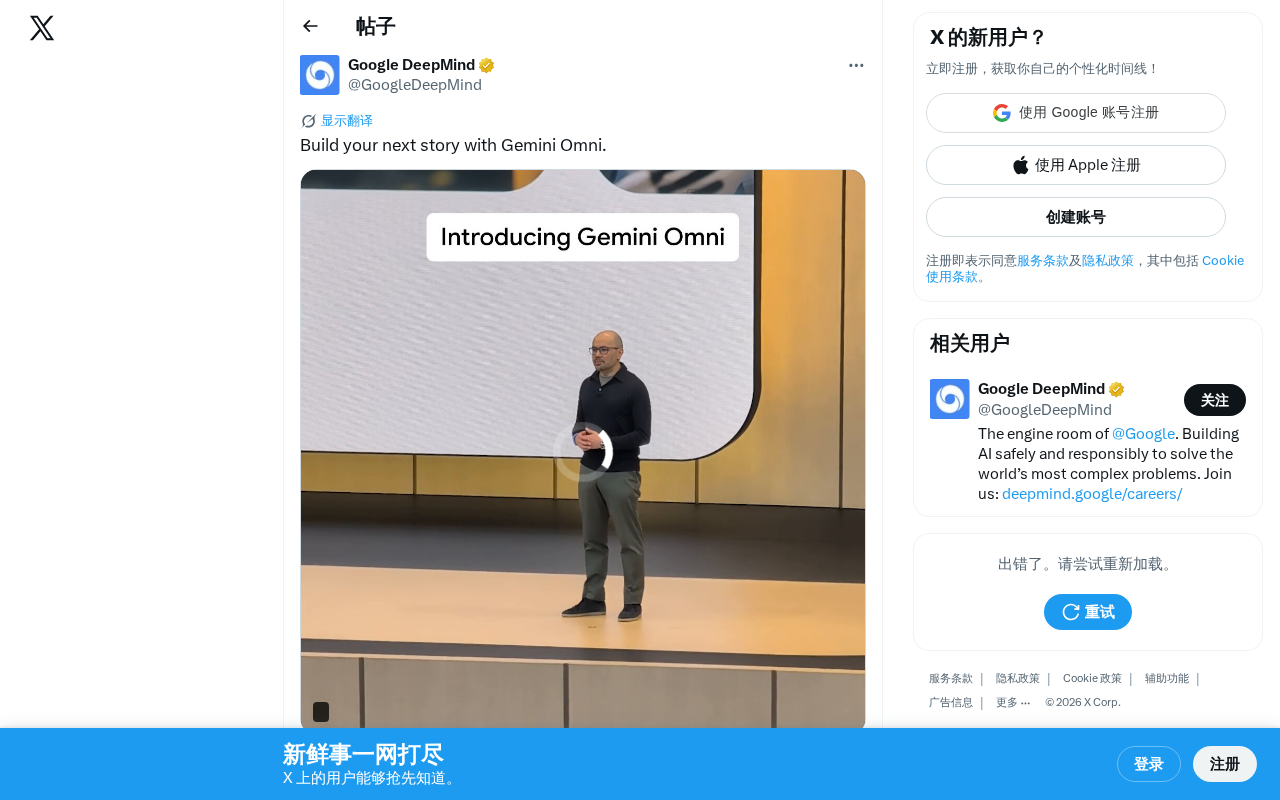
Google's Gemini Omni positions itself as a multimodal AI creative partner for end-to-end story building.
Google has announced Gemini Omni with the tagline "Build your next story," positioning it as a multimodal AI tool for creative storytelling. Built on the Gemini series' native multimodal architecture, it likely supports text, image, audio, and video generation within unified workflows. The tool competes directly with GPT-4o in the creative AI space, with potential advantages through deep integration with Google's ecosystem including Docs and YouTube.
Gemini Omni: A New AI Capability for Creative Storytelling
Google recently posted a brief but meaningful message on social media — "Build your next story with Gemini Omni." This marks a new step for the Gemini model series in the creative content generation space.
What Is Gemini Omni? Core Positioning and Feature Analysis
From a naming perspective, "Omni" derives from Latin, meaning "all" or "all-encompassing." Combined with Google's established technical roadmap for the Gemini series, Gemini Omni is most likely a multimodal AI model capable of simultaneously processing and generating multiple forms of input and output, including text, images, audio, and even video.
Google's Gemini model series was first released in December 2023, built from the ground up by the Google DeepMind team as a natively multimodal large language model. Unlike previous approaches that stitched together separate models for different modalities, Gemini was trained from the start on text, images, audio, video, and code simultaneously, giving it inherent advantages in cross-modal understanding and reasoning. The series has gone through multiple iterations including 1.0, 1.5 Pro, and 1.5 Flash, with Gemini 1.5 Pro attracting industry attention for its million-token context window. The launch of Gemini Omni clearly represents a further evolution built on this technical foundation.
The core technical principle behind multimodal AI models involves encoding different types of information (text, images, audio, video) into a unified high-dimensional vector space for processing. This typically involves multiple specialized encoders (such as Vision Transformers for images and audio encoders for sound) and a unified fusion layer. Through large-scale pretraining, the model learns correspondences between different modalities — for example, understanding the semantic relationship between a text description and its corresponding image. This architecture enables the model to perform cross-modal tasks, such as generating images from text or producing text summaries from video content. It's precisely this underlying capability that makes "building stories with AI" possible.
The tagline "Build your next story" clearly positions it for creative storytelling scenarios. This means Gemini Omni isn't just a conversational assistant — it's a creation tool that can help users build complete stories from scratch. Whether it's short fiction, screenplay outlines, or multimedia narrative content, Gemini Omni likely provides end-to-end creative support.
Industry Trends in Multimodal Storytelling
The Competitive Landscape of AI Creation Tools
The AI-assisted creation space is currently in fierce competition. OpenAI's GPT-4o has already demonstrated powerful multimodal capabilities — this model, released in May 2024 (where 'o' stands for 'omni'), was the industry's first commercial model to achieve unified text, audio, and visual input/output, capable of processing audio input at near-human reaction speed (averaging 320 milliseconds) and understanding emotions, scenes, and text within images. Anthropic's Claude excels at long-form text creation, while Meta's various open-source models continue to iterate.
Google's decision to launch Gemini Omni with "story building" as its core selling point at this time clearly aims to establish a differentiated advantage in the high-value creative generation space. Notably, Gemini Omni's naming closely mirrors GPT-4o's "omni" concept, suggesting direct competition in product positioning and reflecting that "all-capable multimodal models" have become a shared strategic direction among leading AI companies.
From Tool to Creative Partner
Traditional AI writing tools mostly remain at the level of "text completion" or "content polishing." The message conveyed by "Build your next story" is that Gemini Omni aims to become a user's creative partner, participating in the complete creative process from ideation and planning to final presentation. This shift in positioning reflects the broader trend of AI technology evolving from assistive tools to collaborative agents.
Four Key Directions to Watch for Gemini Omni
While Google has disclosed very limited information so far, we can monitor Gemini Omni's development across several dimensions:
1. Multimodal Output Capabilities
Can it simultaneously generate text, illustrations, and even audio narration within a single workflow to achieve true multimedia storytelling? This requires the model not only to possess generation capabilities across modalities but also to maintain stylistic and semantic consistency between them — for example, generated illustrations need to precisely match the atmosphere of the scenes described in the text.
2. Coherence in Long-Form Narratives
AI often faces challenges with logical consistency and character coherence when generating long-form content — has Gemini Omni made breakthroughs here? This is one of the most critical technical challenges in AI creation today. As generated content grows longer, models may forget character traits or plot foreshadowing established earlier; causal relationships, timelines, and world-building in complex stories need global consistency; and models tend to fall into fixed narrative patterns and vocabulary choices. Current industry solutions include: expanding context windows (like Gemini 1.5's million-token window), introducing external memory mechanisms, and using hierarchical planning (generating outlines first, then filling in details). If Gemini Omni can achieve substantial progress in these areas, it will greatly enhance the practicality of AI-assisted long-form creation.
3. Interactive Creative Experience
Can users collaborate with AI in real-time through natural language, dynamically adjusting story direction and style? The ideal interaction model should resemble a conversation between an author and an editor — the user proposes creative directions, the AI offers multiple possible development paths to choose from, and both parties refine the work through iterative exchanges.
4. Integration with the Google Ecosystem
Will it deeply integrate with platforms like Google Docs and YouTube to create a closed loop from creation to publication? Google possesses the world's most complete content creation and distribution ecosystem — Google Docs has over 1 billion users, YouTube is the world's largest video platform, and Google Workspace covers core enterprise collaboration scenarios. If Gemini Omni can deeply integrate these platforms, it means users could brainstorm screenplays with AI in Google Docs, automatically generate storyboards, and then publish videos through YouTube integration — forming a complete loop from creative inception to content distribution. This ecosystem advantage is difficult for pure AI companies like OpenAI and Anthropic to replicate, and may become Gemini Omni's most competitive differentiating moat.
Summary
While the Gemini Omni announcement preview contains limited information, the direction of "building stories with AI" itself is full of imaginative possibilities. As multimodal large model capabilities continue to improve, AI is moving from "answering questions" to "creating content," and from "passive response" to "active collaboration." For content creators, this represents both an upgrade in efficiency tools and potentially a profound transformation in creative paradigms.
From a broader perspective, the intensive investments by Google, OpenAI, Anthropic, and others in creative AI signal that 2025 may become the pivotal year when "AI creation tools" truly go mainstream. When AI is no longer just helping you fix typos but can co-build an entire narrative world with you, the boundaries of human-AI collaboration will be redefined.
We will continue to follow up with coverage as Google officially releases more technical details.
Related articles

Claude Code for Test Development in Practice: An AI Programming Workflow That Doubles Your Efficiency
A practical guide to Claude Code for test development: auto-generating test scripts, Plan Mode workflows, MCP + Playwright integration, and Subagent parallel tasks to build systematic AI-assisted workflows.
Hermes Agent Hands-On Review: An AI Efficiency Revolution for Indie Game Developers
Indie game developer reviews Hermes Agent vs OpenClaude: intelligent context compression, real-time Memory, remote control via Telegram, and practical use cases in game dev, social media, and email.
Vibe Coding Beginner's Guide: Tool Selection Across Three Categories with Practical Examples
A comprehensive guide to Vibe Coding's three tool categories: Agent frameworks, CLI Coding, and IDE tools, with practical examples including Snake game and data analysis workbench.