What Makes Claude Code So Powerful? A Five-Dimension Comparison with Traditional AI Chat Tools
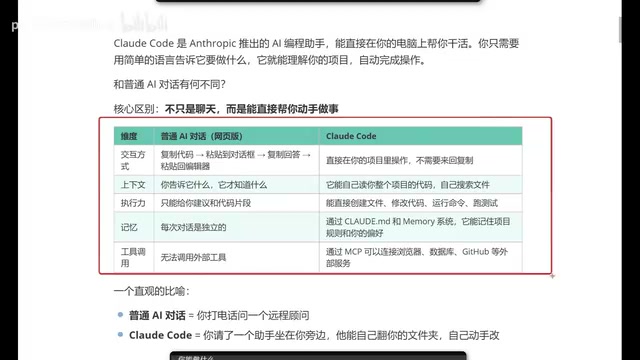
Five-dimension comparison showing how Claude Code evolves from giving advice to getting work done.
This article compares Claude Code with traditional AI chat tools like ChatGPT and DeepSeek across five key dimensions: interaction model, context understanding, execution capability, memory persistence, and tool invocation via MCP. Claude Code represents the shift from conversational AI to agentic AI, working directly in your project to read, write, and execute code autonomously.
Introduction: Why Claude Code Suddenly Took Off
Recently, Claude Code has been rapidly gaining popularity among developers. As an AI programming assistant from Anthropic, it's fundamentally different from the AI chat tools we're familiar with like ChatGPT and DeepSeek — it doesn't just chat, it actually gets things done for you.
Claude Code's rise isn't a coincidence. It represents a major shift in AI programming tools from the Copilot paradigm to the Agent paradigm. Early AI coding tools like GitHub Copilot primarily offered line-level or function-level code completion — essentially a sophisticated autocomplete engine. The Agent paradigm's core philosophy is to give AI the ability to autonomously plan, call tools, and execute multi-step operations, enabling it to understand tasks, break down steps, execute actions, and verify results like a real developer. The technical foundation for this shift lies in significant advances in large language models' reasoning capabilities, long-context processing, and Function Calling.
In simple terms, Claude Code can work directly on your computer, and all you need to do is tell it what you want in natural language. It can understand your entire project structure and automatically handle code writing, file management, command execution, and a whole series of operations. Sound similar to regular AI chat? Hold on — let's break down the core differences across five dimensions.
Claude Code vs. Traditional AI Chat: A Deep Dive Across Five Dimensions
According to a detailed analysis by a Bilibili content creator, Claude Code and traditional web-based AI chat tools (such as GPT, DeepSeek, Doubao, etc.) differ significantly across five key dimensions.
Interaction Model: Breaking Free from the Copy-Paste Loop
When using traditional AI chat tools to write code, the workflow typically goes like this: copy code → paste into the chat box → wait for a response → copy the response → paste it back into the editor. The process isn't exactly complicated, but it's incredibly tedious, especially during frequent debugging sessions.
Claude Code is entirely different. It runs directly in your project directory, with all operations completed locally — no back-and-forth copy-pasting required. You launch it in the terminal, and it can directly read and modify your code files, eliminating a massive amount of repetitive work. This shift in interaction model may seem simple, but its implications are profound — it removes the developer's role as an "information courier," allowing them to focus on thinking and decision-making rather than mechanical copy-paste operations.
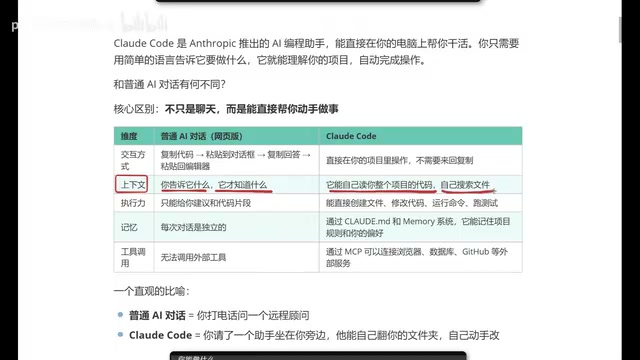
Context Understanding: From "It Only Knows What You Tell It" to "It Goes and Looks for Itself"
With traditional AI chat, context depends entirely on your input — it only knows what you tell it. This means you need to manually provide sufficient background information, or the AI's suggestions may be completely irrelevant to your project.
Claude Code takes a fundamentally different approach: it can automatically read your entire project's code and search for relevant files on its own. This means its understanding of your project is holistic rather than fragmented. When you say "help me optimize this function," it knows where the function is, who calls it, and what modules it depends on.
This involves the Context Window technology of large language models. The context window refers to the maximum number of tokens a model can process in a single inference. The Claude 3.5/4 series models support context windows of up to 200K tokens, meaning they can read the contents of dozens of code files at once. But even so, the codebase of large projects often far exceeds the context window's capacity. That's why Claude Code employs an intelligent retrieval strategy — rather than loading all files at once, it dynamically searches and loads relevant code snippets based on user instructions, combined with AST (Abstract Syntax Tree) analysis to understand function call relationships and module dependencies, achieving a holistic understanding of the project within the limited context window.
Execution Capability: From "Giving Advice" to "Getting It Done"
This is the most critical difference between Claude Code and traditional AI chat tools. Regular AI can only give you suggestions or code snippets — it can't deliver complete project-level code. After all, a real project consists of numerous files and complex code structures that a simple chat box simply can't accommodate.
Claude Code has genuine execution capability:
- Create files: Generate new files directly in your project
- Modify code: Automatically locate and modify existing code
- Run commands: Execute build, test, and other terminal commands
- Run tests: Automatically run test suites and analyze results
This is no longer "armchair strategizing" — it's real, hands-on work. Notably, Claude Code requests user confirmation before executing operations. This "Human-in-the-Loop" design ensures both efficiency and safety, preventing risks that could arise from fully autonomous AI operations.
Memory: Persistent Project Cognition
Traditional AI chat memory is ephemeral. Close the window, start a new conversation, and all previous context is lost — you have to re-explain your requirements and project background every time.
Claude Code achieves persistent memory through configuration files (like CLAUDE.md). CLAUDE.md is essentially a persistent Prompt Engineering solution — every time Claude Code starts up, it automatically reads the CLAUDE.md file in the project root directory and injects its contents as part of the System Prompt into the model's context. Developers can define the project's tech stack, coding conventions, architectural decisions, commonly used commands, and more in this file.
It can remember:
- Your project rules and conventions
- Your coding style preferences
- Project-specific tech stack and architectural decisions
This design elegantly addresses the inherent "stateless" limitation of large language models — although the model itself doesn't have cross-session memory, persistent external file storage achieves an effect similar to "long-term memory." Similar approaches have been adopted by other AI tools, such as Cursor's .cursorrules file. This means that over time, Claude Code becomes increasingly attuned to your preferences, generating code that better matches your style.
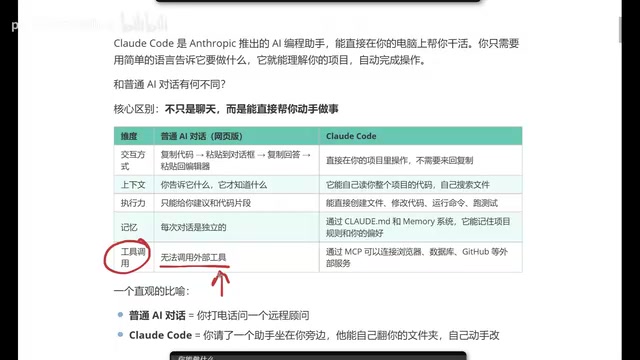
Tool Invocation: MCP Protocol Connects the External Ecosystem
Traditional web-based AI chat tools have limited tool invocation capabilities. While products like GPT already support some external tools, configuration is complex and some features require payment.
Through MCP (Model Context Protocol), Claude Code can directly connect to:
- Browsers
- Databases
- GitHub
- Other external services
MCP is a standardized protocol open-sourced by Anthropic in late 2024, designed to solve the connection problem between AI models and external data sources and tools. Before MCP, every AI application needed to develop separate adapters to integrate with different external services, resulting in massive duplication of effort. MCP adopts a design philosophy similar to the USB interface — defining a unified communication standard that allows any protocol-compliant tool to interact with AI models in a plug-and-play fashion. The protocol uses a client-server architecture where AI applications act as clients making requests, and various external services expose their capabilities by implementing MCP Servers. This design dramatically lowers the barrier to ecosystem integration, with hundreds of community-developed MCP Servers now covering scenarios ranging from database queries to cloud service management.
This makes Claude Code not just an assistant within a code editor, but an intelligent agent deeply integrated with the entire development toolchain.
Claude Code's Complete Capability Map
Based on Claude Code's own capability description, its functionality goes far beyond just writing code:
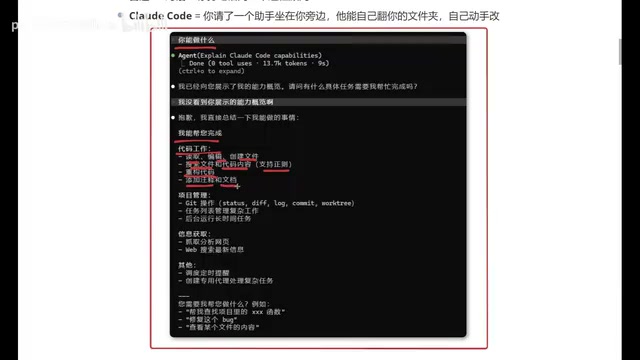
Code Work:
- Read, edit, and create files
- Search files and code content
- Refactor code, add comments and documentation
Project Management:
- Git operations (commits, branch management, etc.)
- Task list management
- Run long-running tasks in the background
Information Retrieval:
- Fetch and analyze web pages
- Web search for the latest information
Advanced Features:
- Schedule timed reminders
- Create specialized agents for complex tasks
For developers, this covers the vast majority of daily development scenarios. The "create specialized agents" capability deserves special mention — it means Claude Code can spawn sub-Agents to handle multiple tasks in parallel. This is a concrete implementation of the "multi-agent collaboration" concept in Agent architecture, and it foreshadows a future where AI programming tools may move toward multi-Agent cooperative workflows.
Claude Code vs. Cursor: How to Choose?
Many developers ask: I've been using Cursor — should I switch to Claude Code?
Based on the content creator's hands-on experience, both have their strengths, and the core takeaway is use whichever one you're more comfortable with. That said, here are a few noteworthy observations:
- More economical token consumption: Claude Code is relatively more efficient with token usage, resulting in lower long-term costs. Tokens are the basic unit of measurement for text processing in large language models — roughly 1-2 tokens per English word and 1-2 tokens per Chinese character. Claude Code's token efficiency likely benefits from its intelligent code retrieval strategy that reduces unnecessary context input, as well as Anthropic's specialized model optimization for programming scenarios, enabling the model to generate more precise code with fewer tokens. For developers who frequently use AI programming tools, token cost is a significant long-term expense that shouldn't be overlooked.
- Better frontend development experience: For frontend developers, Claude Code generates results that better match expectations.
- Comparable feature coverage: What Cursor can do, Claude Code can generally do as well.
From a product positioning perspective, Cursor is a complete IDE (Integrated Development Environment), deeply customized based on VS Code, offering visual features like graphical code diff comparison and inline editing. Claude Code, on the other hand, is a pure command-line tool, better suited for developers who prefer terminal-based workflows. There's also overlap in their underlying models — Cursor also supports calling Claude models, which means differences in pure code generation quality stem more from tool-level design choices than model capabilities themselves.
Of course, this is just one person's experience — different tech stacks and usage habits may lead to different impressions. It's recommended to try both for a while and find the tool that best fits your workflow.
An Intuitive Analogy: Remote Consultant vs. On-Site Assistant
If we use an analogy to summarize the difference between Claude Code and traditional AI chat:
- Traditional AI chat = calling a remote consultant on the phone. The consultant is indeed brilliant and knowledgeable, but they can only give you advice — you still have to do all the actual work yourself.
- Claude Code = having an assistant sitting right next to you. They can browse through your folders themselves, modify code with their own hands — all you need to do is tell them what the goal is.
This transformation from "remote consultant" to "on-site assistant" is the core direction of AI programming tool evolution. In the AI field, this shift is known as the progression from "Conversational AI" to "Agentic AI." The defining characteristic of Agentic AI is autonomy — it can not only understand instructions but also independently plan execution paths, invoke tools, handle exceptions, and iteratively optimize results. The industry widely believes that Agentic AI will be the next major phase for large language model applications, and the programming domain — with its highly structured tasks and clear feedback signals (whether code runs, whether tests pass) — has become one of the first application scenarios where Agentic AI has matured.
Claude Code represents not just a product, but an important milestone in AI-assisted development's journey from "conversational" to "agentic."
Key Takeaways
Related articles
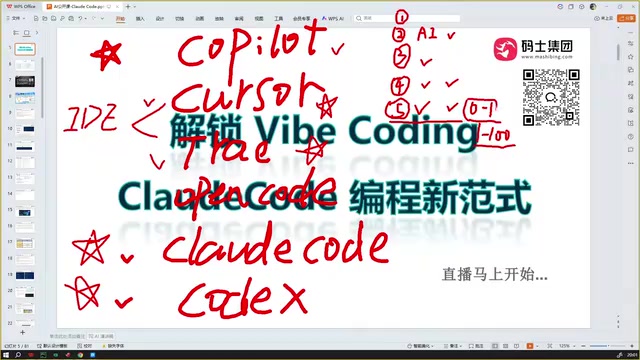
Claude Code Installation Guide & The Five Stages of AI Programming Tools Explained
Complete Claude Code installation guide with the five stages of AI programming tools, from manual coding to agents. Learn 0-to-1 project building and 1-to-100 iteration challenges.
Enterprise-Level AI Project Rules Files: 5 Hard Rules + 6 Writing Techniques
AI keeps messing up your code? Learn 5 hard rules and 6 writing techniques for enterprise-level Rules files in Claude Code, Cursor & more, with templates.
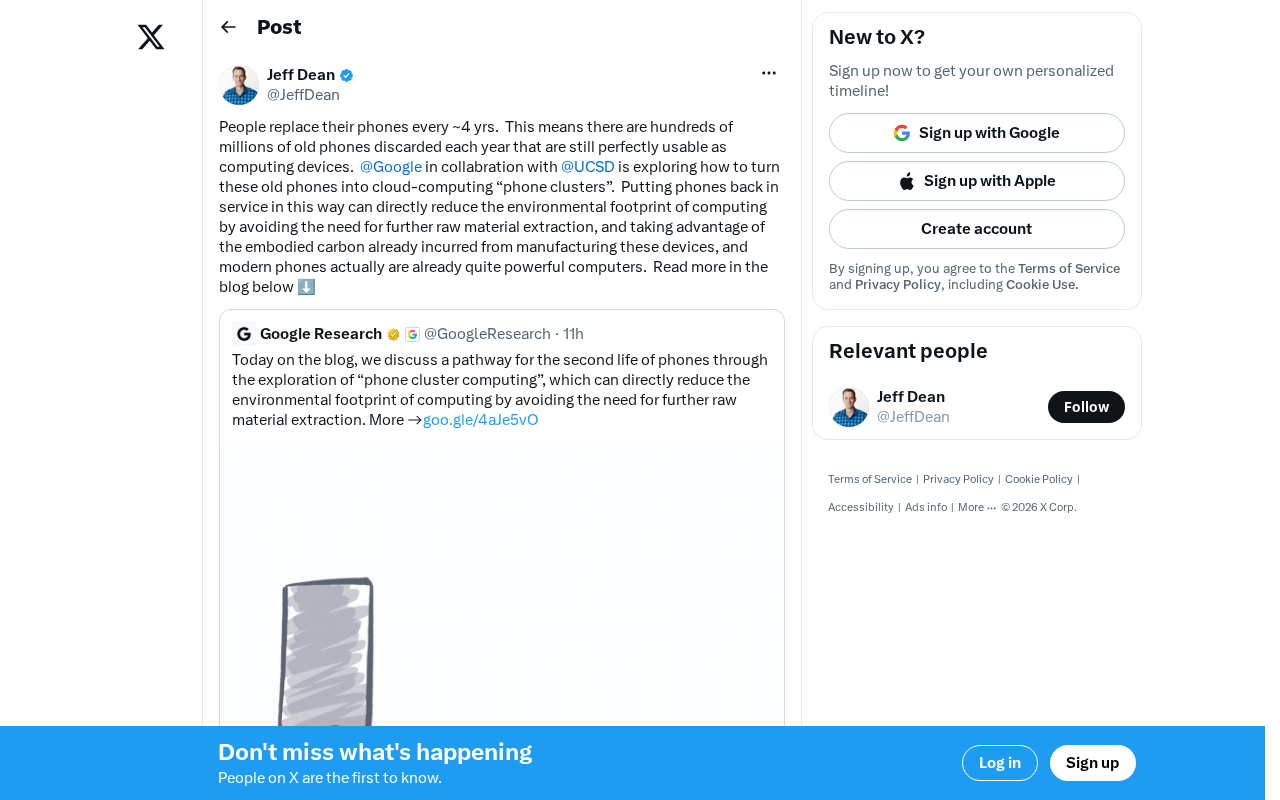
Building Cloud Computing Clusters from Old Phones: Google and UCSD Explore a New Path to Sustainable Computing
Google and UCSD explore building cloud clusters from old phones, leveraging ARM chip efficiency to cut e-waste and data center carbon footprints.