Why Are AI Startups Getting Into Smart Home? A Viral Tweet Reveals the Product Boundary Dilemma
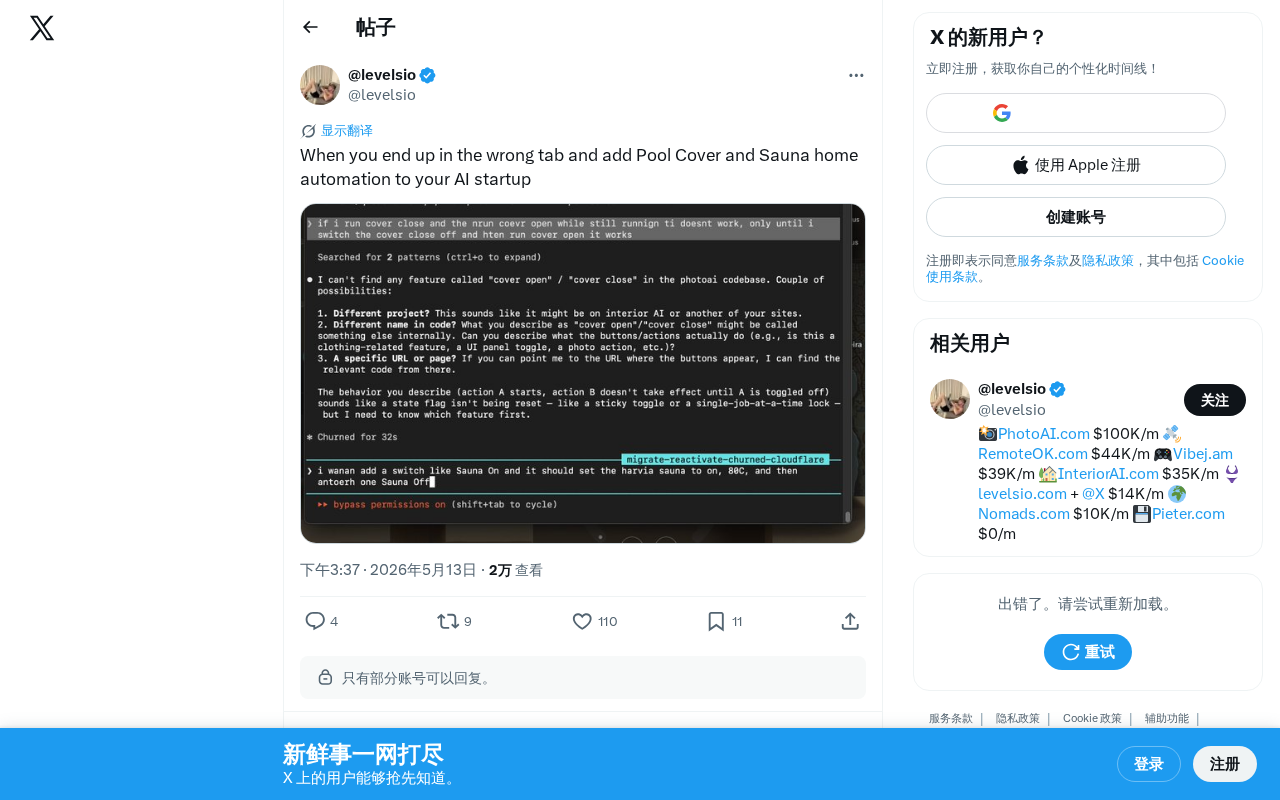
A viral tweet about an AI startup's bizarre smart home features exposes the industry's product boundary crisis.
A humorous tweet about an AI startup accidentally listing pool cover and sauna automation sparked widespread discussion about feature creep in the AI industry. This article examines why AI startups struggle with blurred product boundaries, analyzes the real technical challenges of LLM-driven smart home integration, and argues that learning to say no may be the hardest skill for AI founders.
When an AI Startup Accidentally "Wanders Into" Smart Home
Recently, a viral Twitter post revealed a rather amusing phenomenon: an AI startup's product page somehow featured smart home automation for pool covers and saunas. The poster quipped — "When you open the wrong tab and accidentally add pool cover and sauna home automation to your AI startup."
This seemingly humorous tweet actually reflects several phenomena in the current AI industry that are worth pondering.
The Blurring Product Boundaries of AI Startups
In today's AI startup boom, many companies face a common dilemma: product positioning boundaries are becoming increasingly blurred.
A company originally focused on a specific vertical might continuously expand its feature boundaries through rapid iteration. From core AI capabilities to peripheral ecosystems, and then to seemingly unrelated smart home controls — this kind of "Feature Creep" is far from rare among startups.
Feature creep is a classic anti-pattern in software engineering and product management, first articulated by software engineers during large-scale enterprise software development in the 1990s. It refers to the continuous addition of features beyond the original scope during product development, leading to project delays, skyrocketing code complexity, and degraded user experience. In the AI startup space, this problem is particularly acute because large language models and general AI architectures inherently have a "can do a bit of everything" quality, making it easy for product managers to fall into the trap of thinking "if it's technically feasible, why not add it?" Historically, Microsoft Windows Vista is a textbook case of feature creep — attempting to simultaneously revolutionize security, interface, search, and more, ultimately resulting in a bloated product that was delayed by years.
Several driving factors lie behind this:
- Platform ambitions: Every AI company wants to become a platform, not just a single tool. According to research by Harvard Business School professor Marshall Van Alstyne, platform companies are typically valued at 5-10x that of tool companies, because platforms benefit from network effects and ecosystem lock-in. This explains why nearly every AI startup claims to be an "AI platform" rather than an "AI tool" in their pitch deck. However, historical data shows that fewer than 5% of companies successfully evolve from a single tool into a platform. Slack's growth from a team communication tool into a workflow platform is one of the rare success stories, while most startups attempting platformization ultimately fail due to scattered resources.
- Investor pressure: The need to demonstrate a larger addressable market and bigger vision
- Technology spillover: AI capabilities can genuinely generalize to many scenarios
The Real Intersection of AI and Smart Home Automation
Jokes aside, the combination of AI and smart home is actually a real and rapidly growing space. From voice assistants to scene automation, AI is redefining the home experience.
Modern smart home automation involves a multi-layered tech stack: at the base are IoT communication protocols (such as Zigbee, Z-Wave, Matter/Thread), the middle layer consists of device management and scene orchestration engines (such as Home Assistant, Apple HomeKit framework), and the top layer is the user interaction interface and AI decision layer. Controlling something like a pool cover may seem simple, but it actually involves motor-driven safety protocols, real-time monitoring of waterproof sensors, and linkage logic with weather APIs. The Matter protocol (jointly launched by Apple, Google, Amazon, and others) is attempting to unify smart home communication standards, but hardware compatibility and safety certifications remain enormous challenges. This means that for an AI company to truly excel at smart home control, it needs deep understanding of embedded systems and physical safety specifications — an entirely different engineering discipline from training language models.
The LLM-Driven Smart Home Convergence Trend
The rise of large language models has fundamentally transformed how users interact with smart homes. Users no longer need to memorize specific voice commands — they can describe their needs in natural language, and AI automatically orchestrates device responses. For example:
- "It's getting hot — open the pool cover and preheat the sauna for me"
- "I'm heading out — take care of everything at home"
This natural language control capability is precisely the technical foundation for AI startups extending into smart home.
It's worth noting that LLM-driven smart home isn't pure hype. Since 2023, multiple open-source projects have achieved integration between LLMs and Home Assistant, allowing users to describe complex scenarios in natural language while models like GPT-4 automatically generate YAML automation configurations. Amazon's Fall 2023 event showcased an LLM-rebuilt Alexa capable of understanding multi-step, conditional complex commands. However, core challenges facing this direction include: latency sensitivity (users don't want to wait 3 seconds for a light to turn on), offline availability (cloud-based LLMs fail when the internet goes down), and safety (misinterpreted commands could cause physical danger, such as incorrectly operating gas appliances). The current industry consensus is that LLMs are better suited as "configuration assistants" rather than "real-time controllers."
The Positioning Challenge for Startups
However, this is precisely where the problem lies. When an AI company tries to do everything, it often means nothing gets done well. Pool cover automation and large language model optimization require completely different domain knowledge and engineering capabilities.
From Memes to Industry Mindset: A Warning About Feature Creep
The reason this tweet resonated so widely is that it precisely hits a pain point in the AI industry: in the pursuit of the "omnipotent AI" narrative, product managers sometimes genuinely lose sight of priorities.
For founders, this is a signal worth heeding:
- Focus on core value: Not everything you can do should be done
- User demand validation: First confirm that users actually need your AI to control their sauna
- Resource constraints: Early-stage teams should invest their energy in the highest-ROI direction. For early-stage AI startups, ROI calculation for resource allocation needs to consider multiple dimensions: technical feasibility, market size, competitive moats, and team capability fit. Y Combinator partner Michael Seibel has repeatedly emphasized "Do things that don't scale" — but the premise of this advice is that those things should be on your core value chain. Paul Graham, in his classic essay Startup = Growth, points out that the essence of a startup is growth, and growth comes from achieving excellence in a narrow domain, not dabbling in multiple areas. Data shows that among AI startups from seed to Series A, those with more than 3 product lines have a survival rate approximately 40% lower than those focused on a single product.
Final Thoughts: The Hardest Part of an AI Startup Is Learning to Say No
While this "wrong tab" meme is amusing, the industry phenomenon it reflects deserves consideration from every AI practitioner. In an era where everyone wants to build an AI platform, perhaps the hardest challenge isn't the technical implementation — it's learning to say no.
After all, just because your AI can control a sauna doesn't mean it should.
Related articles

Claude Code for Test Development in Practice: An AI Programming Workflow That Doubles Your Efficiency
A practical guide to Claude Code for test development: auto-generating test scripts, Plan Mode workflows, MCP + Playwright integration, and Subagent parallel tasks to build systematic AI-assisted workflows.

Hermes Agent Hands-On Review: An AI Efficiency Revolution for Indie Game Developers
Indie game developer reviews Hermes Agent vs OpenClaude: intelligent context compression, real-time Memory, remote control via Telegram, and practical use cases in game dev, social media, and email.
Vibe Coding Beginner's Guide: Tool Selection Across Three Categories with Practical Examples
A comprehensive guide to Vibe Coding's three tool categories: Agent frameworks, CLI Coding, and IDE tools, with practical examples including Snake game and data analysis workbench.