Why Has Japan's Software Industry Fallen Behind? Structural Challenges and Paths Forward in the AI Era
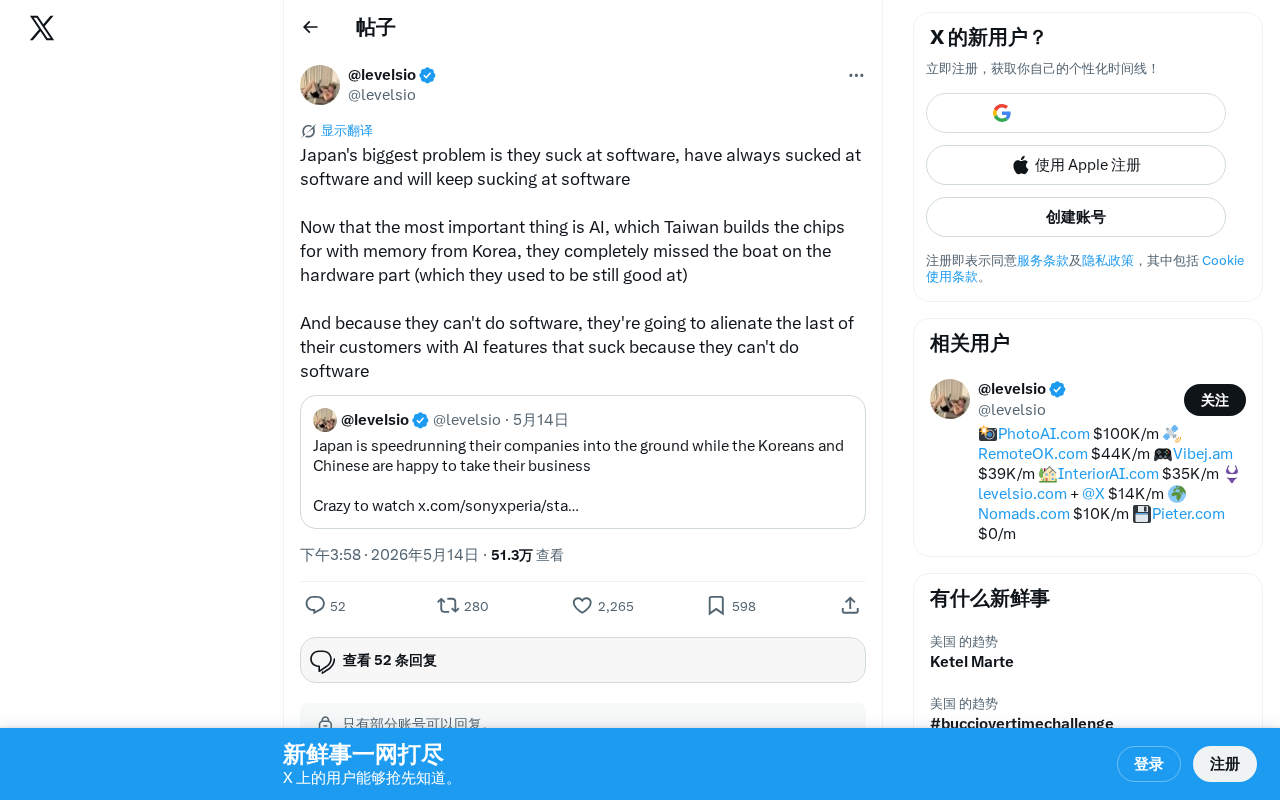
Japan's structural software weakness is becoming an existential threat in the AI era.
Japan's software industry has long lagged behind due to structural factors including lifetime employment, multi-layered outsourcing (SIer model), language barriers, and risk-averse corporate culture. In the AI era, these weaknesses are amplified as AI is fundamentally software-intensive, while Japan's former hardware advantages in semiconductors have eroded. Despite efforts by SoftBank, PFN, and government initiatives, breaking decades of path dependency remains Japan's critical challenge.
Introduction: A Sharp but Thought-Provoking Perspective
Recently, a viral Twitter post bluntly stated that Japan's biggest problem lies in its long-standing lack of software capabilities—and that in the AI era, this weakness is being dramatically amplified. While the wording may be provocative, the underlying structural issues it highlights deserve serious examination.
The Historical Predicament of Japan's Software Industry
Hardware Glory vs. Software Gap
Looking back at the history of the tech industry, Japan once achieved extraordinary success in hardware—from Sony's Walkman to Nintendo's game consoles, from Toyota's lean manufacturing to Canon's optical equipment. Yet in software, Japan has never produced a global enterprise that matches its hardware stature.
This is no coincidence. Japanese corporate culture's emphasis on "craftsmanship" (monozukuri) and physical products meant that software development was long treated as an accessory to hardware rather than an independent value-creation activity. During the same period when Silicon Valley was giving birth to software giants like Google, Microsoft, and Meta, Japan's IT industry remained dominated by the System Integrator (SIer) model, heavily reliant on outsourcing and waterfall development processes.
The SIer (System Integrator) model is the most distinctive structural feature of Japan's IT industry. Under this system, large system integrators like NTT Data, Fujitsu, and NEC take on enterprise clients' IT needs, then subcontract the actual development work layer by layer to secondary contractors, tertiary contractors, and even smaller downstream development firms. This pyramid-shaped industrial structure originated from Japan's manufacturing general contractor model, but when applied to software development, it created serious problems: engineers who actually write the code see their compensation heavily compressed, innovation incentives are weak, and the entire system tends toward maintaining existing systems rather than creating new products. According to Japan's Ministry of Economy, Trade and Industry, approximately 80% of Japan's IT spending goes toward maintaining legacy systems, with only 20% directed at new value creation—a ratio that is roughly reversed in the United States.
Structural Root Causes
The reasons behind Japan's software industry lag are multi-layered:
- Low talent mobility: The lifetime employment system restricts technical talent from moving between companies and dampens entrepreneurial ambition
- Multi-layered outsourcing system: The cascading subcontracting model for IT development severely compresses both innovation space and profit margins
- Language barriers: A development environment primarily conducted in Japanese limits deep integration with the global open-source community
- Risk-averse culture: Corporate decision-makers lack patience for the long payback cycles of software investments
These factors compound each other, forming a vicious cycle that is extremely difficult to break.
The Double Blow of the AI Era on Japanese Tech
The Loss of Hardware Advantage
A harsh reality: the most critical hardware in the AI era—AI chips are manufactured by TSMC, and memory chips are dominated by Samsung and SK Hynix. Japan's once-proud semiconductor industry, after its decline in the 1990s, has missed the core position in the AI hardware wave.
The rise and fall of Japan's semiconductor industry provides crucial historical context. In the 1980s, Japanese semiconductors held over 50% of global market share, with NEC, Toshiba, and Hitachi dominating the DRAM space. The 1986 US-Japan Semiconductor Agreement is widely considered the turning point—the US used political pressure to force Japan to open its market and restrict exports. Subsequently, Samsung rose rapidly with aggressive investment strategies, and TSMC's foundry model fundamentally changed the industry's division of labor. Japanese companies, locked into the IDM (Integrated Device Manufacturing) model, struggled to adapt, watching their market share plummet from a peak of 50% to less than 10% today. Rapidus, established in 2022 with Japanese government backing to re-enter advanced 2nm process manufacturing, faces significant uncertainty regarding its chances of success.
While Japan retains advantages in semiconductor materials and equipment (such as Tokyo Electron and Shin-Etsu Chemical), these upstream companies do not directly determine the market competitiveness of AI products.
How the Software Gap Is Amplified in the AI Era
AI is fundamentally a software-intensive field. From training large language models to inference optimization, from application-layer product design to user experience refinement, every stage demands exceptional software engineering capabilities.
Specifically, developing large language models involves full-stack technical complexity. The training phase requires mastery of distributed computing framework optimization—how to achieve efficient model parallelism and data parallelism across thousands of GPUs, training data cleaning and processing pipeline design, and engineering implementation of alignment techniques like RLHF (Reinforcement Learning from Human Feedback). The inference phase demands quantization, KV cache optimization, speculative decoding, and other techniques to reduce latency and cost. The application layer is pure software competition—RAG (Retrieval-Augmented Generation) architecture design, multi-step reasoning orchestration for Agent systems, and end-user product experience refinement. All these stages require world-class software engineering teams, not the traditional outsourcing-style development approach.
The core concern is this: when traditional Japanese hardware companies try to add AI features to their products, their insufficient software capabilities will result in AI experiences far inferior to competitors', potentially alienating their existing customer base. This assessment is not unfounded—some Japanese consumer electronics products have already exhibited the awkward situation of "adding AI for the sake of adding AI."
Reflection and Paths Forward
Japan's AI Efforts Should Not Be Entirely Dismissed
While the criticisms above have merit, we should also objectively acknowledge Japan's positive moves in AI.
SoftBank Group's positioning in the AI era is particularly noteworthy. Masayoshi Son has explicitly designated AI as SoftBank's core strategy for the next decade. The investment portfolio includes: ARM (a key IP provider for AI chip architectures) through the Vision Fund, early investment in NVIDIA, and plans announced in 2024 to build large-scale AI data centers in Japan. SoftBank is also collaborating with the Japanese government to promote AI computing infrastructure development, attempting to address Japan's significant lag behind the US and China in GPU clusters needed for AI training. However, whether infrastructure investment can translate into software-level competitiveness remains an unresolved critical question.
Preferred Networks (PFN) represents another facet of Japan's AI startup ecosystem. Founded in 2014, this unicorn company developed the deep learning framework Chainer (later transitioning to the PyTorch ecosystem) and has deep partnerships with manufacturing giants like Toyota and Fanuc, focusing on applying AI to robotics control, drug discovery, and autonomous driving. PFN's development path reflects a typical strategy for Japanese AI companies: rather than competing head-on with OpenAI in general-purpose large models, they seek intersection points between AI and Japan's traditional manufacturing strengths in vertical domains. However, PFN's valuation and influence remain orders of magnitude behind American AI companies, reflecting the structural limitations of Japan's AI startup ecosystem in terms of capital scale, talent density, and market size.
Additionally, the Japanese government's heightened focus on national AI strategy in recent years, combined with Japan's unique competitive advantages in fields where AI deeply integrates with hardware—such as robotics and autonomous driving—should not be overlooked.
Key Paths to Breaking Through
If Japan is to find its place in the AI era, it needs to fundamentally change how it positions and approaches software:
- Redefine software from a "cost center" to a "value center"
- Break the rigid multi-layered outsourcing system and build internal R&D capabilities
- Actively attract global software talent by lowering language and cultural barriers
- Find differentiated paths at the AI application layer that leverage existing manufacturing strengths
Conclusion
The viral post that sparked widespread discussion may have been overly absolute in its wording, but the structural problems it reveals are real. As AI reshapes the global technology landscape, software capability is no longer a "nice-to-have"—it is a fundamental condition for survival. Whether Japan can break free from decades of path dependency will determine its position in the next technology cycle.
Related articles

Claude Code for Test Development in Practice: An AI Programming Workflow That Doubles Your Efficiency
A practical guide to Claude Code for test development: auto-generating test scripts, Plan Mode workflows, MCP + Playwright integration, and Subagent parallel tasks to build systematic AI-assisted workflows.

Hermes Agent Hands-On Review: An AI Efficiency Revolution for Indie Game Developers
Indie game developer reviews Hermes Agent vs OpenClaude: intelligent context compression, real-time Memory, remote control via Telegram, and practical use cases in game dev, social media, and email.

Vibe Coding Beginner's Guide: Tool Selection Across Three Categories with Practical Examples
A comprehensive guide to Vibe Coding's three tool categories: Agent frameworks, CLI Coding, and IDE tools, with practical examples including Snake game and data analysis workbench.