Why Is Airplane Food So Salty? The Complete Science of Taste at High Altitude
The science behind why airplane food is so salty: altitude impairs taste by up to 30%.
Airplane food tastes overly salty due to the combined effects of low cabin pressure, extremely low humidity, and engine noise at cruising altitude. Research shows saltiness perception drops 20-30% and sweetness 15-20% at altitude. Airlines compensate with extra salt, umami seasonings, and spices. Interestingly, umami perception remains stable, explaining why tomato juice is disproportionately popular on flights.
The Taste Dilemma on Airplanes
Have you ever noticed that airplane food always seems overly salty and heavily seasoned? This isn't a reflection of the airline chef's skill level — it's actually a fascinating physiological science phenomenon.
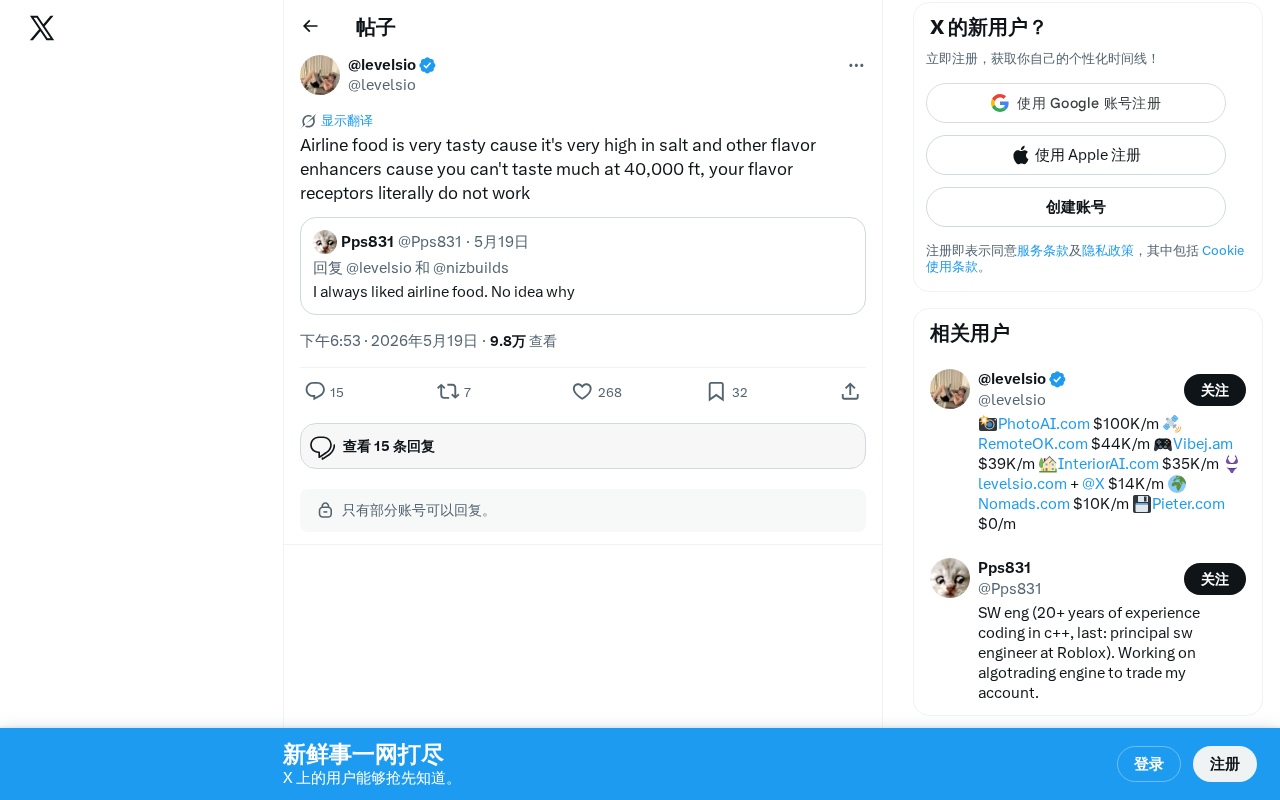
A widely discussed tweet pointed out: The reason airline food contains so much salt and flavor enhancers is that at 40,000 feet (approximately 12,000 meters), human taste receptors can barely function normally.
How High-Altitude Environments Affect Taste
The Double Blow of Air Pressure and Humidity
At cruising altitude, cabin air pressure typically corresponds to an environment at 6,000-8,000 feet elevation. When commercial aircraft fly at cruising altitude (usually 35,000-42,000 feet), the external atmospheric pressure is only about one-quarter of sea-level pressure, with oxygen too thin for human survival. That's why aircraft are equipped with pressurization systems that compress outside air using engine bleed air or dedicated electric compressors before pumping it into the cabin. However, due to airframe structural strength and fuel economy considerations, the cabin isn't pressurized to standard sea-level pressure (1013 hPa) but instead maintained at a pressure level equivalent to 6,000-8,000 feet elevation (approximately 750-800 hPa). This means passengers are effectively in a low-pressure environment similar to a high plateau, with blood oxygen saturation dropping from a normal 97-99% to approximately 91-95%, affecting various physiological functions to different degrees.
This low-pressure environment has a significant impact on taste:
-
Nasal mucosa swelling: Olfactory sensitivity decreases noticeably, and smell contributes approximately 80% of our "taste" perception. The process of perceiving "taste" is far more complex than most people imagine — taste buds on the tongue can only identify five basic tastes: sweet, salty, sour, bitter, and umami. What we commonly call "flavor" is actually a comprehensive experience combining taste, smell, texture (mouthfeel), and temperature perception. The contribution of smell is particularly crucial: when food is chewed in the mouth, volatile aromatic molecules rise through the nasopharyngeal passage at the back of the oral cavity to the olfactory epithelium (retronasal olfaction), a process that contributes most of what we perceive as "taste." This is why food becomes bland when you have a stuffy nose from a cold. In the dry cabin environment, nasal mucosa becomes dehydrated and swollen, olfactory receptors are covered, the retronasal olfactory pathway is obstructed, and flavor perception is significantly diminished.
-
Extremely low cabin humidity (typically only 10-15%): The mouth and nasal cavity dry out, further weakening taste and smell function
-
Background noise interference: Research shows that the constant noise from aircraft engines also suppresses the perception of sweet and salty tastes. In 2010 and 2011, Professor Charles Spence's team at the University of Manchester published groundbreaking research revealing cross-modal interactions between hearing and taste. In experiments, subjects tasted food while wearing headphones playing white noise (simulating aircraft engine noise at approximately 80-85 decibels). Results showed their ratings for sweetness and saltiness decreased significantly, while their perception of food crunchiness actually increased. This phenomenon is believed to be related to the brain's attention resource allocation — continuous background noise occupies some cognitive resources, weakening the processing of certain taste signals.
Scientific Research Evidence
A classic study by Germany's Fraunhofer Institute found that in simulated cabin environments, the perception of saltiness decreases by approximately 20-30%, and sweetness perception drops by about 15-20%. In other words, food that's perfectly seasoned on the ground becomes bland and tasteless at high altitude.
The experimental design of this study was itself quite creative: commissioned by Lufthansa, the Fraunhofer Institute for Building Physics used a retired Airbus A310 aircraft in 2010, converting it into an experimental chamber where air pressure, humidity, temperature, and noise levels could be precisely controlled. Over 100 volunteers tasted various foods and beverages in a simulated cruising environment (pressure reduced to 750 hPa, humidity lowered to 12%, background noise reaching 80 decibels). The research not only quantified the degree of attenuation for various tastes but also discovered that umami was the least affected of all basic tastes — a finding that directly influenced the subsequent direction of airline catering recipe design.
How Airlines Respond
Enhancing Flavor Rather Than Simply Adding Salt
To compensate for the taste loss caused by high altitude, airline catering teams employ multiple strategies:
- Increasing salt and umami seasonings (such as MSG and soy sauce)
- Using more spices and herbs to compensate for flavor loss caused by reduced olfactory function
- Favoring sour and spicy dishes, as these two taste sensations are less affected by the high-altitude environment
- The tomato juice effect: Tomato's umami actually becomes more prominent at high altitude, which explains why tomato juice is one of the most popular beverages on airplanes
The tomato juice effect has a solid biochemical basis. Umami is the fifth basic taste, discovered in 1908 by Japanese chemist Kikunae Ikeda, with taste receptors (T1R1+T1R3) sensitive to glutamate and nucleotide substances. Tomatoes are among the fruits and vegetables with the highest natural glutamate content (approximately 250 mg of free glutamic acid per 100g), and they also contain nucleotides that enhance umami. The Fraunhofer Institute's experiments confirmed that in low-pressure environments, the perception threshold for umami remains virtually unchanged and may even slightly improve under certain conditions. This explains a phenomenon that long puzzled the aviation industry: tomato juice isn't particularly popular on the ground, but its consumption on airplanes is unusually high — Lufthansa serves approximately 1.7 million liters of tomato juice onboard each year, nearly matching beer consumption. Passengers instinctively choose the beverage that provides the strongest taste stimulation at high altitude.
Health Concerns of High-Salt Airplane Meals
While this high-salt, heavily-seasoned strategy improves the taste experience, it also raises health considerations. For passengers who need to control sodium intake, the salt content of airplane meals may far exceed daily dietary standards, requiring particular attention during long-haul flights. The World Health Organization recommends that adults consume no more than 2,000 mg of sodium per day (approximately 5 grams of salt), yet a single altitude-seasoned airline meal may contain 1,000-1,500 mg of sodium — close to half to three-quarters of the daily recommended amount. Combined with the accelerated fluid loss caused by the high-altitude environment itself, a high-sodium diet may also worsen post-flight edema and discomfort.
Summary
The "heavy flavor" of airplane food is no accident — it's the result of a battle between food science and human physiology. Next time you taste a meal at 10,000 meters altitude, consider this: your taste buds are experiencing a "downgrade" in perceptual ability, and that seemingly ordinary meal has actually been carefully calibrated through science.
Key Takeaways
Related articles

Claude Code for Test Development in Practice: An AI Programming Workflow That Doubles Your Efficiency
A practical guide to Claude Code for test development: auto-generating test scripts, Plan Mode workflows, MCP + Playwright integration, and Subagent parallel tasks to build systematic AI-assisted workflows.

Hermes Agent Hands-On Review: An AI Efficiency Revolution for Indie Game Developers
Indie game developer reviews Hermes Agent vs OpenClaude: intelligent context compression, real-time Memory, remote control via Telegram, and practical use cases in game dev, social media, and email.
Vibe Coding Beginner's Guide: Tool Selection Across Three Categories with Practical Examples
A comprehensive guide to Vibe Coding's three tool categories: Agent frameworks, CLI Coding, and IDE tools, with practical examples including Snake game and data analysis workbench.