Zero-Code QR Code Ordering Mini Program with Cursor: A 38-Lesson AI Programming Course
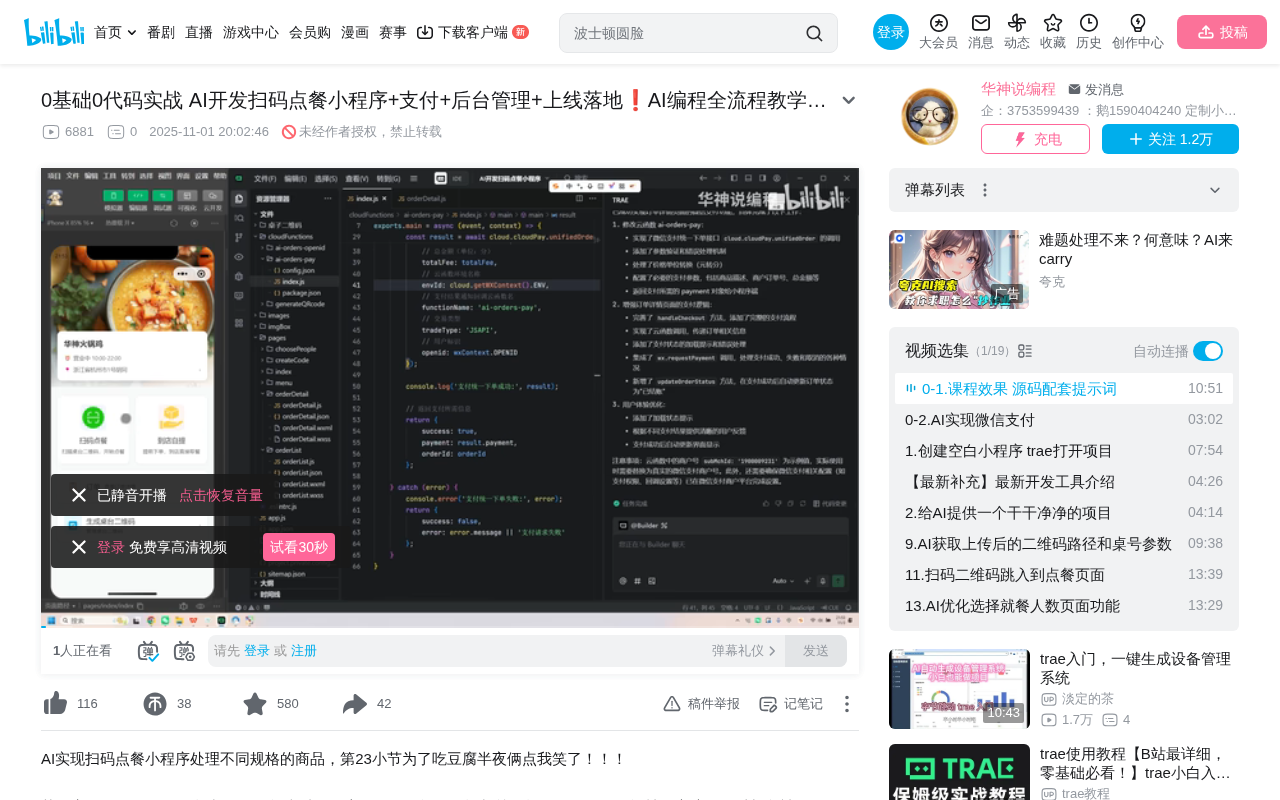
A 38-lesson course on building a full QR ordering WeChat Mini Program with zero code using Cursor AI.
A Bilibili creator demonstrates how to build a complete QR code ordering system—including a frontend mini program, backend management, WeChat Pay integration, and data analytics—entirely without writing code, using only Cursor AI and the Vibe Coding approach across 38 lessons. The core methodology is "humans control architecture, AI implements features" through carefully designed prompts, emphasizing that AI programming lowers the coding barrier but not the system design barrier.
Full-Stack Development in the AI Programming Era
As the Vibe Coding philosophy gains popularity, a Chinese content creator on Bilibili demonstrated how to develop a fully functional QR code ordering WeChat Mini Program entirely without writing code—using only the AI tool Cursor. The project includes a frontend mini program, a backend management system, WeChat Pay integration, and a data analytics module. The complete course spans 38 lessons, teaching from scratch and targeting users with zero programming background.
Vibe Coding is a concept proposed by OpenAI co-founder Andrej Karpathy in early 2025. It refers to developers fully immersing themselves in conversation with AI, describing requirements in natural language and letting AI generate the code. Developers only need to "feel the vibe"—checking whether the code runs—without needing to understand every single line. The core shift is this: programming transforms from "writing code" to "expressing intent," representing a fundamental paradigm shift in software development—from manual coding to intent-driven development.
The significance of this project lies not only in demonstrating the capability boundaries of AI programming tools, but also in providing a replicable methodology: how to use carefully designed prompts to have AI handle the entire development process, from project architecture to feature implementation.
Project Feature Overview: A Complete Restaurant System
Mini Program Core Features
This QR code ordering system covers the complete business workflow of a real restaurant scenario:
Table QR Code Generation: The system generates a unique QR code for each table. For example, a restaurant with 30 tables can generate corresponding QR codes one by one, print them, and place them on tables for customers to scan.
Diner Count Selection: After scanning, customers first select the number of diners (1-4, etc.). The system continuously displays the table number and diner count in the upper left corner, making it easy for kitchen staff and servers to confirm.
Smart Specification Selection: This is a noteworthy design detail—dishes with specifications (e.g., stir-fried pork slices with options like mild spicy or extra spicy) trigger a specification selection popup, while dishes without specifications (e.g., tofu) are added directly to the cart. The same dish with different specifications appears as separate items in the cart.
Dual Ordering Modes: The system supports both "Scan to Order" and "Pickup" modes. The pickup mode generates a pickup code for customers to collect their orders.
Orders & Payment: After submitting an order, the system displays complete order information (order number, order time, number of diners, table name). Once the admin confirms the order, WeChat Pay can be triggered. WeChat Pay integration in mini programs involves a complete payment chain: merchants must register on the WeChat Pay Merchant Platform to obtain a merchant ID, configure API keys and certificates; the backend must implement a unified order interface to send pre-payment requests to WeChat Pay servers for a prepay_id; the frontend triggers the payment panel via the wx.requestPayment API. The entire process involves signature verification, callback notification handling, order status synchronization, and more, with extremely high security requirements. This is one of the typical challenges for AI programming—payment features have zero tolerance for errors, and any minor parameter mistake will cause payment failure. Therefore, even when using AI-generated code, developers need a clear understanding of the payment flow.
Backend Management System
The backend management system is equally comprehensive:
- Dish Management: Supports CRUD operations for dishes, including specification editing, category management, and sort order settings
- Order Management: View all order details, distinguish between scan-to-order and pickup types, support order status transitions (Pending → Accepted → Settled)
- Data Analytics: Includes settlement status statistics, daily diner count statistics, ordering type distribution analysis, daily sales line charts and bar charts, and other visualization dashboards
Development Methodology: Practical Application of Prompt Engineering
Cursor Development Toolchain
The core tools used throughout the project include:
- Cursor: AI programming assistant, handling the main code generation work
- WeChat Developer Tools: For mini program debugging and preview
- Supporting prompt documentation: Recording the Prompt design for each step
Cursor is an AI-native code editor developed by Anysphere, deeply rebuilt on the VS Code architecture. It integrates multiple large language models (such as GPT-4, Claude, etc.) and supports code completion, multi-file editing, conversational programming, and more. Unlike plugin-style AI assistants like GitHub Copilot, Cursor deeply embeds AI capabilities into every interaction point of the editor, supporting inline editing via Cmd+K, multi-file collaborative modifications via Composer, and project-level conversations via the Chat panel. Since 2024, Cursor has rapidly become one of the most popular tools in the AI programming space, with a valuation exceeding several billion dollars.
WeChat Mini Programs are a lightweight application platform launched by Tencent that runs within the WeChat client without requiring download or installation. Its technical architecture uses a dual-thread model: the rendering layer uses WebView for page rendering, the logic layer uses JSCore to execute JavaScript code, and the two communicate through the Native layer. Development languages include WXML (an HTML-like template language), WXSS (a CSS-like styling language), and JavaScript. This closed architecture ensures security while providing a relatively standardized development paradigm for AI code generation—because the framework constraints are explicit, AI can more easily generate code that conforms to specifications.
Prompt Design Strategy
The course demonstrates a clear prompt engineering methodology:
Control architecture yourself: Project structure creation and overall architecture design are planned by the developer based on experience. This ensures project maintainability and rationality, rather than leaving everything to AI to generate arbitrarily.
Delegate features to AI: Each specific feature implementation is handed to Cursor through carefully designed prompts. The course provides complete prompt templates, marked with boxes, that students can copy and use directly.
Multiple input methods: Cursor supports instructions via files, images, voice, and other input methods. The course demonstrates practical operations like having AI generate layouts from UI screenshots and implement API integrations from API documentation.
Prompt Engineering has evolved from simple "Q&A tips" into a systematic engineering discipline. In AI programming scenarios, effective prompts need to contain several key elements: clear context (what tech stack the project uses, what files already exist), precise task descriptions (what functionality to implement, what boundary conditions exist), expected output format (code style, naming conventions), and constraints (performance requirements, compatibility requirements). The course's strategy of "controlling architecture yourself while delegating features to AI" is essentially a form of layered abstraction—humans handle high-level decisions (system design, module division), AI handles low-level implementation (actual code writing). This division of labor precisely matches their respective strengths.
Advanced Configuration Tips
Beyond basic prompt usage, the course also covers the following advanced topics:
- Project Rules: Setting project-level constraints and standards for AI
- Personal Rules: Customized development preference settings
- MCP Agents: Context management and agent usage
- Model Selection: Choosing appropriate AI models for different tasks
MCP (Model Context Protocol) is an open standard protocol released by Anthropic in late 2024, designed to provide AI models with a unified interface for interacting with external tools and data sources. In Cursor, MCP allows the AI assistant to connect to databases, call APIs, read documentation, and access other external resources, thereby gaining richer contextual information to generate more accurate code. For example, by connecting to a database via MCP, AI can directly understand table structures to generate corresponding CRUD code; by connecting to design tools, AI can automatically generate frontend layouts based on design mockups. The emergence of MCP marks the evolution of AI programming from "pure code generation" to "an intelligent development assistant with environmental awareness."
Course Design and Learning Path
The complete course consists of 38 lessons, designed with a strict linear learning path. According to the creator, no detail is omitted in any lesson, making it suitable for complete beginners to follow along.
The core value of the course lies in this: it's not merely a demonstration of "watching AI write code," but provides a complete workflow from requirements analysis, architecture design, and prompt writing to feature implementation, debugging, and deployment. This offers strong reference value for anyone looking to use AI tools for actual project development.
The Boundaries and Possibilities of AI Programming
This case demonstrates an important milestone for current AI programming tools—a complete commercial project containing frontend, backend, payment, and data analytics can be accomplished with Cursor assistance with zero coding background. But what you might not have noticed is that "zero code" doesn't mean "zero thinking." Project architecture design, business logic decomposition, and precise prompt expression all require developers to possess clear product thinking and system design capabilities.
AI programming tools lower the barrier to code writing, not the barrier to system design. This is perhaps the most important insight of the Vibe Coding era: knowing how to "direct" AI is more important than knowing how to write code.
Key Takeaways
- Developed a complete mini program system with QR code ordering, WeChat Pay, backend management, and data analytics using Cursor AI with zero code
- Prompt engineering methodology: architecture design is controlled by humans, while specific feature implementation is delegated to AI through carefully designed prompts
- The system supports dual modes (scan-to-order and pickup) with smart specification selection, order status transitions, and complete business logic
- The 38-lesson course covers advanced AI development techniques including Rules configuration and MCP agent usage
- AI programming lowers the barrier to code writing, not system design—product thinking and architecture skills remain core competencies
Related articles
 Tutorials
Cursor + Codex Dual-IDE Collaboration: A Practical Methodology for Open-Source Project Customization
A complete methodology for open-source project customization based on real-world experience, detailing the Cursor+Codex dual-IDE workflow, seven-stage process, MVP validation, and AI source code reading techniques.
 Tutorials
Cursor Multi-Agent in Practice: Building a Full-Stack Next.js Blog in 50 Minutes
Build a full-stack blog in 50 minutes using Cursor IDE's multi-Agent mode with Next.js, Clerk auth, and Supabase. Learn the 4-phase AI Agent workflow and key integration pitfalls.
 Tutorials
Building an AI Software Factory from Scratch: A Cursor Engineer's Hands-On Experience with Multi-Agent Collaboration
Cursor engineer Eric shares practical insights on building an AI software factory: automation levels, guardrail design, parallel Agent management, and scaling to 1000+ Agents for 24/7 development.