4% Semantic Cache False-Hit Rate: The Accuracy Cost Behind LLM Application Performance Optimization

Semantic cache false-hit rates reach 4%, revealing its nature of trading accuracy for performance and its applicable boundaries.
Based on a developer's real experience shared on Reddit, the article points out that after enabling semantic caching, about 4% of cache hits returned wrong answers. The author analyzes the root cause of false hits: semantic caching replaces exact matching with vector similarity, but semantic closeness does not equal identical intent, and subtle differences such as negation words and entity substitutions are diluted in vector representations. The article further estimates that in high-concurrency scenarios this error rate can be amplified to thousands of erroneous responses per day, and false hits are hard to detect. It then offers practical directions such as raising thresholds with A/B validation, introducing a secondary verification layer, tiered caching by scenario, and recording the full hit chain, emphasizing that semantic caching is not a silver bullet and is unsuitable for scenarios with high requirements for factual accuracy, such as healthcare, finance, and code generation.
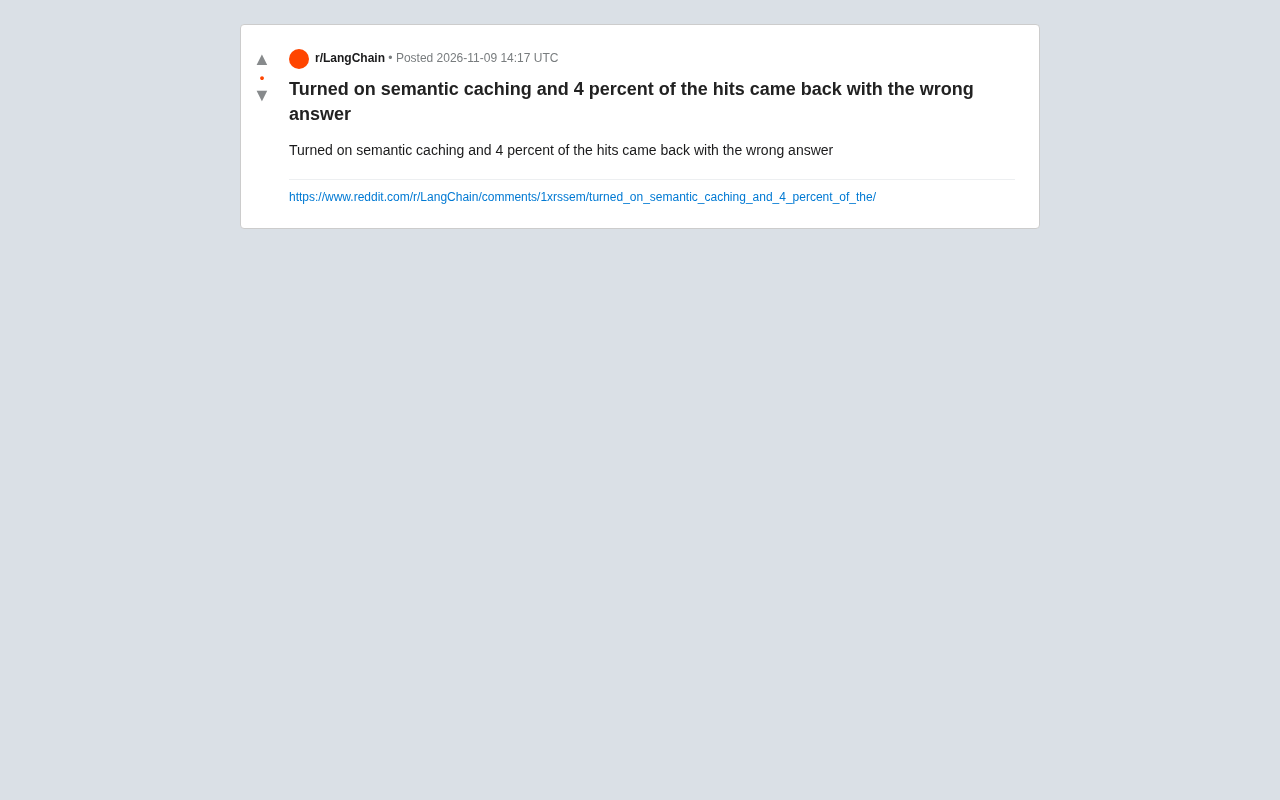
Semantic caching is seen as a powerful tool for reducing large model call costs and improving response speed. But an experience shared by a developer on Reddit poured cold water on this wave of enthusiasm: after enabling semantic caching, 4% of cache hits returned wrong answers. This number may seem negligible for a single request, but in a production environment it could mean hundreds of erroneous responses every day.
Why Semantic Caching Can "Answer the Wrong Question"
Traditional caching relies on exact matching—a hit occurs only when the keys are completely identical, making the logic simple and the result deterministic. Semantic caching is different: it encodes user queries as vectors, retrieves historical queries in a vector database whose similarity exceeds a threshold, and directly reuses their answers. The problem lies precisely in the word "similar."
According to the developer's description in the Reddit post, the root cause of false hits is that semantic similarity does not equal identical intent. For example, "how to cancel an order" and "how to modify an order" are very close in vector space, but the corresponding operation guides are completely different. If the threshold is set loosely, the hit rate goes up, but so does the error rate; if the threshold is set tightly, the cache becomes little more than a decoration.
This ambiguity is compounded by another hidden risk: subtle differences such as punctuation, negation words, and entity substitutions may be diluted in the vector representation, causing the system to merge questions that should have been distinguished.
Vector similarity and cosine distance: Semantic caching usually relies on cosine similarity between embedding vectors to determine "similarity," with values ranging from -1 to 1; the closer to 1, the more aligned the directions. In engineering practice, cosine similarity is often converted into a distance (such as 1 minus similarity), and then a threshold is set as the hit boundary. It should be noted that an embedding model compresses a sentence into a fixed-dimensional dense vector, and this process itself is lossy: it tends to preserve the overall semantic field while actively compressing local details such as word order, negation, and quantity. Therefore, "similarity 0.95" does not mean the two sentences have the same meaning; it only means they are close in the semantic space learned by the model. Different embedding models (such as the text-embedding-3, BGE, and E5 series) may score the same pair of sentences very differently, so thresholds cannot be directly copied across models and must be recalibrated for the chosen model.
What a 4% Error Rate Means
From the perspective of a single conversation, a 4% error rate may seem acceptable. But semantic caching is usually deployed in high-concurrency scenarios, and according to the information revealed in the post, this ratio was observed in real traffic. At an estimated 100,000 cache hits per day, about 4,000 users receive wrong answers every day.
What is more troublesome is the hidden nature of the errors. When an exact cache misses, the system falls back to model computation and the result is correct; when a semantic cache falsely hits, the system "confidently" returns incorrect content, making it difficult for users and developers to notice immediately. The developer also located this problem only while investigating user feedback.
The Dilemma of Trading Accuracy for Cost
In community discussions, multiple developers agreed on one judgment: semantic caching is not suitable for scenarios with high requirements for factual accuracy, such as medical consultation, financial data queries, and code generation. In these fields, the cost of fixing one wrong answer may far exceed the token costs saved. Relatively speaking, scenarios with greater tolerance for errors, such as customer service FAQs and marketing copy, are more suitable for introducing semantic caching.
Joint metrics for hit rate and error rate: Looking only at "4% of hits being wrong" can easily lead to misjudging the severity. A more reasonable approach is to split the metric into two dimensions: hit rate (hits/total requests) and hit error rate (wrong hits/hits). If the hit rate is 30% and the hit error rate is 4%, then the overall error injection ratio for requests is about 1.2%; if the hit rate is as high as 80%, the same 4% will bring an overall error rate of about 3.2%. Therefore, when estimating capacity and cost, you should simultaneously record the hit rate, hit error rate, false-hit fallback rate, and overall error injection rate, and set alert thresholds for each.
The cost structure of the fallback mechanism: The value of semantic caching is built on "a hit saves one model call," but after a false hit is intercepted by secondary verification, the system still has to fall back to model computation. The actual cost of these requests is higher than in a no-cache scenario—it pays extra for one vector retrieval, one similarity calculation, and one verification overhead. In other words, the secondary verification layer is not free insurance; it converts the cost of a false hit from "outputting a wrong answer" into "additional inference and verification overhead." During design, it is necessary to estimate the interception rate and miss rate of the verification layer. Only when the interception benefit (avoided error cost) is greater than the verification overhead does this mechanism become economically viable.
Practical Directions for Reducing False-Hit Risk
In response to this pain point, several actionable ideas emerged in the Reddit discussion, and developers can combine them according to their own scenarios:
- Raise the similarity threshold and conduct A/B validation: Do not set the threshold based on intuition. Instead, conduct offline evaluation based on real query samples, observe the hit rate and error rate curves under different thresholds, and find the operating point acceptable to the business.
- Introduce a secondary verification layer: Perform lightweight rule-based verification on cache hit results, such as checking whether the key entities in the answer are consistent with the current query, and falling back to model computation if they are not.
- Adopt scenario-based tiered caching: Disable semantic caching for high-risk intents, or cache only manually reviewed question-answer pairs.
- Record the full chain of cache hits: Retain query vectors, hit records, and answer sources to facilitate post-event auditing and error attribution.
The developer's experience also reminds teams that before launching semantic caching, they should establish a monitoring metric for the "wrong answer rate" rather than focusing only on hit rate and latency.
Semantic Caching Is Not a Silver Bullet
From community feedback, the value of semantic caching is real, especially in customer service and question-answering scenarios with high repetition rates, where it can significantly reduce inference costs. But the 4% false-hit rate reveals its essence: it is an engineering method that trades accuracy for performance, not a cost-free optimization.
Whether to enable it, where to set the threshold, and which scenarios to exempt all need to be judged based on the business's tolerance for errors. For systems that pursue determinism, it is better to sacrifice hit rate than to let the cache "guess" answers on behalf of the model.
(This article is based on a developer's sharing on Reddit; the specific data and views come from the original post discussion.)
Related articles

Loop Engineering Primer: Agent Loop and Intelligent Agent Loop Design in Practice
Starting from Agent Loop, this article breaks down Loop Engineering: how agents differ from LLMs in tool calling and memory, while-loop implementations, termination conditions, tool boundaries, and context management.

The Ultimate Bilibili Guide to Codex: From Installation to Hands-On Practice, Let AI Operate Your Computer
A full breakdown of the Bilibili step-by-step Codex tutorial: installing from the app store, configuring Everyday Work mode, project folder management, organizing messy files, generating Excel summary tables, and building a visual dashboard with Plan Mode, plus practical tips for beginners.

Decoding the Underlying Logic of Large Models: A Practical Introduction from Prompts to Agents
From the Transformer dividing line to the large-model training pipeline and applications in education, healthcare, and office work, this systematically explains the underlying logic and practical use of large models.