gbrain: An Open-Source Brain Built for OpenClaw Agents
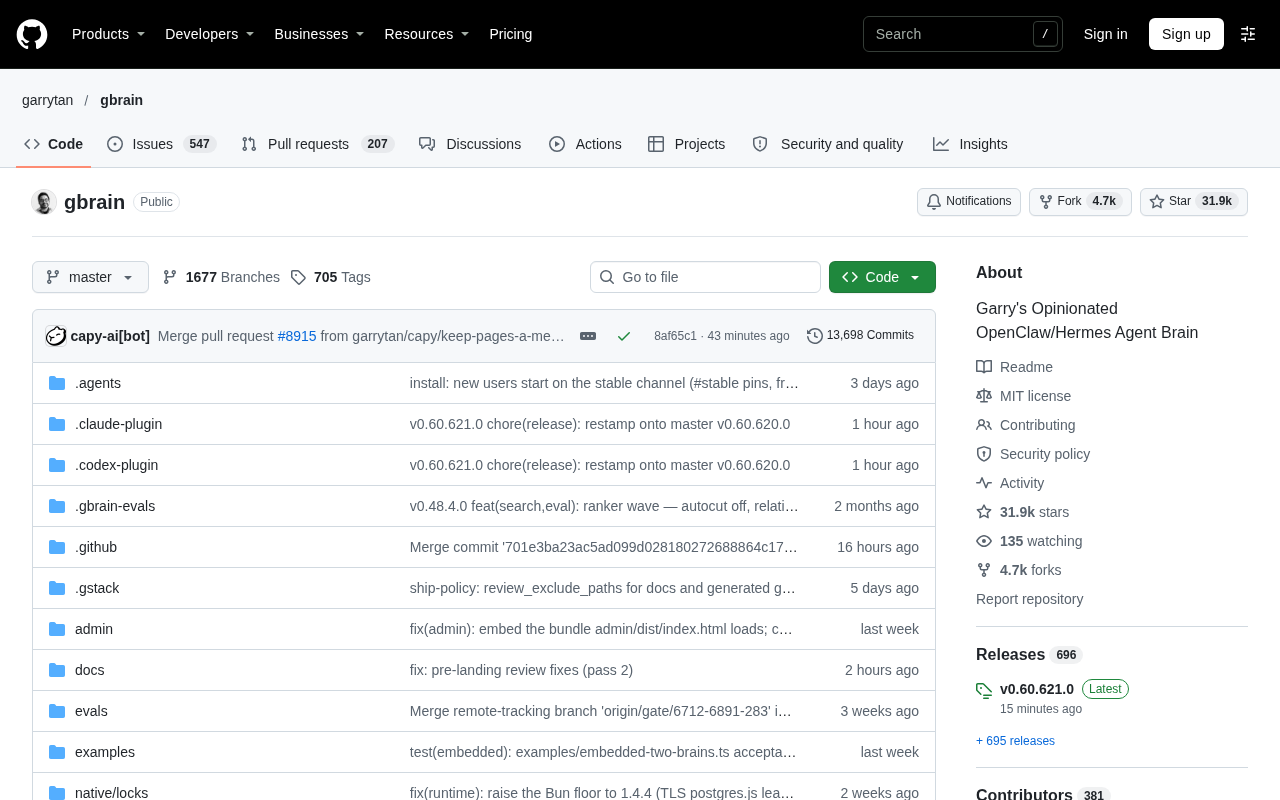
gbrain is a TypeScript "opinionated" brain layer for OpenClaw/Hermes agents, making agent strategies reusable and behavior predictable.
gbrain is an open-source project by garrytan on GitHub, positioned as Garry's "opinionated" OpenClaw/Hermes Agent Brain, written in TypeScript. It addresses unstable behavior and over-reliance on improvised prompts in multi-step tasks by solidifying agent decision patterns into a configurable brain, making behavior predictable and strategies codifiable. With 31,838 stars and 4,742 forks, it's the brain layer of the agent runtime rather than a new framework, assuming users already use OpenClaw or Hermes. It suits teams engineering behavior strategies; those seeking zero-preset freedom may find it restrictive.
What is gbrain?
As AI agents move from demos toward real tasks, how to give agents stable, reusable "judgment" has become a focus for developers. The open-source project garrytan/gbrain on GitHub is a direct response to this problem: it positions itself as Garry's "opinionated" OpenClawAd/Hermes Agent Brain, written in TypeScript, offering a preset set of agent decision-making logic.
The project currently has 31,838 stars and 4,742 forks, with 215 new stars in a single day, indicating considerable attention in the open-source community. The word "Opinionated" in the title means it is not a completely neutral framework, but a "brain" implementation with a clear design direction.
OpenClaw and Hermes are two agent tool codenames that recur throughout the article. In the open-source agent ecosystem, they typically refer to an agent runtime/framework for task execution (similar to scaffolding that lets models call tools, maintain state, and chain multi-step workflows). gbrain does not replace them; instead, it embeds as a "brain" plugin layer: OpenClaw/Hermes gets the task running, and gbrain provides decision strategies and memory organization at key junctures. Only by understanding this division of labor can one see why gbrain's documentation emphasizes "assumes you're already using OpenClaw or Hermes"—it solves strategy-layer problems, not the runtime itself. If you're unfamiliar with these two names, think of them first as agent execution environments within the same tech stack.
Why do agents need an "opinionated" brain?
General-purpose large models excel at generation but often lack stable behavioral constraints in multi-step tasks. gbrain's approach is to solidify the agent's decision patterns into a configurable "brain," so that agents like OpenClaw/Hermes follow consistent strategies during execution rather than improvising through prompts each time.
The direct benefit of this "opinionated" design is predictable behavior: teams can debug and iterate around a shared decision logic, reducing output instability caused by prompt drift. For agent projects that need to run long-term or involve multi-person collaboration, this matters more than raw model capability alone.
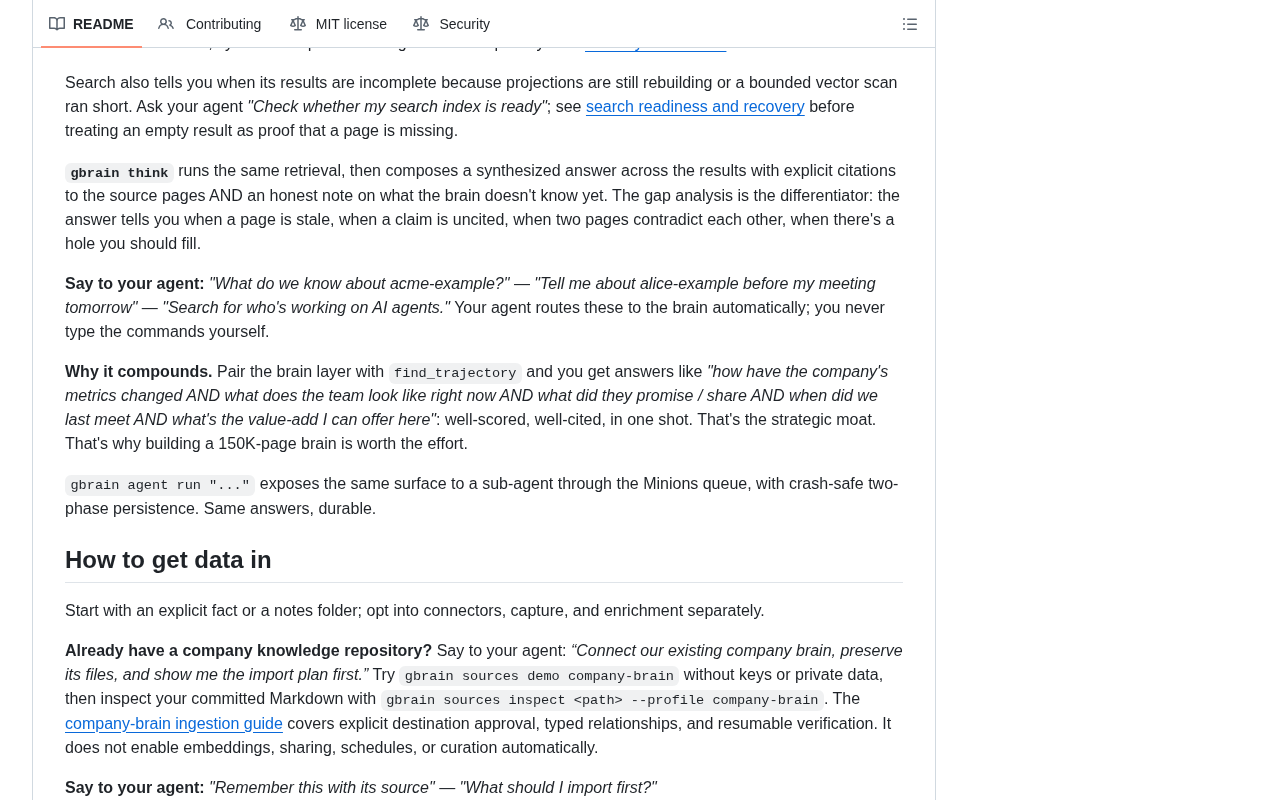
Prompt drift refers to the phenomenon where an agent's behavior gradually deviates from its original setup across multiple calls or long-chain tasks, due to context accumulation, model sampling randomness, or partial prompt modifications. It manifests as inconsistent results for the same task from one day to the next, or strategy divergence when multiple maintainers each edit prompts. Solidifying decision logic into a codified "brain" essentially converts easily drifting natural-language constraints into engineering assets that can be version-controlled and tested, thereby maintaining behavioral consistency in long-running and multi-collaborator scenarios. This is the core engineering value of the "opinionated" design, not merely a stylistic preference.
Technical choices and ecosystem position
gbrain is implemented in TypeScript, which aligns with the agent toolchain ecosystem it inhabits—OpenClaw and Hermes-related tools are mostly built on the JS/TS stack, and using TypeScript lets front-end and back-end developers extend agent behavior with the same language, lowering the barrier to adoption.
In terms of positioning, gbrain is closer to "the brain layer of the agent runtime" rather than yet another brand-new agent framework. It assumes you're already using OpenClaw or Hermes and supplements decision-making and memory logic on top of that. This layered approach favors composition with existing tools rather than starting from scratch.
"The brain layer of the agent runtime" can be understood as a layer between the underlying runtime and business logic: the runtime handles tool calls, sessions, and state management; the brain layer handles "what to do next and what memory to base the judgment on." This layering is akin to common agent architectures (planner/executor separation)—gbrain plays the planning and strategy role, while OpenClaw/Hermes plays the execution role. The benefit of layering is that strategies can be independently replaced and evolved without modifying the runtime; the cost is needing to conform to the interface and configuration formats defined by this layer, offering less freedom than building from scratch.
What the community heat signals
Over thirty thousand stars and four thousand-plus forks indicate gbrain has attracted a group of hands-on developers, not just bookmark collectors. The 215-star daily growth also shows sustained recent exposure. For an "opinionated" agent brain, this community scale means configuration examples and experience sharing will gradually accumulate, lowering the learning curve for newcomers.
Who should try it?
If you're building agents with OpenClaw or Hermes and want to crystallize agent behavior strategies into maintainable code rather than scattered prompts, gbrain is worth a look. Conversely, if you need a fully custom, zero-preset agent framework, its "opinionated" nature may actually be a constraint—it depends on whether you value out-of-the-box consistency or maximum freedom.
One-line Summary
gbrain is a TypeScript "opinionated" brain layer for OpenClaw/Hermes agents, making agent strategies reusable and behavior more predictable.
Paragraph Summary
gbrain is an open-source project by garrytan on GitHub, positioned as Garry's "opinionated" OpenClaw/Hermes Agent Brain, written in TypeScript. It addresses the problem of unstable behavior and over-reliance on improvised prompts in multi-step tasks with general-purpose large models: it solidifies agent decision patterns into a configurable brain, making behavior predictable and strategies codifiable. The project has 31,838 stars and 4,742 forks, with 215 new stars in a single day, indicating high community interest. It positions itself as the brain layer of the agent runtime rather than a brand-new framework, assuming users already use OpenClaw or Hermes, making it easy to combine with existing tools. It suits teams looking to engineer behavior strategies, though users seeking zero-preset freedom may find it restrictive.
Related articles
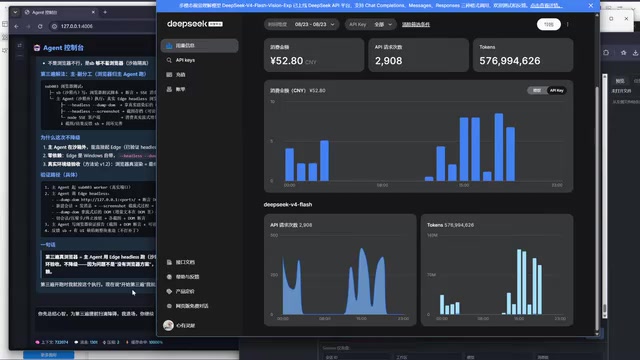
The Harness Is the Core of an Agent: Three Keys to Industrial-Grade Multi-Agent Deployment
From a Bilibili hands-on demo, we analyze why the Harness is the core of an Agent: Master-Worker dual-Agent architecture, mindset consistency constraints, three autonomous iterations, and reusable framework essentials for industrial multi-Agent deployment.
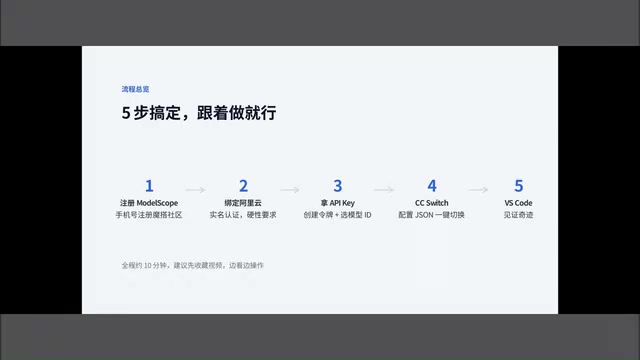
Zero-Cost Claude Code: A Guide to Configuring ModelScope's Free API
A Bilibili creator shares how to use ModelScope's free API quota with VS Code and the SystemService protocol conversion tool to call domestic models like DeepSeek in Claude Code at zero cost. Includes a five-step setup, model selection tips, and three common pitfalls to avoid.
Pi Agent: A Practical Guide to a Minimalist Open-Source Coding Agent
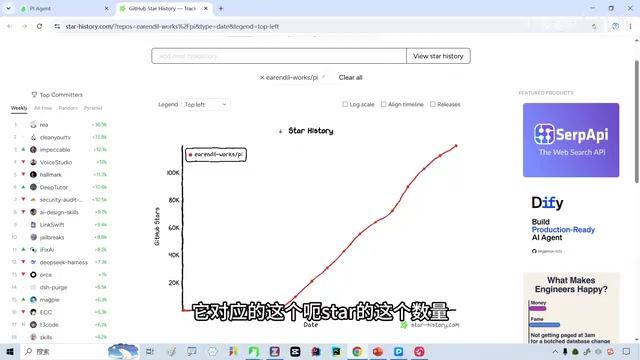
Pi Agent is a minimalist open-source coding agent benchmarked against Codex and Claude Code, with growing GitHub Stars. Learn its rise, design philosophy, and a practical path from principles to extensions.