How Can Large Language Models Crack the Code of Medical Exam Question Difficulty?

LLMs induce difficulty rules from medical exam questions, revealing mechanisms but not reliably improving judgments.
The study has LLMs (Claude Opus 5) induce scoring rubrics for absolute and pairwise difficulty judgments based on empirical difficulty labels from USMLE and PANCE questions, then tests whether rule guidance improves the models' judgments. All rules excluded surface features like stem length or option count, instead highlighting cue convergence, misleading cues, and option competition. Rule guidance improved coarse-grained consistency but not ranking accuracy, making judgments more order-sensitive. The authors see the main value as generating testable hypotheses.
Title
How Can Large Language Models Crack the Code of Medical Exam Question Difficulty?
Meta Description
A study uses empirical difficulty labels from real USMLE and PANCE questions to guide LLMs in inducing rules of medical question difficulty. It finds difficulty does not stem from surface features like stem length; instead, cue convergence, misleading cues, and option competitiveness are key patterns. Rule guidance improves coarse-grained judgments but does not reliably boost ranking accuracy.
Article Content
In medical exams, some questions look simple yet repeatedly trip up examinees, while some long, complex questions are easier to answer correctly. What exactly underlies this "empirical difficulty"? A new study attempts to use large language models (LLMs) to automatically induce difficulty rules from real exam data, and tests whether these rules can in turn improve the model's own difficulty judgment ability.
Study Design: Letting Models Learn from "Empirical Difficulty"
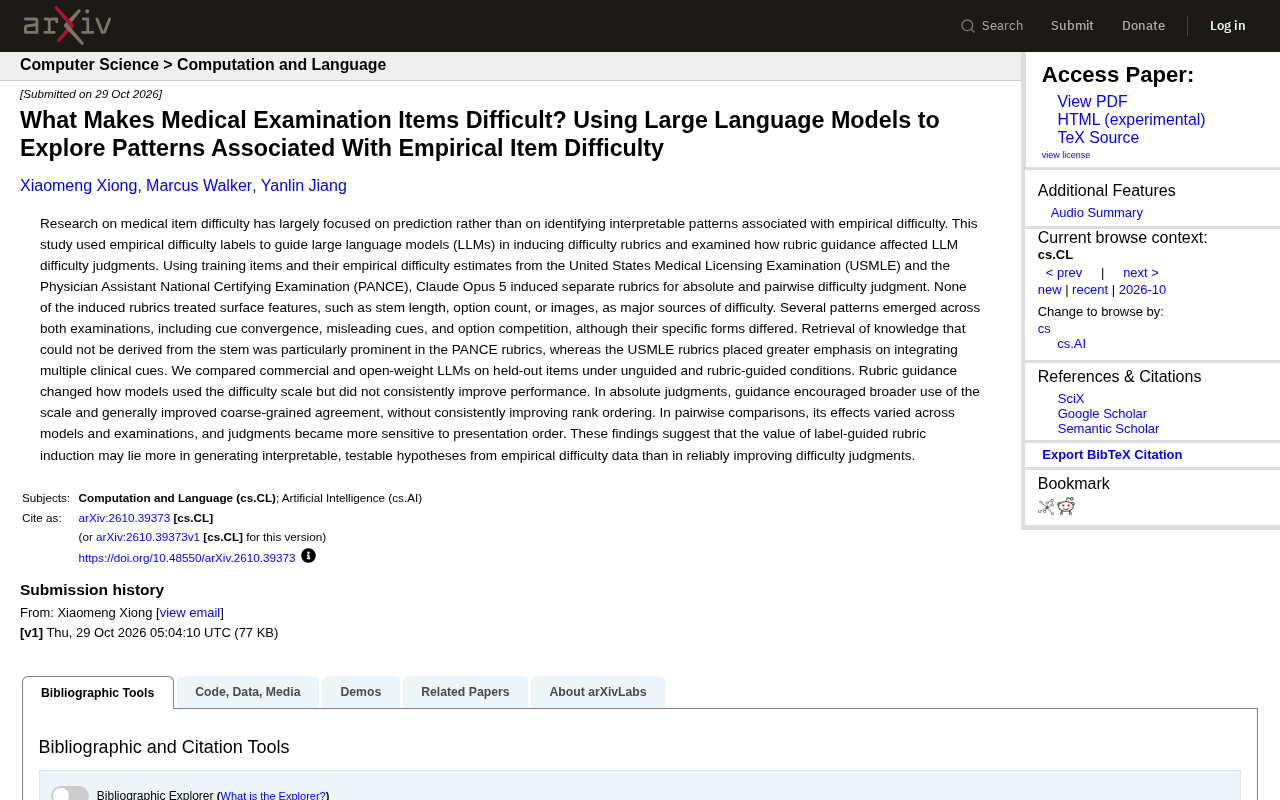
The study does not stop at having LLMs predict question difficulty. It first uses exam questions with empirical difficulty labels to guide the model in inducing a set of "difficulty scoring rules" (rubric), then observes how this rubric affects the model's own judgments. Training data came from questions and their empirical difficulty estimates from the United States Medical Licensing Examination (USMLE) and the Physician Assistant National Certifying Exam (PANCE). Claude Opus 5 induced separate scoring rubrics for absolute difficulty judgments and pairwise comparison difficulty judgments.
This "label-guided rule induction" approach is essentially an attempt to transform black-box difficulty prediction into interpretable, testable hypotheses.
Empirical difficulty contrasts with a priori difficulty based on question features. The former is typically calculated from actual examinee response data, such as the question's correct-answer rate (p-value) or difficulty parameters estimated via IRT models; the latter is pre-assessed by item writers based on question content. The advantage of empirical difficulty is that it reflects real response performance, but it is also affected by factors such as examinee samples, guessing behavior, and question exposure. The empirical difficulty estimates for USMLE and PANCE questions used in the study come precisely from statistical modeling of large volumes of examinee response records, and can therefore be regarded as "post hoc" difficulty labels rather than item writers' subjective expectations.
USMLE and PANCE are two important types of standardized exams in the U.S. medical education system. The USMLE (United States Medical Licensing Examination) consists of three stages—Step 1, Step 2 CK, and Step 3—and mainly targets medical students and residents; the PANCE (Physician Assistant National Certifying Exam) targets physician assistant (PA) candidates. The two exams differ in their content blueprints: the USMLE emphasizes the integration of basic medical and clinical knowledge, while the PANCE focuses more on clinical decision-making in primary care settings. This difference in competency structure is precisely the institutional context behind the divergence in difficulty rules between the two exams in the study.
Difficulty Does Not Come from Surface Features
A counterintuitive finding is that none of the induced rules treated surface features such as stem length, number of options, or accompanying images as the main source of difficulty. This was highly consistent across both exams.
The patterns that truly recurred include: cue convergence (multiple cues pointing to the same conclusion), misleading cues, and competitiveness among options. However, the specific manifestations of these patterns differed between the two exams.
Cue convergence is a common design strategy in medical exam item writing: the stem presents multiple mutually corroborating clinical cues (such as symptoms, signs, laboratory tests, and imaging findings), and examinees must converge these cues onto the same diagnosis or management conclusion. The more numerous and consistent the cues, the easier the question tends to be; conversely, when cues are sparse or point in scattered directions, difficulty rises. Misleading cues refer to information in the stem that points away from the correct answer, luring examinees toward an incorrect conclusion—a typical "distractor design." Option competitiveness describes the degree to which options are semantically and clinically close to one another: when multiple options all seem plausible and differ only in subtle but key ways, examinees must make fine discriminations among options, and difficulty increases accordingly. All three types of patterns are features of a question's "cognitive structure" rather than countable surface attributes such as stem length or number of options—which explains why the rules induced by the LLM consistently excluded the latter.
The Two Exams Emphasize Different Aspects of Difficulty
According to the study's analysis, the factor of "requiring knowledge that cannot be directly derived from the stem" was particularly prominent in PANCE rules, while USMLE rules placed more emphasis on the ability to integrate multiple clinical cues.
This difference suggests that different exams assess different competency structures, and the sources of difficulty diverge accordingly. A single-dimension difficulty model can hardly fit both types of exams at once.
Does Rule Guidance Work? Mixed Results
On held-out questions, the researchers compared the performance of commercial models and open-weight models under two conditions: "no guidance" and "rule guidance."
In absolute difficulty judgments, rule guidance prompted models to use the difficulty scale more fully and generally improved coarse-grained consistency, but did not reliably improve ranking accuracy. In pairwise comparisons, effects varied by model and exam, and judgments became more sensitive to presentation order.
In other words, rule guidance changed how models used the difficulty scale, but did not reliably improve judgment quality.
Absolute difficulty judgment requires the model to assign a difficulty level or score to a single question on a given difficulty scale; pairwise comparison difficulty judgment requires the model to determine which of two questions is harder. Psychometrically, the two correspond to different measurement paradigms: absolute judgments directly produce scale values but are susceptible to inconsistent model understanding of scale increments; pairwise comparisons produce only relative ordering and are generally considered more robust, but results may be affected by question presentation order (i.e., order effects). The observed phenomenon that "models became more sensitive to presentation order after rule guidance" suggests that the rule text may have altered the model's allocation of attention to question information, making it rely more on the first-presented question as an anchor during comparison. In addition, coarse-grained consistency refers to whether the model's judgment agrees with empirical difficulty at a broad level (e.g., easy/medium/hard), whereas ranking accuracy concerns whether the model can precisely reproduce the difficulty ordering of questions—the former improved while the latter did not, indicating that rule guidance mainly changed how the model used the difficulty scale rather than its discriminative ability itself.
The Value Lies in Generating Testable Hypotheses
The authors therefore propose that the value of label-guided rule induction may lie more in generating interpretable, testable hypotheses from empirical difficulty data than in reliably improving difficulty judgments themselves.
For medical exam item writing and assessment research, this offers a new path for mining difficulty mechanisms from data, but there is still a gap before LLMs can replace human difficulty assessment.
One-line Summary
LLMs induce difficulty rules from medical exam questions, revealing difficulty mechanisms but not reliably improving judgments.
Paragraph Summary
The study has large language models (Claude Opus 5) induce scoring rubrics for absolute difficulty judgments and pairwise comparison judgments based on empirical difficulty labels from real USMLE and PANCE questions, then tests whether rule guidance can improve the models' own difficulty judgments. Results show that none of the rules treated surface features such as stem length, number of options, or images as the main source of difficulty; recurring patterns were cue convergence, misleading cues, and option competition. PANCE emphasized retrieval of knowledge beyond the stem, while USMLE emphasized integration of multiple clinical cues. Rule guidance improved coarse-grained consistency but did not reliably improve ranking accuracy, and made judgments more sensitive to presentation order. The authors argue that the true value of the method lies in generating interpretable, testable hypotheses from empirical difficulty data.
Related articles

The AI Production Pipeline Behind Great Videos: From Research to Agent Validation
AI video production isn't just a model race. This article breaks down a transferable four-step pipeline: researching professional workflows, organizing a skill checklist, configuring agents, and experimental validation—and explains how general-purpose LLMs like DeepSeek can replace paid tools to run the entire process.

Get Started with Hermes Agent in 20 Minutes: Build Your AI Assistant with Zero Code
Zero-code tutorial to get started with Hermes Agent in 20 minutes: deploy a VPS with Hostinger in one click, connect Nels Portal models, link Telegram for notifications, and set up scheduled monitoring tasks and cross-session memory preferences to build an always-on personal AI assistant.

Download Folder a Dumping Ground? Auto-Archive It in Two Seconds with a Local AI Script
A Bilibili creator shares using a local large model to write a Python script that auto-archives the download folder: zero third-party dependencies, classifying only by extension with the os and shutil libraries, sorting over two hundred files in two seconds, and letting the AI adjust rules anytime.