How Does ChatGPT Check the Weather? The AI Agent Tool-Calling Loop Explained

ChatGPT checks weather via a tool-calling loop; an Agent is a model with tools deciding in a loop.
Using ChatGPT's real-time weather query as an example, the article breaks down the core mechanism of AI Agents. A large language model's knowledge stops at its training cutoff, but it can generate structured tool-call requests executed by external code, with results fed back for the model to decide whether to continue. This closed loop forms an Agent's operating skeleton. The article offers a minimal definition: an Agent is a model in a loop, equipped with tools. Tool-calling capability is becoming a core competitive advantage of model platforms.
You ask ChatGPT "What's the weather in Paris right now?" and it answers immediately. But the model's training data was frozen months ago—how could it possibly know the weather at this moment? The answer isn't that the model got smarter; it's that it learned to use tools. This seemingly simple mechanism is the key step in the evolution from chatbot to AI Agent.
From Chatbot to Agent: The Essence of Tool Calling
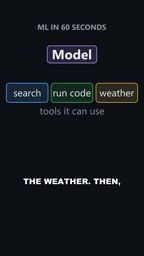
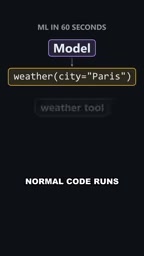
According to a breakdown in the YouTube educational short video "How ChatGPT checks the weather: AI agents explained," the process of ChatGPT checking the weather isn't mysterious. The system first tells the model what tools are available—for example, searching the web, running code, or querying weather. The model itself doesn't directly perform these operations; instead, it generates a specially formatted message, such as "call the weather tool, city equals Paris." Then, ordinary code takes over, actually calls the external tool and pastes the result back into the conversation. After reading the result, the model decides whether to answer the user directly or continue calling the next tool.
This process reveals a commonly overlooked fact: a large language model is itself just a text predictor, and its "knowledge" stops at the training cutoff date. Tool calling frees the model from a closed knowledge base, enabling it to reach real-time information, perform calculations, and operate external systems. Without tools, ChatGPT can only honestly say it doesn't know when asked about "the weather right now."
Function Calling is a structured output mechanism provided by large language model platforms. Developers predefine tool names, function descriptions, and parameter schemas (usually described with JSON Schema). During inference, if the model determines that external capabilities are needed, it outputs a JSON object that conforms to that schema rather than natural language. The host program parses this JSON, actually executes the function, and passes the return value back to the model as a new message. The key point is that the model is only responsible for "deciding what to call and what parameters to pass," while actual execution is entirely handled by deterministic code. This both avoids the security risks of the model directly operating external systems and makes the calling process auditable and retryable. OpenAI launched this capability in June 2023, and it has since become a standard feature of major model platforms and foundational infrastructure for building Agents.
The Complete Loop Behind a Single Weather Query
Zoom in on a single query. After the user asks a question, the model receives a list of tools—part of the system prompt, equivalent to telling the model "these are the capabilities you have on hand." The model determines that it needs weather data, so it outputs a structured call request instead of a natural language answer. External code parses this request, makes a real call to the weather API, gets a structured result like "Paris, sunny, 18°C," and inserts it back into the conversation context as a new message.
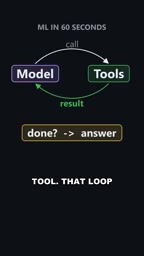
After seeing the result, the model makes a judgment: if the information is sufficient, it generates the final answer; if not, it continues calling another tool. This closed loop of "model output → code execution → result feed-back → model re-judgment" is the operating skeleton of an Agent. One detail: the model never leaves the scope of text generation—it handles decision-making and expression, while execution is left to deterministic code. This division of labor allows the system to retain the flexibility of a language model while gaining the reliability of traditional software.
The Definition of an Agent: A Model with Tools in a Loop
The video gives a minimal yet precise definition: An Agent is simply a model in a loop, equipped with tools. Broken down, all three elements are indispensable. The model is the decision-making core, responsible for understanding intent, selecting tools, and interpreting results; tools extend capabilities, compensating for the model's shortcomings in real-time awareness, computational power, and external operations; the loop is the operating mechanism that allows the model to adjust its next action based on feedback from each step, rather than giving an answer all at once.
The value of this definition lies in stripping away marketing rhetoric. Descriptions of Agents on the market often pile on words like "autonomous," "intelligent," and "end-to-end," but back in engineering implementation, it's just an inference loop with tool-calling capabilities. Understanding this lets developers focus on what truly matters: whether tool interfaces are clearly designed, whether loop termination conditions are reasonable, and whether error handling is robust. No matter how powerful the model is, if tools can't be called or the loop won't stop, the Agent cannot work reliably.
ReAct (Reasoning + Acting) is a classic paradigm of the Agent loop, proposed by Shunyu Yao et al. in 2022. It has the model alternately generate "Reasoning" and "Acting": first analyze the current state and decide what to do next, then output a tool call; after the tool result returns, the model continues reasoning based on the new information. This alternating structure enables the model to dynamically adjust its plan based on intermediate results, rather than planning all steps at once. ReAct is highly consistent with the closed loop described in this article—"model output → code execution → result feed-back → model re-judgment"—and can be seen as a concrete implementation of that loop at the prompt engineering level. Understanding ReAct helps developers design more reasonable system prompts and guide the model to reason explicitly at each step, thereby reducing blind calls and runaway loops.
Industry Significance of Tool-Calling Capabilities
Weather queries are just a minimal example, but they point in a clear direction. When models can call search, code execution, database queries, and third-party APIs, the boundary of chatbots expands from "conversing" to "doing things." Customer service Agents can look up orders and change addresses; coding Agents can run tests, read error messages, and iterate fixes; data analysis Agents can write SQL, fetch data, and generate charts. The common thread across these scenarios is that the model doesn't need to memorize all knowledge—it only needs to call the right tool at the right moment and correctly interpret the returned result.
This also explains why function calling has become one of the core capabilities of large model platforms. The focus of competition among model vendors is shifting from pure parameter scale and benchmark scores to the richness of the tool ecosystem and the reliability of calls. A model that can reliably call a hundred tools may be far more valuable in real products than a model with slightly higher benchmark scores but frequent tool-calling errors.
MCP (Model Context Protocol) is a standardized protocol open-sourced by Anthropic in November 2024, aimed at solving the fragmentation of the tool ecosystem. Before MCP, each model platform defined tools differently, and developers integrating multiple models had to repeatedly write adapter layers for each platform. MCP uses a unified client-server architecture to describe tools, resources, and prompt templates, allowing the same tool server to be directly called by different models or Agent frameworks. This greatly reduces the marginal cost of tool integration and makes "a model reliably calling hundreds of tools" more feasible. The emergence of MCP marks that tool calling is moving from proprietary platform capability to an industry-wide standard, and it is an indispensable part of understanding the current evolution of the Agent ecosystem.
Conclusion
The answer to how ChatGPT checks the weather isn't in the model's weights, but in the pipeline formed by the model, tools, and the loop. Understanding this pipeline means understanding the technical essence of the current AI Agent boom: it's not magic, but an engineering pattern that allows language models to safely "reach out" and touch the external world.
One-line Summary
ChatGPT checks the weather through a tool-calling loop; an Agent is essentially a model with tools making decisions in a loop.
Paragraph Summary
Using ChatGPT's real-time weather query as an example, the article breaks down the core mechanism of AI Agents. A large language model's knowledge stops at its training cutoff and cannot directly answer "what's the weather in Paris right now," but it can generate structured tool-call requests, which external code actually executes and feeds results back, after which the model decides whether to continue calling. This closed loop of "model output → code execution → result feed-back → model re-judgment" forms the operating skeleton of an Agent. The article thus offers a minimal definition: an Agent is a model in a loop, equipped with tools; the model handles decision-making and expression, while deterministic code handles execution, and this division of labor combines flexibility with reliability. Tool-calling capability is becoming a core competitive advantage of large model platforms, potentially more valuable than improvements in benchmark scores.
Related articles

Microsoft Fabric Database Agent in Action: From Reactive Firefighting to Intelligent Detective
A deep dive into the Microsoft Fabric Database Agent: how to enable it, supported monitoring scenarios, a blocking-issue demo, and the roadmap from reactive to autonomous operations.

Zendesk Uses ChatGPT Enterprise to Build a Sales Agent with 1,000 Daily Active Users
Zendesk opened ChatGPT Enterprise to all employees, who built about 600 apps themselves, including a sales expansion agent with about 1,000 daily active users. This article analyzes how it turns internal data into sales opportunities and its "don't wait" implementation strategy.

Google Releases Gemini 4 Carbon: Its Strongest Model Yet, Debuting with a Cybersecurity Focus
Google releases Gemini 4 Carbon, calling it its strongest model, with a cybersecurity focus. It tops the third-party composite ranking at 59 points but leads by only one or two. This article analyzes its security test results, staged rollout, token pricing, and the divergence between self-reported and third-party tests on hallucinations.