Jevper: A Unified Jev Interface Layer for Any OpenAI-Compatible Model

Jevper is an early-stage abstraction layer over OpenAI-compatible models, with limited public info so far.
Jevper debuted on Hacker News Show HN as an early-stage project positioning itself as a unified "Jev interface" abstraction layer on top of any OpenAI-compatible model. Its value is best understood in context: OpenAI's Chat Completions API has become the de facto standard for LLM tooling, with frameworks like vLLM and Ollama all implementing the same interface, creating a market for middleware offering vendor decoupling and unified developer experience. Jevper is the latest attempt in this space, but with only 4 points, no comments, and no source code or docs available, its technical depth and differentiation from mature solutions like LiteLLM and OpenRouter remain to be seen.
What Problem Does Jevper Aim to Solve
On Hacker News's Show HN section, a project called Jevper has drawn initial attention. According to the author, Jevper is the Jev interface on top of any OpenAI-compatible model.
In short, it's positioned as an abstraction layer: as long as the underlying model follows OpenAI's API specification, Jevper can provide a unified calling interface on top of it. Tools like this are not uncommon in today's LLM ecosystem — their core value lies in reducing the friction developers face when switching between different model services.
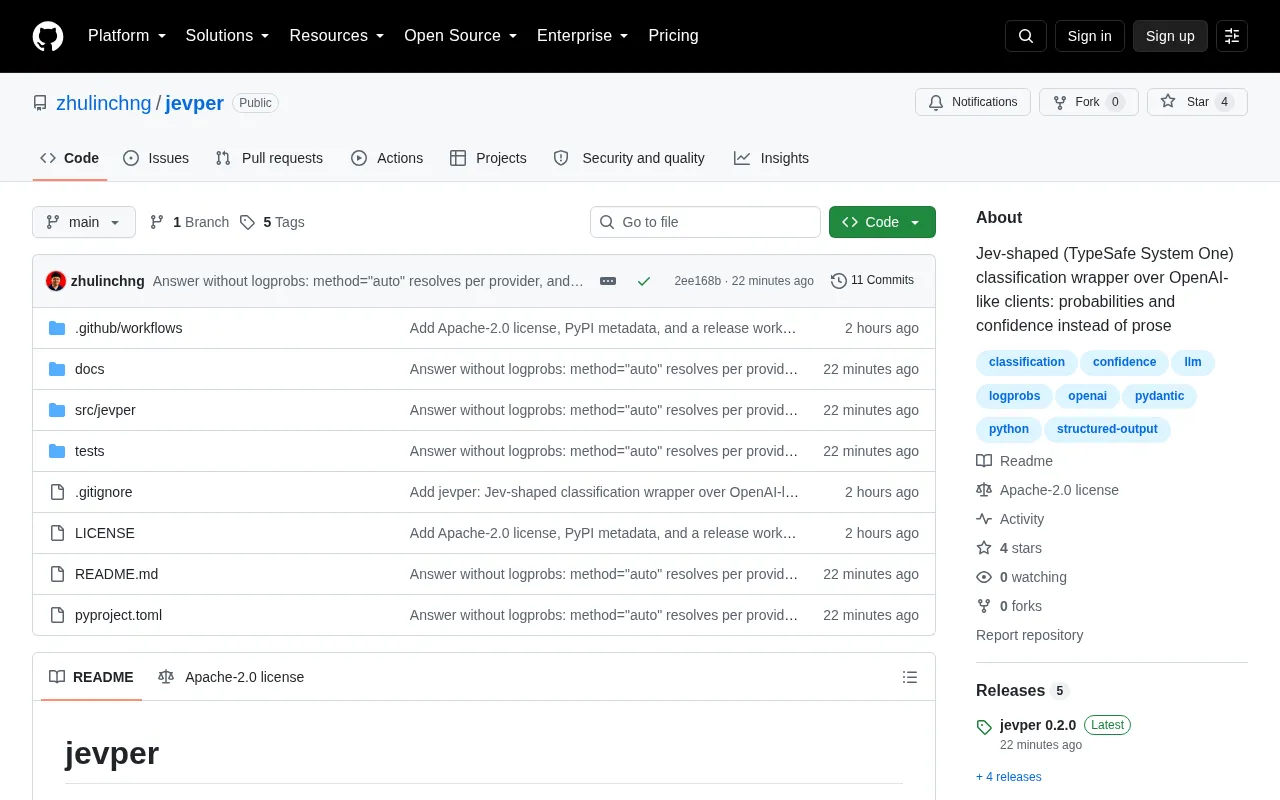
It's worth noting that the publicly available information on this Show HN post is quite limited — only 4 points and no comments so far, and the author has not included detailed technical documentation or usage examples. The following analysis is therefore primarily based on the positioning implied by the title and common practices in the OpenAI-compatible ecosystem.
Why "OpenAI Compatible" Has Become the De Facto Standard
Understanding Jevper's value requires understanding the "OpenAI compatible" premise. Since the launch of OpenAI's Chat Completions API, its request and response format has gradually evolved into the industry's de facto standard. A large number of open-source inference frameworks (such as vLLM, Ollama, and LM Studio) and third-party model service providers have chosen to be compatible with this interface, precisely so that existing client code can be integrated with minimal changes.
This has created a market for middleware: since all the underlying services speak the "same language," wrapping them in an interface better suited to specific workflows becomes a natural product direction. The "Jev interface" that Jevper provides is an extension of this logic — it doesn't reinvent the model, it reorganizes how models are called.
The core format of the OpenAI Chat Completions API is based on JSON over HTTPS. The request body includes fields like model and messages (an array of role-based conversation turns), while the response returns a choices array and usage statistics. This format is generic enough that swapping out the underlying model only requires changing the base_url and model fields — the rest of the code stays the same. vLLM is a high-performance open-source LLM inference engine, Ollama focuses on one-click local model deployment, and LM Studio provides a desktop GUI for managing local models. Despite their different positioning, all three integrate into the same ecosystem by implementing the same API endpoint (/v1/chat/completions). This "interface as protocol" trend is essentially the POSIX moment of the LLM toolchain: unified standards reduce fragmentation costs and create space for higher-level abstraction tools like Jevper.
Typical Value of Interface Abstraction Layers
From an engineering perspective, interface layers built on top of OpenAI-compatible models typically deliver value in several ways:
Vendor Decoupling
Developers can freely switch between local open-source models and cloud-based commercial models without modifying upstream business logic. This has real implications for cost control, privacy compliance, and avoiding vendor lock-in.
Unified Developer Experience
Different model services still differ in their details — streaming responses, function calling, timeout handling, and so on. A well-designed interface layer can absorb these differences and expose a consistent programming model, reducing cognitive overhead for developers.
Easier Extension and Governance
At the abstraction layer, it becomes much easier to uniformly add cross-cutting concerns like logging, rate limiting, caching, and retry logic, rather than reimplementing them at every call site.
Judgments That Should Be Reserved for Now
It must be honestly stated that the information Jevper has disclosed so far is insufficient to support any substantive assessment of its technical depth or differentiated advantages. Whether it's a lightweight SDK, a proxy gateway, or a full tool with a UI cannot be confirmed from the current title alone. What exactly the "Jev interface" refers to in terms of its abstraction design also awaits clarification from the author.
For developers following the LLM toolchain space, the reasonable approach is to treat it as "yet another abstraction layer attempt in the OpenAI-compatible ecosystem" for now, and wait for the author to release source code, documentation, or a demo before evaluating what sets it apart from mature solutions like LiteLLM and OpenRouter.
LiteLLM and OpenRouter are the two main reference points in this space. LiteLLM is an open-source Python library that provides a unified function-calling interface supporting 100+ model providers, with built-in load balancing, cost tracking, and fallback logic — positioning it as a developer SDK. OpenRouter is a hosted proxy gateway where users route to different models via a single API key, without needing to manage each provider's authentication and billing themselves — making it more of a SaaS offering. For a new abstraction layer tool to establish differentiation, it typically needs to make a deliberate trade-off or go deeper on some dimension — such as lighter dependencies, native support for a specific language, finer-grained observability, or targeted optimization for specific workflows like agents or RAG. Whether Jevper's claimed "Jev interface" represents a unique design philosophy is not yet supported by any publicly available material.
Summary
Jevper represents a direction that continues to resonate in the LLM tooling ecosystem — layering friendlier development abstractions on top of standardized model interfaces. This direction addresses a clear real-world need, but when it comes to Jevper specifically, its maturity and competitive standing remain unknown quantities. Interested readers would do well to keep an eye on the Show HN post for future updates and community feedback.
Related articles

Will GitHub Die? Open Source Maintainer Burnout and the Collaboration Crisis in the AI Era
Lex Fridman podcast discussion on open source maintainer burnout and GitHub's predicament: massive pull requests overwhelm core maintainers, and AI worsens code bloat. Using math journal peer review and Poincaré conjecture verification as analogies, the article analyzes why verification in knowledge production must be deliberately slow, and how open source communities can avoid the failure mode of maintainers exiting.

Stop Building Cookie-Cutter AI Websites: 3 Tools That Transform Your Coding Agent
Three tools that boost AI coding agents: FFmpeg skill for local video editing in Claude Code and Cursor, Hallmark's 50 design themes to fix cookie-cutter AI sites, and Jailbreaks' 25+ model prompts.

How America's Gerontocracy Squeezes the Younger Generation
Americans over 55 hold nearly three-quarters of national wealth, alongside an 80-year-old president and elderly congressional leaders. The Atlantic's Idrees Kahloon explains how gerontocracy drives up housing costs, squeezes opportunities for the young, and explores zoning reform and child poverty reduction as practical fixes.