OpenAI Launches Business Profiles, Accelerating ChatGPT's Transformation into a Discovery Engine

OpenAI launches business profiles, pivoting ChatGPT toward a Google-style consumer discovery engine.
OpenAI is rolling out business profiles that let merchants create structured showcase pages within ChatGPT, so they can be more precisely discovered and recommended when users ask for shopping or local services. Seen as a key step in ChatGPT's shift from a conversational tool to a consumer discovery engine, the logic closely mirrors Google's search discovery loop via Google Business Profile — except the interface shifts from a search box to a conversation. For merchants, AI-conversation visibility becomes a new customer acquisition dimension and may spawn a new battleground for optimizing AI recommendation results. However, key details like profile fields, ranking logic, identity verification, and monetization remain undisclosed, and whether OpenAI can challenge Google's local search dominance is still uncertain.
OpenAI is pushing ChatGPT from a simple conversational tool toward a consumer discovery engine. According to RSS sources, OpenAI is rolling out new business profiles that let merchants create their own showcase pages within ChatGPT, so they can be more precisely discovered and recommended when users make requests. This move is widely interpreted as a key step in ChatGPT's shift toward a Google-style search business model.
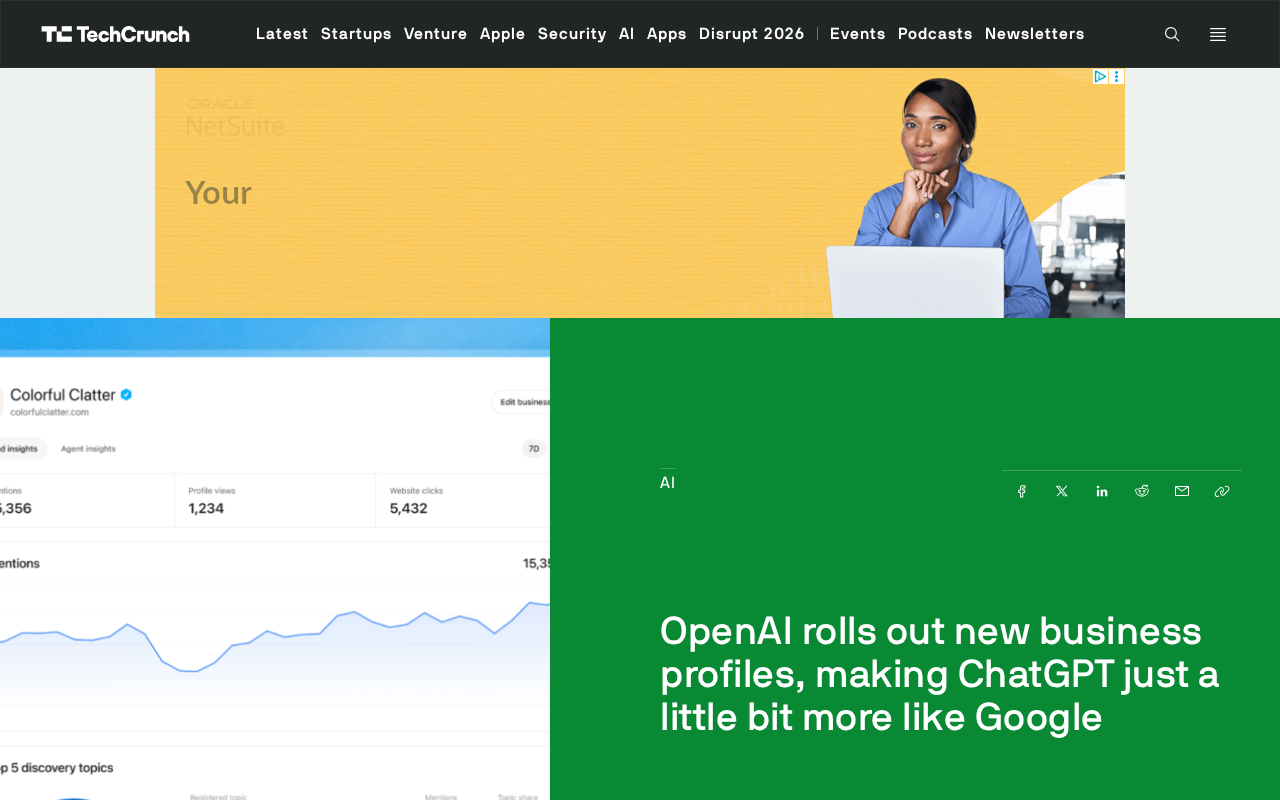
From Conversational Assistant to Discovery Gateway
ChatGPT initially won users over with its Q&A and content generation capabilities. But as users began relying on it for shopping decisions, finding local services, or comparing products, a natural need emerged: how can merchants be accurately represented by AI? OpenAI's new feature is a direct response to that need. Business profiles give merchants a chance to have a structured presence in ChatGPT's answers, rather than passively waiting for the model to piece together information from its training data.
The significance of this shift is that ChatGPT is no longer just the endpoint of information — it is gradually becoming the starting point for users accessing internet services. When users ask ChatGPT "what are some good cafés nearby" or "recommend a skincare product for sensitive skin," business profiles will directly influence which merchants make it into the recommendation list.
Why It Looks More Like Google
Google's business model is built on search discovery: merchants maintain their information through Google Business Profile, users find them through search, and advertising and local services form a closed loop. OpenAI's business profiles follow a highly similar logic — except the interface has changed from a search box to a conversation.
According to RSS source analysis, OpenAI's move aims to make ChatGPT a "more powerful consumer discovery engine." The business profiles feature gives merchants the ability to actively participate in AI recommendation results, much the same way Google lets merchants manage their own search listings. For small and medium-sized businesses that have long relied on search engines for customer acquisition, a new traffic gateway is taking shape.
Google Business Profile (formerly Google My Business) is a free information management tool Google provides for local merchants, where they can maintain details such as business hours, address, contact information, photos, and user reviews. This structured data appears directly in business cards on Google Search and Maps, influencing users' decisions to visit and the delivery of Google local ads. For small and medium-sized businesses, it is one of the most important local customer acquisition channels. OpenAI's business profiles are highly similar in functional positioning: both let merchants actively submit and manage their information to influence what the platform shows users. The difference is that Google's display gateway is search keywords and maps, while ChatGPT's gateway is natural language conversation. This analogy helps explain why OpenAI is seen as replicating Google's discovery-layer logic.
What It Means for Merchants
The emergence of business profiles means merchants need to rethink their "visibility" in AI conversations. In the past, SEO optimization targeted search engine crawlers and ranking algorithms; now, merchants may need to consider how to get ChatGPT to cite their information when answering relevant questions. The launch of the profiles feature lowers this barrier — merchants no longer have to wait for the model to crawl their data on its own; they can actively submit and update their information.
For brands, this also introduces a new competitive dimension. When multiple merchants in the same category all have profiles, how ChatGPT ranks them, how it presents them, and whether commercial placements will appear are all questions worth watching. OpenAI has not yet disclosed its ranking logic or whether paid promotion is involved, but following Google's evolutionary path, commercialization is almost inevitable.
GEO (Generative Engine Optimization) is a concept that has emerged in recent years, referring to optimizing content for generative AI systems such as ChatGPT, Perplexity, and Google AI Overviews so that brands or merchants are more likely to be cited and recommended in AI answers. Unlike traditional SEO, which focuses on crawler indexing and link rankings, GEO emphasizes content citability, factual consistency, and structure, because generative models tend to synthesize multiple sources into a single answer. The industry also uses similar terms like AIO (AI Optimization). With the introduction of proactive submission mechanisms like business profiles, merchants' visibility in AI recommendations will shift partly from "passively learned by the model" to "actively declared information," making GEO's practical pathways more concrete.
Open Questions
The business profiles feature is still in its early stages. OpenAI has not disclosed details such as the specific fields of a profile, the review mechanism, or how merchants verify their identity. Information accuracy is also a potential challenge: if the information a merchant submits conflicts with what the model already knows, how ChatGPT will handle it remains unclear.
Another issue worth watching is the impact on the content ecosystem. If ChatGPT gradually becomes the primary gateway for users to discover merchants and products, optimization around AI recommendation results (which could be called AIO or GEO) may become a new marketing battleground. This will have structural implications for the SEO industry and local service merchants alike.
OpenAI's intent to turn ChatGPT into a discovery engine is already clear, and business profiles are just one piece of the puzzle. Whether it can truly challenge Google's position in local search and commercial discovery depends on merchant participation, the speed at which user habits shift, and how OpenAI balances recommendation quality with commercial interests.
One-line Summary
OpenAI launches business profiles, transforming ChatGPT into a Google-style consumer discovery engine.
Paragraph Summary
OpenAI is rolling out business profiles that allow merchants to create structured showcase pages within ChatGPT, so they can be more precisely discovered and recommended when users make requests for shopping, local services, and more. This move is seen as a key step in ChatGPT's transformation from a conversational tool into a consumer discovery engine, following a logic highly similar to Google's search discovery loop built through Google Business Profile — except the interface shifts from a search box to a conversation. For merchants, this means "visibility" in AI conversations becomes a new customer acquisition dimension and may spawn a new battleground for optimizing AI recommendation results. However, key details such as profile fields, ranking logic, identity verification, and commercialization methods have not been disclosed, and whether OpenAI can challenge Google's position in local search remains to be seen.
Related articles

Claude Adds Three New Interactive Artifacts: Whiteboard, Sheets, and Data
Anthropic adds Whiteboard, Sheets, and Data interactive artifacts to Claude in Beta for all paid plans. This hands-on breakdown covers usage, sharing, and external app connections.

Do Men's Friendships Need to Be "Deep"? Emotionally Restrained Camaraderie Counts Too
The Atlantic's Tyler Austin Harper argues that fewer male friendships is a real problem, but emotionally restrained, activity-based friendship is not inherently wrong.

Nvidia's Backup Plan for China's Autonomous Driving
TechCrunch Mobility reports on Nvidia's backup plan for China's autonomous driving industry, analyzing its strategic context, industry impact, and uncertainties.