vLLM Releases v0.31.0: Adds Upper Bound Constraint for Transformers Version
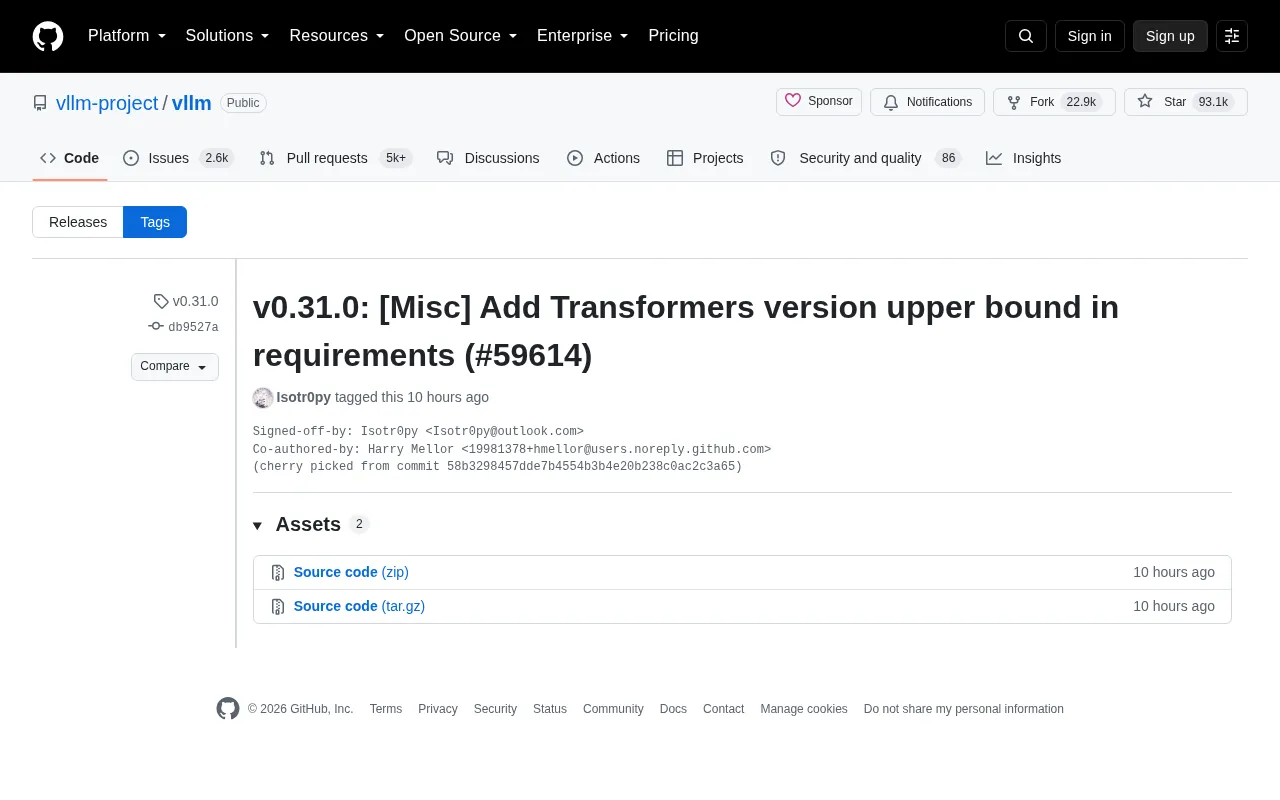
vLLM v0.31.0 adds a Transformers version upper bound to improve compatibility and deployment stability.
vLLM has released v0.31.0, with the core change from PR #59614 adding an upper bound constraint on the Hugging Face Transformers library in its dependency declarations. Because vLLM is tightly coupled to Transformers internals and Transformers frequently introduces breaking changes, a lower-bound-only dependency could cause pip to pull in incompatible newer versions, leading to runtime errors. The upper bound improves deployment reproducibility and reduces hidden compatibility issues. Users who require a higher version of Transformers should be aware of potential conflicts and may need to use an isolated environment or wait for a future vLLM release.
vLLM v0.31.0 Released
vLLM has recently released version v0.31.0. As one of the most popular LLM inference and serving engines available today, vLLM has accumulated over 93.1k stars on GitHub with 22.9k forks, making it one of the most influential projects in the open-source LLM inference ecosystem.
The primary change in this release comes from PR #59614, which adds an upper bound constraint on the Transformers library in the project's requirements. The commit was initiated by contributor Isotr0py in collaboration with Harry Mellor, cherry-picked from main branch commit 58b3298 as a targeted fix.
Why Add an Upper Bound for Transformers
vLLM relies heavily on Hugging Face's Transformers library for model loading, configuration parsing, and weight mapping. The two projects operate on different release cadences — Transformers updates frequently and often introduces breaking changes, such as modifying model configuration fields, changing API signatures, or refactoring internal implementations.
Declaring only a lower bound in a dependency (e.g., transformers>=x.y) without an upper bound creates a hidden risk: when users install or upgrade their environment, pip may automatically pull in the latest version of Transformers, which may not be fully compatible with the current version of vLLM — leading to runtime errors or abnormal inference results.
By adding an upper bound (i.e., a constraint like transformers>=x.y,<z), the maintenance team can lock the compatibility range to a verified interval, preventing downstream users from running into issues caused by aggressive upstream updates. This is a common and pragmatic dependency management practice, especially well-suited for projects like vLLM that are tightly coupled to underlying libraries.
What is Cherry-pick? Cherry-pick is a Git operation that takes a specific commit from one branch and applies it to another, without merging the entire branch history. In large open-source projects, the main branch is typically in a state of rapid iteration, containing many new and unstable features. When a bugfix or critical patch is completed on the main branch, maintainers use cherry-pick to selectively port it to the more conservative release branch — bringing the fix into a stable release without introducing the risk of other in-progress changes. The dependency constraint change in vLLM v0.31.0 was merged into the release branch via this mechanism from main branch commit 58b3298, reflecting the rigorous release quality standards of a mature open-source project.
Practical Impact for Users
For engineering teams currently using vLLM, this kind of seemingly minor change can significantly improve environment reproducibility and stability:
- More reliable deployments: Newly provisioned production or test environments won't accidentally pull in incompatible versions of Transformers.
- Easier debugging: Eliminates hidden bugs caused by upstream library version drift, reducing troubleshooting overhead.
- Clearer upgrade paths: The version constraint documents officially verified compatibility combinations, making it easier for teams to plan dependency upgrades.
One thing to be aware of: if your other dependencies or application code require a higher version of Transformers, this upper bound constraint may cause conflicts. In that case, you'll need to weigh whether to wait for a future vLLM release that relaxes the constraint, or handle the conflict in an isolated environment.
A note on version drift in Python packaging: Dependency version drift is a widespread pain point in the Python packaging ecosystem. When resolving dependencies, pip follows a "latest compatible version first" strategy — if a project only declares a lower bound with no upper bound, the actual version installed in a new environment can vary each time, leading to the classic "it works on my machine" problem. Common mitigations include exporting a lockfile with
pip freeze, or using tools likepip-tools,Poetry, oruvto generate a lock file that pins exact versions for all dependencies. vLLM's addition of an upper bound in its requirements is an official compatibility declaration at the package level, complementing the lock file strategies used on the deployment side — the former is the responsibility of project maintainers, the latter of the deployment team, together forming the foundation of a reproducible environment.
A Glimpse into Open-Source Collaboration
This release also reflects how large open-source projects operate day to day: a small fix submitted by a community contributor, reviewed collaboratively, and cherry-picked into the release branch is exactly the kind of work that keeps a project healthy over the long term. Compared to headline-grabbing feature releases, this kind of dependency maintenance and compatibility work may be unglamorous — but it directly affects the experience of hundreds of thousands of users.
We recommend that regular vLLM users keep an eye on official Release Notes and verify that version constraints align with their environment before upgrading, in order to get the best possible stability.
Related articles

Will GitHub Die? Open Source Maintainer Burnout and the Collaboration Crisis in the AI Era
Lex Fridman podcast discussion on open source maintainer burnout and GitHub's predicament: massive pull requests overwhelm core maintainers, and AI worsens code bloat. Using math journal peer review and Poincaré conjecture verification as analogies, the article analyzes why verification in knowledge production must be deliberately slow, and how open source communities can avoid the failure mode of maintainers exiting.

Stop Building Cookie-Cutter AI Websites: 3 Tools That Transform Your Coding Agent
Three tools that boost AI coding agents: FFmpeg skill for local video editing in Claude Code and Cursor, Hallmark's 50 design themes to fix cookie-cutter AI sites, and Jailbreaks' 25+ model prompts.

How America's Gerontocracy Squeezes the Younger Generation
Americans over 55 hold nearly three-quarters of national wealth, alongside an 80-year-old president and elderly congressional leaders. The Atlantic's Idrees Kahloon explains how gerontocracy drives up housing costs, squeezes opportunities for the young, and explores zoning reform and child poverty reduction as practical fixes.