Why Do LLMs Accept Generic Statements? Psycholinguistic Factors Reveal the Model's Judgment Mechanism

LLMs weigh prevalence and distinctiveness like humans when judging generic statements, but rely more on factual truth.
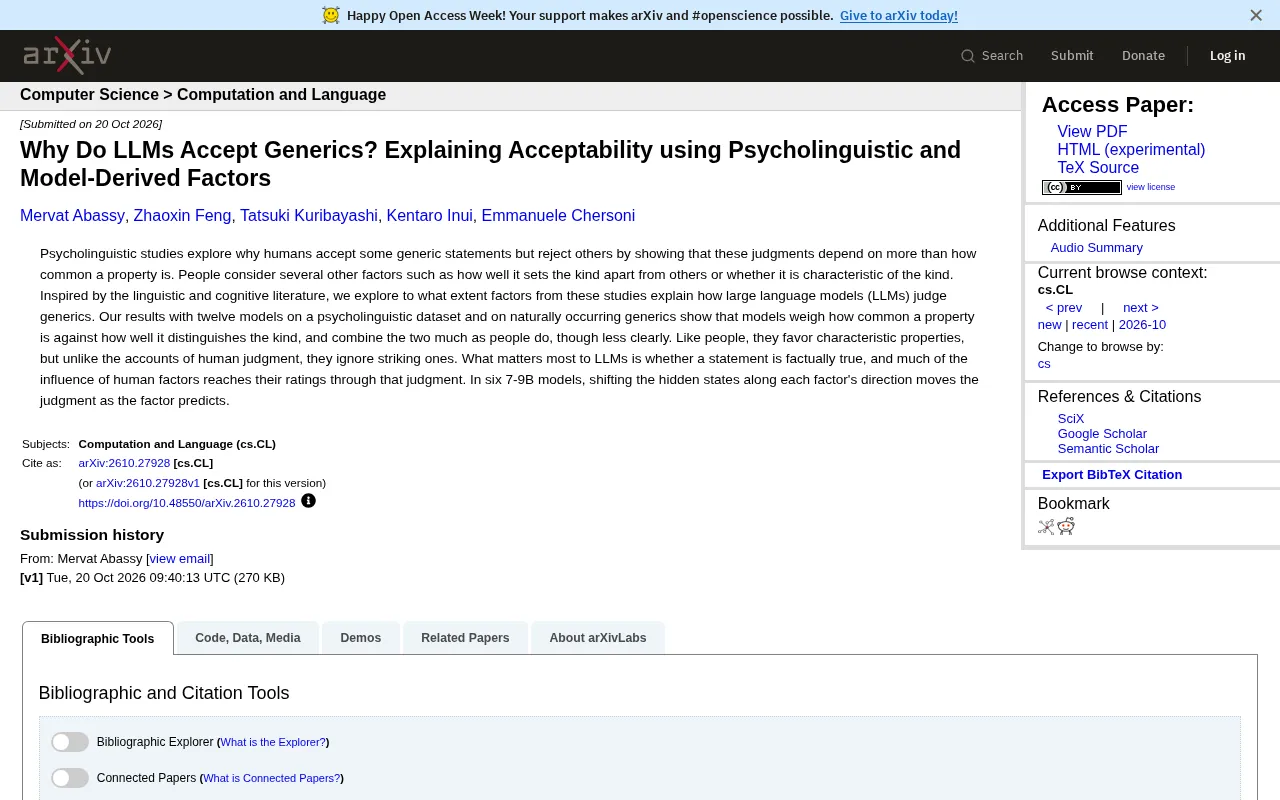
Inspired by psycholinguistics, this study tested 12 models using psycholinguistic datasets and natural-corpus generic statements to examine how LLMs judge acceptability of statements like "dogs are loyal." LLMs weigh prevalence and distinctiveness and combine them human-like, and prefer characteristic attributes, but the combination is less clear and they ignore "strikingness." Most importantly, factual truth is the dominant factor, mediating many human-factor effects. Hidden state steering experiments on six 7-9B models provide causal evidence that these factors are encoded and drive judgments.
Introduction: The Puzzle of Generic Statement Acceptability
"Dogs are loyal" and "dogs are four-legged" are both generic statements, yet people generally accept the former and question the latter. Psycholinguistic research shows that human acceptability of generic statements does not depend solely on how common an attribute is—people also consider whether the attribute distinguishes a category from others and whether it is characteristic of the category. So do large language models (LLMs) follow a similar cognitive logic when judging generic statements?
A study inspired by linguistic and cognitive literature tested 12 models using psycholinguistic datasets and generic statements from natural corpora, attempting to answer this question. The research found that LLMs do weigh attribute prevalence and distinctiveness and combine the two in a human-like way, though the combination is less clear-cut than in humans.
The Triple Logic of Human Judgment of Generic Statements
Psycholinguistic research on generic statements reveals a key fact: people's acceptability of generic statements cannot be explained simply by "how common the attribute is." For example, "lions have four legs" is factually true and the attribute is common, yet people are more inclined to accept statements like "lions are fierce" that capture the essence of the category.
Specifically, human judgments rely on at least three types of factors:
- Prevalence: how frequently the attribute appears among category members.
- Distinctiveness: the degree to which the attribute distinguishes this category from others.
- Characteristicness: whether the attribute is regarded as a typical feature of the category.
In addition, the research mentions "strikingness"—whether the attribute is attention-grabbing—which also affects human judgments. Together these factors make human acceptability of generic statements exhibit a complex pattern that goes beyond statistical frequency.
Generic statements are a core concept in linguistics and psycholinguistics, referring to sentences that express category-level regularities without quantifiers like "all" or "most," such as "dogs are loyal" or "birds fly." Unlike universally quantified sentences, generic statements allow exceptions (not every dog is loyal), making their semantics difficult to characterize simply in terms of truth conditions. Psycholinguistics has therefore turned to studying acceptability: why people accept some generic statements and reject others. Classic explanations include cognition-probability-based models (the frequency of an attribute within a category) and essentialism-based models (whether an attribute is regarded as the essence of a category). This issue is particularly critical for LLM research, because models lack real-world experience and can only acquire their "intuitions" about generic statements from corpus statistics; comparing the two helps reveal the different computational bases underlying human-like semantic judgments.
LLM Acceptability Judgments: Human-like but More "Pragmatic"
The research team tested 12 models using psycholinguistic datasets and naturally occurring generic statements. The core finding: LLMs weigh attribute prevalence and distinctiveness and combine the two—similar to what humans do, but with less clarity in the combination.
Consistent with humans, the models also prefer characteristic attributes. However, unlike human judgment theories, the models ignore the "strikingness" factor. In other words, whether an attribute is striking enough does not affect the models' acceptability judgments.
The more critical difference is that for LLMs, the most important factor is whether the statement is factually true. Many of the effects of human factors (prevalence, distinctiveness, characteristicness) actually reach model ratings indirectly through this "factual truth" judgment. This suggests that models may first assess whether a statement is true and then layer other considerations on top of that.
This finding implies a structural difference between LLMs' generic statement judgment mechanism and that of humans: humans may process multiple cues in parallel, whereas models rely more on a core truth-value judgment as a mediator.
Causal Validation: Hidden State Steering Experiments
To verify whether these factors actually play a causal role in the models, the researchers conducted hidden state steering experiments on six models with 7-9B parameters. Specifically, they shifted the hidden states along the direction corresponding to each factor and observed whether the model judgments changed as the factors predicted.
The results showed that such steering did change model judgments, in directions consistent with the factors' predictions. This provides causal evidence that the models internally encode these psycholinguistic factors, rather than merely showing correlational observations.
The significance of this experimental design is that it goes beyond surface-level analysis of "model outputs correlating with human ratings" and directly intervenes in the model's internal representations, thereby more powerfully demonstrating which factors drive judgments.
Hidden state steering is a class of causal intervention methods in mechanistic interpretability research. The basic idea is: first locate the direction in the model's hidden representation space corresponding to a concept or factor (typically by contrasting representation differences obtained from different inputs, or by training linear probes to estimate it), then add or subtract a vector along that direction at inference time to amplify or suppress the encoding strength of that factor, and finally observe whether the model output changes systematically accordingly. Compared with observational analyses that only report correlations between outputs and human ratings, such interventions can provide causal evidence: if shifting representations along the "prevalence" direction changes acceptability ratings as expected, it shows that this factor is explicitly encoded within the model and participates in judgment, rather than merely co-occurring with the outcome by chance. This paradigm has been widely used in research on concepts such as emotion, truthfulness, and refusal behavior.
Implications for Cognitive Modeling of LLMs
The significance of this research goes beyond generic statements themselves. It demonstrates a research paradigm: using psycholinguistic theoretical frameworks and experimental methods to dissect LLM judgment mechanisms, and using causal interventions to verify the role of factors.
From the results, LLMs do not simply replicate human judgments. They share some factors (prevalence, distinctiveness, characteristicness) but weight them differently and lack certain factors (strikingness). At the same time, the models' heavy reliance on factual truth may reflect how training objectives (such as factual rewards) shape the judgment process.
For developers and researchers concerned with LLM cognitive abilities, this suggests that the "human-like" behavior models exhibit on semantic judgment tasks may be built on internal computations that differ from those of humans. Understanding these differences is quite important for building more reliable and more interpretable models.
Conclusion
The reasons LLMs accept generic statements have both similarities with humans—weighing prevalence and distinctiveness, preferring characteristic attributes—and clear divergences: ignoring strikingness and using factual truth as a core mediator. The hidden state steering experiments further confirm the causal role of these factors. This research provides a fine-grained psycholinguistic dissection of LLMs' cognitive mechanisms and reminds us that the "human-like" judgments of models may rest on a different set of computational logic.
One-line Summary
Research finds that LLMs weigh prevalence and distinctiveness in a human-like way when judging generic statements, but rely more on factual truth.
Paragraph Summary
Inspired by psycholinguistics, this study tested 12 models using psycholinguistic datasets and generic statements from natural corpora to examine how LLMs judge the acceptability of generic statements like "dogs are loyal." Results show that LLMs weigh attribute prevalence and distinctiveness and combine the two in a human-like way, and also prefer characteristic attributes, but the combination is less clear-cut than in humans, and they ignore the "strikingness" factor present in human judgments. More critically, the most important factor for models is whether the statement is factually true; many effects of human factors are actually mediated indirectly through this truth-value judgment. The study also provided causal evidence through hidden state steering experiments on six 7-9B models, showing that these factors are indeed encoded within the models and drive judgments.
Related articles
AWS AgentCore Gateway: Connecting AI A…
AWS AgentCore Gateway: Connecting AI Agents to Enterprise Backends with MCP
How AWS AgentCore Gateway acts as a primary MCP server to aggregate REST APIs, Lambda, and existing MCP services? Analyzing its AST real-time mapping, zero cold start, semantic search for tool overload, session isolation, and key injection security design, plus the architectural approach to decoupling enterprise AI agents from backends.

One Link Gives Figma AI a New Skill: Hands-On with MCP Connectors
Paste one MCP server link and the AI Agent in Figma gains new tool capabilities. We break down the setup flow, 20+ one-click apps, read/write permissions and execution policies, and the public HTTPS requirement.

Cognition SWE-2 in Practice: One Prompt to Handle the Whole Product Launch Process
Analyzing a YouTube creator's prompt for using Cognition SWE-2 to launch a product: a landing page, seven-email sequence, and non-buyer follow-up tool, plus how the 'test and report' constraint changes AI delivery quality.