Zest Launches AI Dining Assistant: Group Chat Voting + Automatic Booking

Zest launches an AI dining concierge that gathers preferences via conversation, votes on restaurants, and auto-books.
Zest's AI agent targets the common pain point of "deciding where to eat" at friends' gatherings. It collects group members' dietary preferences through text conversation, generates a list of candidate restaurants and organizes a vote, then has the AI complete the booking directly—compressing restaurant selection, negotiation, and reservation into one conversation. Its differentiator is placing the agent at the front-end stage of coordinating multi-person decisions rather than pure recommendation, involving negotiation, voting, and task execution, making it closer to a true assistant. This model covers information gathering, option generation, group decision-making, and external system invocation, and can be migrated to scenarios like choosing a movie or planning an itinerary. However, key details—preference collection methods, tie handling, booking failure fallbacks, and local merchant data coverage—remain undisclosed, determining whether the product is a demo or a usable tool.
From "What Should We Eat" to "It's Booked": Zest's AI Dining Concierge
The hardest part of a friends' get-together is often not finding a time, but deciding where to eat. Everyone has different tastes, budgets, and dietary restrictions, and group chats frequently descend into long back-and-forth standoffs. Zest's newly launched AI agent targets exactly this scenario: it gathers everyone's preferences through text conversation, generates restaurant candidates, initiates a vote, and finally completes the booking directly.
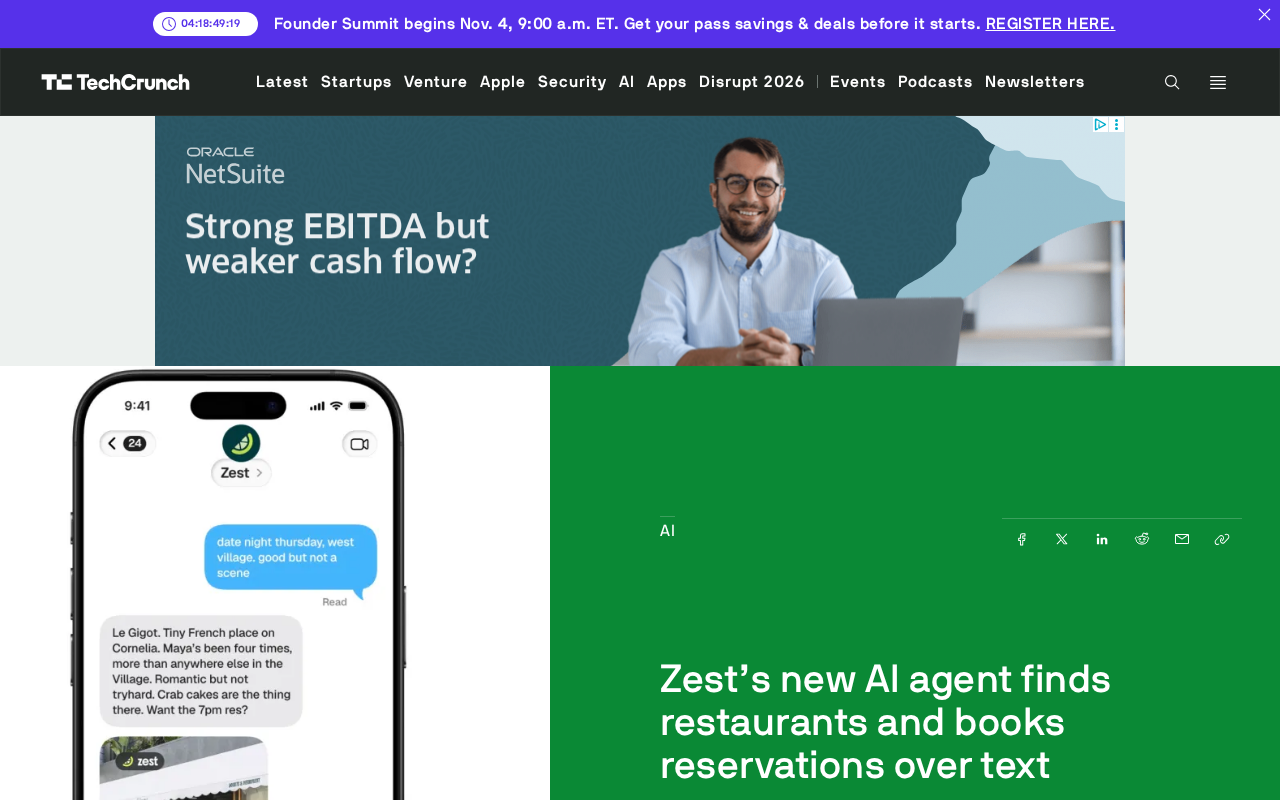
According to reports from an RSS source, Zest's AI concierge can "combine everyone's tastes, put the restaurant options to a vote, and complete the booking." This means users no longer need to switch back and forth between multiple apps—choosing a restaurant, negotiating, and booking a table are all compressed into a single conversation.
How It Solves the "Everyone Has Different Tastes" Problem
Preference Aggregation and Voting Mechanism
Zest's core approach is to structure the decision-making process. The AI first collects group members' dietary preferences, then generates a list of candidate restaurants based on those preferences, and then lets each person vote. This approach centralizes the fragmented information that would otherwise be scattered across the group chat, avoiding ineffective "whatever" and "anything works" communication.
AI agent is fundamentally different from traditional recommendation systems or chatbots. Recommendation systems are usually single-turn: they take a user profile or historical behavior as input and output a ranked list; chatbots mostly respond to immediate requests in a Q&A format. An AI agent, by contrast, emphasizes autonomously orchestrating multiple steps after being given a goal, calling external tools, and completing a closed-loop task. In Zest's scenario, the agent needs to sequentially: proactively collect preferences from group members, generate a candidate set based on constraints, organize a vote and tally the results, and finally call a booking interface to execute the reservation. This chain of actions involves state maintenance, multi-party interaction, and external system integration—far beyond the scope of a single model inference, and closer to a software agent that can execute tasks.
Automatically Completing the Booking
Once the vote is over and the result is determined, the AI directly executes the booking action. The original article does not disclose which booking platforms it integrates with or which cities it covers, but based on its product positioning, it is more of a front-end "decision + execution" layer rather than a pure restaurant recommendation tool.
Restaurant booking platform interfaces are the key background for understanding Zest's execution layer. Mainstream platforms such as OpenTable and Resy open inventory queries and reservation APIs to third parties through partnerships, allowing developers to search for available tables by date, party size, and time slot, and submit booking requests. However, such interfaces usually have coverage limitations: not all restaurants are connected, penetration varies greatly across cities, and some restaurants only open limited time slots to online channels. If Zest relies on such APIs, the pool of bookable restaurants will be constrained by the partner platforms' merchant networks; if it uses alternatives such as phone calls or web automation, it faces reliability and compliance risks. This directly determines whether the "decision-to-execution" loop can hold up in enough scenarios.
Why This Direction Is Worth Watching
Restaurant booking itself is not a new arena—platforms like OpenTable and Resy have long occupied users' minds. Zest's differentiator is that it places the AI agent at an earlier stage: "coordinating multi-person decisions." Recommendation algorithms solve "what you might like," while an agent solves "how a group of people can reach consensus"—the latter involves negotiation, voting, and task execution, making it closer to a true assistant role.
From an industry trend perspective, AI agents are shifting from single-turn Q&A to multi-step task orchestration. The dining scenario naturally encompasses four stages—information gathering, option generation, group decision-making, and external system invocation—making it a suitable testing ground for agent capabilities. If Zest can make this chain run smoothly, the same model can be migrated to more group decision scenarios such as choosing a movie or planning an itinerary.
Multi-step task orchestration is a core capability metric in current AI agent research. It requires the model not only to understand single-turn instructions, but also to plan steps within a long workflow, remember intermediate states, adjust strategies based on feedback, and call external tools when needed. The industry commonly uses "tool calling" and "function calling" mechanisms to let models interact with real systems. The dining scenario happens to cover the typical dimensions of such evaluations: information gathering corresponds to multi-turn dialogue and clarification, option generation corresponds to constraint satisfaction, group decision-making corresponds to multi-agent negotiation, and external invocation corresponds to API integration. Therefore, products like Zest are not only commercial attempts but can also be seen as stress tests of agent capabilities under real-world constraints.
Questions to Watch
Public information is currently limited, and several key questions remain unclear: how the AI obtains group members' preferences—whether through individual conversations with each person or unified collection in the group chat; how to handle a tie in the vote; and what the fallback plan is if the booking fails. These details determine whether the product is an "interesting demo" or a "genuinely usable tool."
Another practical constraint is data coverage. The quality of restaurant recommendations depends heavily on the breadth and freshness of local merchant data, and the accumulation cost for new players in this area should not be underestimated.
Tie-breaking and conflict resolution in group decision-making is a challenge that is easily underestimated in product design. When options are scattered, multi-person voting can easily result in ties or no option receiving a majority. Common solutions include multi-round elimination voting, setting weights (such as giving the initiator priority), introducing randomness to break ties, or having the agent proactively recommend a compromise based on constraints. In addition, the privacy boundaries of preference collection also deserve attention: if each member needs to converse with the AI individually, how to ensure information is not leaked to others in the group, and how members who did not participate in the conversation are included, are practical issues that affect the experience. The quality of these mechanism designs often determines whether a product is usable more than the model itself.
Conclusion
Zest's AI agent redefines "finding a restaurant" as "coordinating a group of people to make a decision and execute it," an entry point that is more imaginative than a simple recommendation list. Whether it succeeds depends on the naturalness of preference collection, the smoothness of the voting process, and the reliable coverage of the booking stage. For those following the real-world adoption of AI applications, this is a sample worth tracking.
One-line Summary
Zest launches an AI dining concierge that collects preferences through conversation, votes on restaurants, and automatically completes bookings.
Paragraph Summary
Zest's AI agent targets the high-frequency pain point of "deciding where to eat" during friends' gatherings. It gathers group members' dietary preferences through text conversation, generates a list of candidate restaurants and organizes a vote, and finally the AI completes the booking directly—compressing restaurant selection, negotiation, and reservation into a single conversation. The article argues that its differentiator lies in placing the agent at the front-end stage of "coordinating multi-person decisions" rather than pure restaurant recommendation, involving negotiation, voting, and task execution, and thus closer to a true assistant role. This model naturally covers four stages—information gathering, option generation, group decision-making, and external system invocation—and can be migrated to scenarios such as choosing a movie or planning an itinerary. However, key details such as how preferences are collected, how ties are handled, fallback plans for booking failures, and local merchant data coverage have not been disclosed, and these determine whether the product is a demo or a usable tool.
Related articles

Surface RTX Spark Dev Box Runs 120B Model Fully Offline: An Intelligent Terminal Hands-On
Microsoft Surface RTX Spark Dev Box demo: running a 120B local model offline via open-source Intelligent Terminal, building a bootable Hyper-V VM with one sentence, showcasing Project Zemuth local AI.

After Affirmative Action Ends: Sharp Drop in Black Enrollment and the Rise of HBCUs
After the Supreme Court ended race-conscious admissions, Black freshman enrollment at the top 50 most selective universities fell 27%, with Harvard dropping from 18% to 11.5% and Yale from 9.5% to 8%, as more Black students turn to HBCUs.

Claude Rolls Out Watermarking Across the Board: Paid Users Can't Opt Out, But Only a Select Few Can Detect It
Anthropic extends Claude's invisible text watermark to Mythos 5, Opus 4.7 and more, globally and with no paid opt-out. Even proofreading and translation get marked, yet detection is limited to regulators and enterprises.