Deep Dives
In-depth AI analysis, industry observations, and technical insights — slow down and read.

v0.5.23 Release: The Engineering Signals Behind a Minor Version Update
Interpreting the v0.5.23 release: analyzing the iteration rhythm, maintenance model, and upgrade risks of a 0.x-stage project through its semantic version number, Bump commit message, and release page asset loading anomaly.

Rejecting Hallucinated Citations: A More Honest Research Agent Practice
Reddit developer shares ResearchAgent: a research agent that only cites real retrieved sources, with calibrated confidence scores and severity-ranked limitations, using an explicit plan→search/verify→synthesize pipeline, running locally with Ollama+DuckDuckGo.
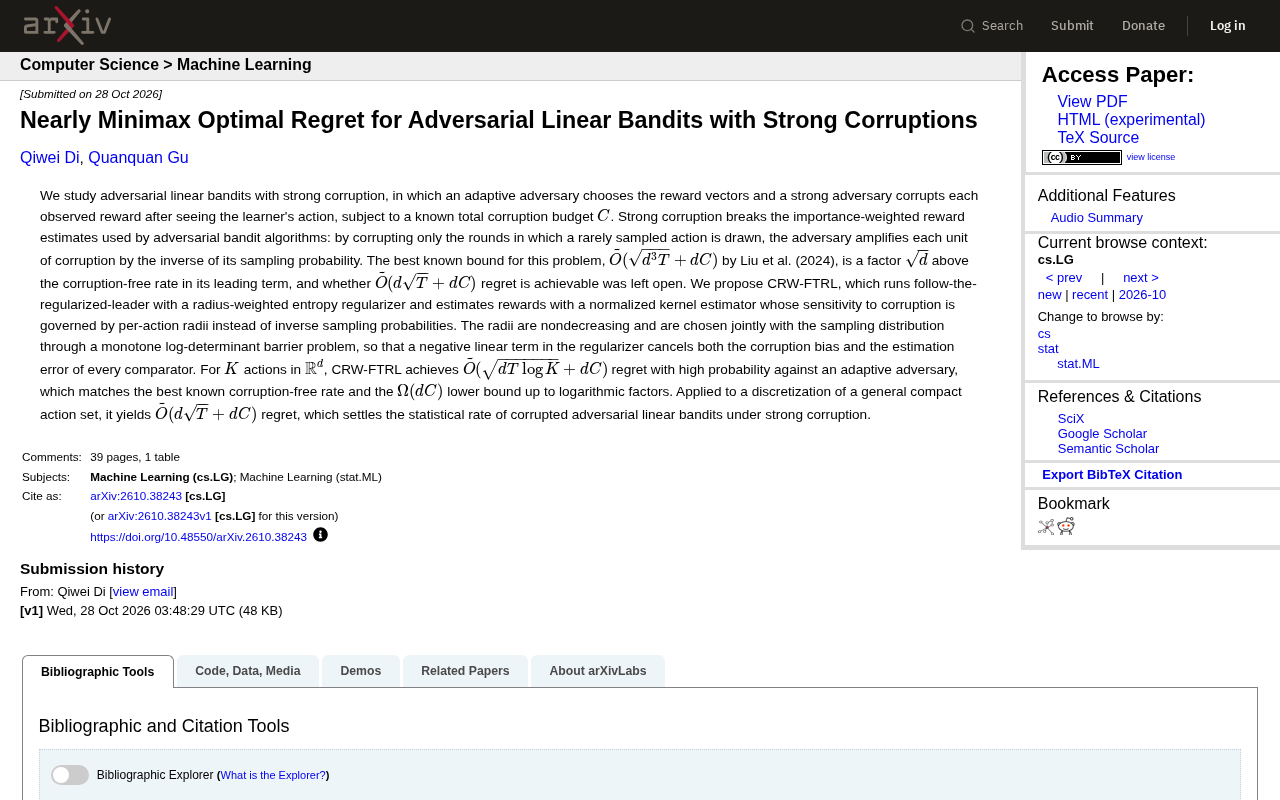
Strong-Corruption Adversarial Linear Bandits: CRW-FTRL Achieves Near-Minimax Optimal Regret
Explaining the new CRW-FTRL algorithm for strongly corrupted adversarial linear bandits: it uses radius-weighted entropy regularization and a normalized kernel estimator to raise the regret upper bound to Õ(√(dT log K)+dC), matching the corruption-free optimal rate and the Ω(dC) lower bound, resolving the open problem left by Liu et al.

Putting Global Law into Git with Claude: The Ambition of Semantic Versioning
Explore an open-source project using Claude to turn global laws into Git repos: multi-agent collaboration downloads legal versions, reconstructs history by effective date, and enables semantic, queryable law. Analysis of implementation, challenges, and AI agent workflow insights.

ParaTTT: Parallelizing Test-Time Training Layers for Deep Memory
ParaTTT parallelizes deep nonlinear memory in test-time training layers via iterative refinement of gradient trajectories, achieving chunk parallelism, significantly faster training, and performance on par with linear recurrences and Transformers.

Transferable Offline Reinforcement Learning: Tackling Unmeasured Confounding and Domain Shift
This article interprets a new transferable offline RL framework that jointly handles domain shift and unmeasured confounding, leveraging multi-source heterogeneous data to identify target-domain causal quantities, proposing CAT-CCB and CAT-CMDP algorithms with finite-sample theoretical guarantees.

A New Approach to Offline RL: How Variational Consequence-Driven Constraints Solve Dynamic Shift
A new offline RL paper proposes Structured Behavior Regularization (StBR), using latent space divergence instead of action distribution constraints to solve dynamic shift, achieving superior performance on diverse benchmarks.

The Endgame of FSDP Communication: TIDE Zero-Copy Collective Communication Optimization
TIDE zero-copy collective communication optimizes FSDP2 layout conversion overhead, reducing step time by up to 27.1% on models like Llama-3.1 70B, cutting SM time by 12.5-14.5x, and significantly lowering communication-computation interference.

HotPOT: How Heterogeneous Physics Experts Solve the PDE Pretraining Interference Problem
HotPOT introduces heterogeneous physics experts with a shared encoder plus neural-numerical experts to overcome cross-task interference in PDE pretraining, beating MoE-POT in all 24 comparisons with 50.7% lower rollout error on average.

Skeleton Coding: Taming AI Coding Agents with Program Structure
Skeleton Coding lets developers and AI agents jointly specify program structure, theoretically reducing required tests exponentially, cutting average test error by 48.4%, narrowing model gaps, and lowering costs.

Evaluation Pitfalls in Machine Learning Rainfall Prediction: Climate Baselines Are Hard to Beat
A study of 35 weather stations in Bangladesh reveals that machine learning rainfall prediction often overestimates performance due to random splitting. Climatology baselines are hard to beat under temporal evaluation, and lagged rainfall features provide only limited skill. Researchers call for leakage-aware protocols.

Averaged Annealed Markov Chains Achieve the Algorithmic Threshold for Tensor PCA
New research proves that spherical Langevin dynamics with annealing and ergodic averaging can reach the Tensor PCA algorithmic threshold from random initialization in polynomial time, overturning the traditional view that local algorithms are inferior to global ones.

How Do Diffusion Models Reduce Scanning Redundancy in Ptychography? An Analysis of the PCPS Method
This article interprets the paper Progressive Coupling Method for Diffusion Posterior Sampling in Ptychography, explaining how PCPS uses diffusion model priors to reduce scanning redundancy in ptychography, improve reconstruction accuracy under low-overlap conditions, and analyzes its comparison experiments with traditional iterative methods and existing diffusion posterior samplers.

Keepace.ai: A Technical Analysis of a Fine-Tuned LLM Specialized in Sports & Health
Keepace.ai is a sports & health domain LLM post-trained on Qwen3.5-27B, focused on Chinese training plan generation, knowledge Q&A, and exercise data analysis. This article analyzes its technical approach, safety-first evaluation framework, and optimization results across three task types.

3DCodeEdit Benchmark: Instruction-Driven 3D Program Editing, Best Model Success Rate Below 60%
3DCodeEdit benchmark contains 2,592 instruction-guided 3D program editing tasks across 108 Blender programs. 17 models average only 37% success; best models under 60% on structural edits. Multi-turn feedback significantly improves performance, with a 27B model surpassing a 2.8T model using critic feedback.

EasyProver: How Recursive Agents Tackle Formal Verification of Real-World Code
EasyProver uses recursive agents, asynchronous search, and elastic elaboration to achieve formal verification in Lean, proving 669/672 problems on PutnamBench, and introduces Aegis, a benchmark for real Rust implementations, with a 52.7% pass rate on a 2,000-statement sample.

Kill Two Birds with One Stone: A Unified Skill-Augmented Generation Framework for Retrieval and Utilization
Skill-Uni is a unified reinforcement learning framework that jointly optimizes skill retrieval and utilization, achieving average performance gains of 66.59% and 34.82% over Qwen3-4B and LLaMA3.1-8B across five benchmarks, and is compatible with multiple retrieval engines.

Language Models Compute Correctly but Judge Incorrectly: Known Mechanical Limit Tests Reveal a Split Between Calculation and Rejection Decisions
A test covering 12 models and 4,860 calls found that language models can precisely calculate known mechanical limits and judge feasibility in isolation, yet accept designs beyond collapse or burst limits in full responses and report them as solved. The study recommends testing feasibility judgment separately from full-answer rejection.

Component Translation and Refusal Rates: A New Dimension in Multilingual Safety Evaluation
Study proposes component translation and paired reversal to evaluate multilingual LLM refusal rates. Main models show no significant component language effect, but Mistral Small 4 shows a significant Spanish swap effect.

Nemotron 3.5 Dual-Model Release: Hybrid Mamba-Transformer Architecture Speeds Up Agentic AI
NVIDIA releases Nemotron 3.5 Super and Lightning: 120B/12B-active multimodal and 30B/3B-active text models with hybrid Mamba-Transformer architecture, 51.78% on SWE-bench Pro, up to 4,856 tokens/s on a single GB200.