All articles
39597 articles

SAUCE: A New Reference-Free, Explainable Method for Dialogue Summarization Evaluation
SAUCE is a reference-free, fact-based evaluation method for cross-lingual dialogue speech summarization that measures accuracy and factual coverage via entailment between conversation and summary, localizes hallucinations and omissions, and shows high consistency with human judgment in preliminary studies.

LooM: Loop-Invariant Memory Makes Loop Transformer Inference Budget Adjustable
LooM proposes loop-invariant memory to solve three loop Transformer issues: memory growing with loops, coarse computation granularity, and hard-to-change loop counts. Looping only in CED decoder layers keeps the KV cache from growing with loops, supporting a continuous budget of 3 to 21 layer executions per token with a single model covering all budgets and no router.

LLMs Don't Know What They Know: The Temporal Boundary Dilemma in Financial Backtesting
FinDendro benchmark reveals LLM self-knowledge reports severely underestimate true knowledge: GPT-5 answers 76% correctly but claims to know only 38%. Vendor cutoff dates, model self-reports, and date instructions all fail to guarantee leak-free financial backtesting—behavioral measurement offers a new path to defining credible backtest windows.

FlowReconBench: Sparse-Sensor Flow Field Reconstruction — Are Learned Models or Classical Methods Stronger?
FlowReconBench benchmark evaluates ten learned and five classical methods for sparse-sensor flow reconstruction. Classical methods lead with low-order, dense sensing; learned methods win with sparse sensing and low observability. Calibration and cost metrics yield different rankings.

Measuring Risk, Not Harm: A New Framework for Detecting Psychological Harm Risk Factors in LLM Conversations
Researchers propose "measuring risk, not harm": operationalizing LLM psychological harm risk as eight observable AI behaviors, building a synthetic multi-label corpus of 47K+ responses, and comparing embedding classifiers, LLM judging, and a cascade achieving F1 0.79 with 97.1% fewer judge calls.

Reinforcement Learning Unlocks Multi-Task Self-Evolution for Generalist Robot Policies
New research shows reinforcement learning enables multi-task self-improvement of generalist robot policies during deployment, with value-based RL and training task distribution as key factors, even generalizing to untrained tasks.

Where Is Mbed TLS Maintenance Heading? Community Discussion Draws Attention
Hacker News discusses the future maintenance of Mbed TLS. This article analyzes the potential impact of changes to this lightweight TLS library's maintenance arrangements on embedded and IoT projects, and offers advice for dependents on tracking and response.

Why Do Faithfulness Evaluation Criteria Disagree? A New Framework Offers a Navigation Path
The paper proposes a faithfulness functional framework that locates disagreement among faithfulness evaluation criteria in three dimensions—claims, comparisons, and aggregation—and uses adverse action notices to show how institutional context narrows operationalization choices, offering auditors a path to navigate conflicting evaluations.

Visual Token Routing: Letting Computer-Use Agents Process Only Key Visual Information
Visual Token Routing (VTR) jointly trains a lightweight spatiotemporal router so computer-use agents keep only essential visual tokens. With 2000 training steps, it matches full-resolution models on OSWorld, reduces visual tokens 2.5-5.8x, cuts inference cost 3.3x, and speeds up prefill 2.9x.

AMM: Budget-Aware Optimizer Routing via Online Probes
AMM uses online probes to measure curvature, separability, basins, and other terrain features, dynamically routing quasi-Newton, trust-region, coordinate, multi-start, and evolutionary strategy engines under a known budget. It holds the highest objective share in 382 of 600 held-out bbob cells, loses its lead on rotationally separable functions, and has lower anytime area than IPOP-CMA-ES on MA-BBOB.

Predicting Grain Growth with Time Series: Thermal-Conditioned Model Breaks Through Non-Isothermal Scenarios
A new study proposes a thermal-conditioned time-series prediction framework that encodes grain size distributions with a CNN, embeds thermal information via an MLP, and predicts evolution with an RNN, achieving second-level grain growth trajectory prediction under non-isothermal conditions with k-fold cross-validation R² above 0.99.

Go Releases a Brand-New JSON API: The Changes Brought by jsonv2
Go's official blog releases a new JSON API (jsonv2), sparking heated discussion on Hacker News. This article covers the new API's design philosophy, performance and compatibility trade-offs, community reaction, and impact on developers.

Google Introduces Agile Deliberation Framework to Tackle Subjective Image Classification
Google Research releases the Agile Deliberation human-AI framework, letting users define subjective visual concepts via borderline images; it lifts Gemini classifier F1 by 10.5 points over zero-shot in 18 sessions—ideal for gray-area image classification like content moderation and design review.

When LLMs Become Neurons: Replacing Neural Network Nodes with Reasoning Models
Reddit's LLM-as-a-Neuron idea: replacing individual neurons with reasoning models. This article analyzes the fundamental obstacles in scale and training, and explores a pragmatic path for LLMs as network modules.

OpenAI Turns to Linux Kernel Security as Kimi K3.1 Pro and Ripple-65B Break Through with Open Source
This issue's AINews covers OpenAI's Linux kernel security work, Kimi K3.1 Pro's open weights, and Ricursive Ripple-65B's open-source release, analyzing how AI competition is extending from applications to infrastructure and open ecosystems.

A Funny Screenshot Story from Qwen Model: AI Self-Awareness and Tool-Calling Reflections
A viral Reddit screenshot of Qwen's thought process: Qwen3.8-27B demonstrates self-awareness, tool calling, and multimodal boundaries, revealing how LLMs use external tools to overcome text limits.

A Hardcore Fighter Jet Simulator in the Browser: An Indie Developer's AI-Powered Hit
An indie developer built a hyper-realistic browser fighter jet simulator with Claude Opus 5.5 and fal models, drawing 25K players in two weeks and a threejs.org homepage feature. Discover the AI agent parallel workflow and cockpit detail polish.
OpenAI Releases GPT-Image-2.6: Flare and Sunburst Dual Models Generate GIF/SVG in 6 Seconds
OpenAI releases Images 2.6 and GPT-Image-2.6 Flare and Sunburst API models. Flare generates images in as fast as 6 seconds, adds GIF output, SVG export, markup edits, and a complexity parameter for design pipelines and real-time interaction.

Together AI Launches Together Compiler: Agent-Driven Inference Acceleration Up to 2.6x
Together AI releases Together Compiler, an agent-driven continuous compilation loop that optimizes inference forward passes as traffic shifts, achieving up to 2.6x TPS versus the best InferenceX configuration on a single model in under 24 hours.
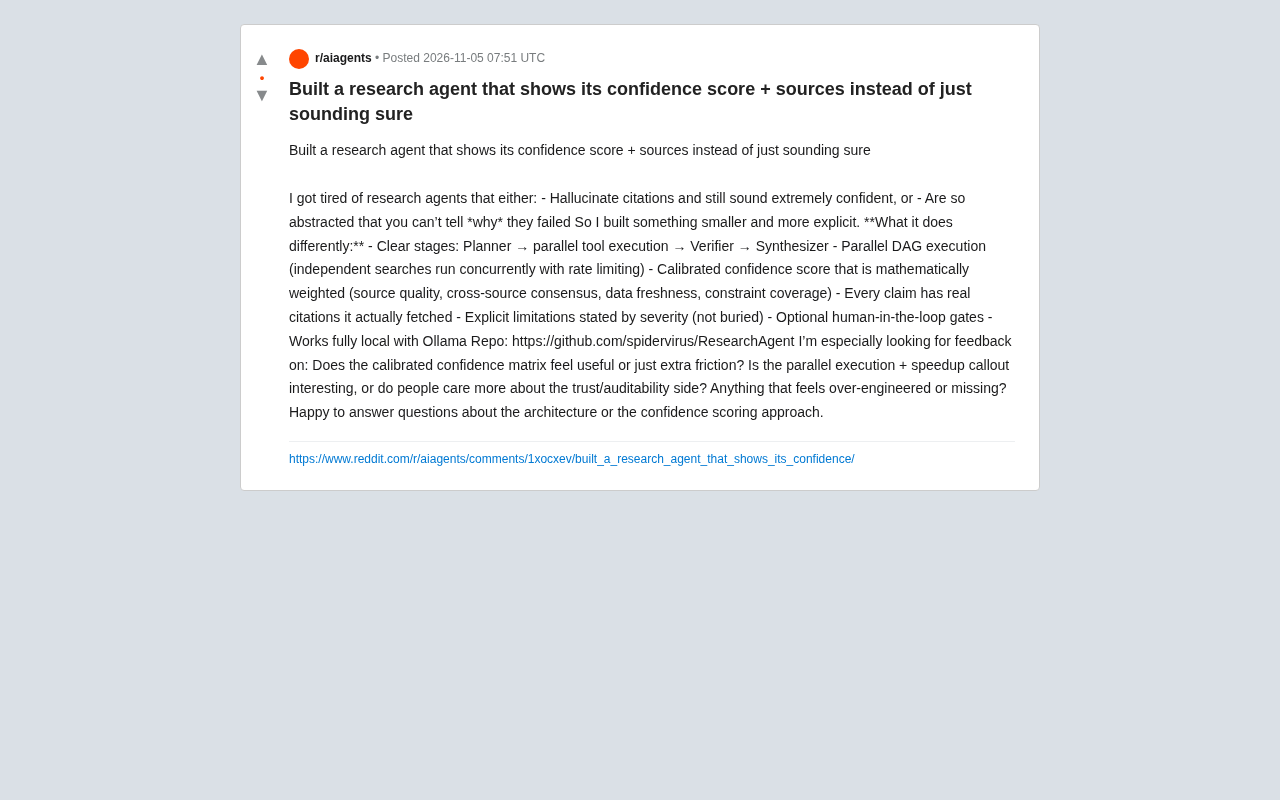
Open-Source Research Agent: Attaching Confidence Scores and Real Sources to Every Conclusion
An open-source research Agent with a four-stage Planner, parallel execution, Verifier, and Synthesizer architecture that attaches mathematically weighted confidence scores and real retrieved citations to every conclusion, with Ollama local support and human-in-the-loop checkpoints.