#大语言模型
305 related articles

Human vs. LLM-Simulated Clients: Comparing Dialogue Patterns in Online Counseling Training
A study compares dialogue patterns of human role-players versus Mixtral 8x7b simulated clients in online counseling training, analyzing at the sentence level whether LLMs can reproduce real conversational dynamics and how counselors' communication differs with humans versus AI, exploring the potential and limits of LLM role-play training.

H²R: Boosting Mathematical Reasoning with Hierarchical Hint Rewards
The paper proposes the H²R framework, using the sub-problem structure inherent in math problems as hierarchical hint rewards to provide intermediate supervision for RLVR training, and releases the HiMath hierarchical math benchmark. Experiments show hierarchical hints consistently improve mathematical reasoning across multiple LLMs, with amplified gains when integrated into RL training.

How Can Large Language Models Crack the Code of Medical Exam Question Difficulty?
A study uses empirical difficulty labels from USMLE and PANCE questions to guide LLMs in inducing medical question difficulty rules, revealing cue convergence and misleading cues as key—but rule guidance does not reliably improve ranking accuracy.

Fusing Heterogeneous Echocardiography AI Outputs in Language Space with Supervised LLMs
A study proposes using a supervised LLM for late fusion in language space, directly aggregating predictions from multi-view echocardiography AI models without model-specific conversion or medical feature engineering, performing comparably to the best reference strategy in cross-validation on 859 studies from 646 patients.

How ChatGPT and AI Agents Actually Work: A No-Math Breakdown of the Core Mechanics
A no-math breakdown of how ChatGPT and AI Agents actually work: from tokenization, neural network weights, and attention to word-by-word generation and the Agent tool loop. Includes three practical principles for using AI at work to help you understand why models make mistakes, why long conversations fail, and why Agents need strict authorization.

From DQI to C-DQI: Using LLMs to Auto-Generate Codebooks for Evaluating Parliamentary Discourse Quality
Research proposes a complete protocol from DQI to C-DQI, using LLMs to auto-generate and evaluate parliamentary discourse quality codebooks, comparing theory-driven and data-driven approaches; data-driven coding shows better inter-model agreement.

FisherEdit: A New Breakthrough in LLM Knowledge Editing via Fisher Information Geometry
FisherEdit proposes a knowledge editing method based on Fisher information geometry, replacing null-space projection with parameter-space importance regularization to achieve SOTA editing performance on Llama-3, Qwen2.5, and other models while maintaining model stability.

How Does an LLM Predict the Next Token? Breaking Down How Large Models Generate Text
How do large language models predict the next token? This article breaks down token definitions, next-token probability prediction, Transformer training, temperature sampling strategies, and uses a Python word-frequency example to explain the essence and limits of the generation mechanism.

How Can We Make System 1 LLMs Exhibit System 2 Capabilities?
Exploring how to make System 1 LLMs exhibit System 2 reasoning—analyzing chain-of-thought, inference-time compute, self-consistency sampling, and the core debate over whether capabilities can be induced.

LLM Test-Time Ensembling: A New Theory of Two Sample Sizes and Weighted Ensembling
A theory reveals the two-sample-size trade-off between labeled questions Q and generations N in LLM test-time weighted ensembling, proving buffered ERM achieves Q^{-1/2}+N^{-β/2} excess risk and identifying three learning regimes and an N^{-β} identification floor.

Oracle-Guided Fine-Tuning: Teaching Generative ASR Post-Editing to Select and Rewrite
A new study proposes Oracle-guided fine-tuning that converts N-best lists into three-pool supervision signals, training generative ASR post-editing models to select or rewrite and reduce over-editing and hallucinations, while revealing pre-training overlap issues in public datasets.

Don't Rush to Generate: Teach Your Model to Read the Room First
New research proposes Scenario-Actor: extracting scenario embeddings from Transformer hidden states to dynamically set LLM sampling temperature, with gains on Llama-3.1-8B-Instruct.
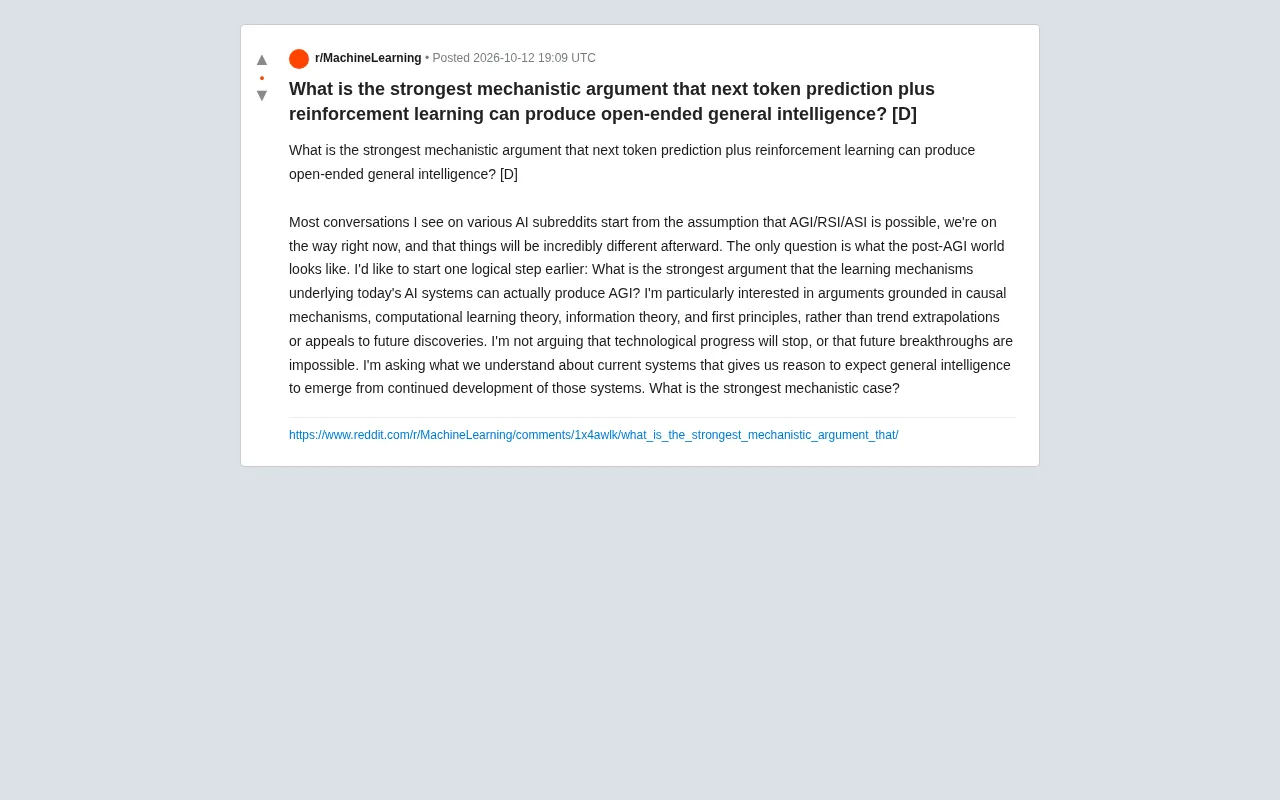
Can Next-Token Prediction Plus Reinforcement Learning Lead to General Intelligence?
Can next-token prediction plus reinforcement learning lead to AGI? This article reviews Reddit discussion and computational learning theory to analyze the strongest mechanistic argument for NTP+RL on the path to AGI and its gaps in goal generation, embodied interaction, and continual learning.

US Nuclear Power Fully Embraces AI: How 94 Reactors Use Large Models to Manage Documents
Nearly all 94 US nuclear reactors have adopted AI, with Atomic Canyon's NIVA and Nuclearn starting from document retrieval. This article analyzes the dual drivers, data silo challenges, and why humans still firmly control operational decisions.

A Practical Guide to Choosing Local LLMs: Stop Obsessing Over Parameters and Leaderboards
How to choose a local LLM for your hardware: a 6-step framework covering task requirements, memory budgeting, quantization trade-offs, context limits, licensing, and reproducible testing.

Model-Level RSI: What It Really Means When AI Starts Improving Its Own Weights
Model-level RSI (Recursive Self-Improvement) means improving model weights without human labels. Learn the 5 stages of self-improvement, 3 rules to avoid self-deception, and how to read leaderboard scores honestly.

Training a Language Model from Scratch on a 4GB GPU: The Failures Are Worth More Than the Success
A developer trained a 22M-parameter LLM from scratch on a 4GB GTX 1650, surviving CUDA crashes, generation loops, and Fibonacci failures. A full breakdown of the workflow, lessons, and why the failures matter most.

LLM Recruiting Benchmark: Who's Really Deciding Your Resume's Fate?
FairScreen tested 10 LLMs on AI resume screening, finding that model config, fact extraction, and output handling matter far more than model reputation. Qwen3 jumped from 39% to 98% with thinking enabled; code replay improved accuracy by 20.5 points on average.
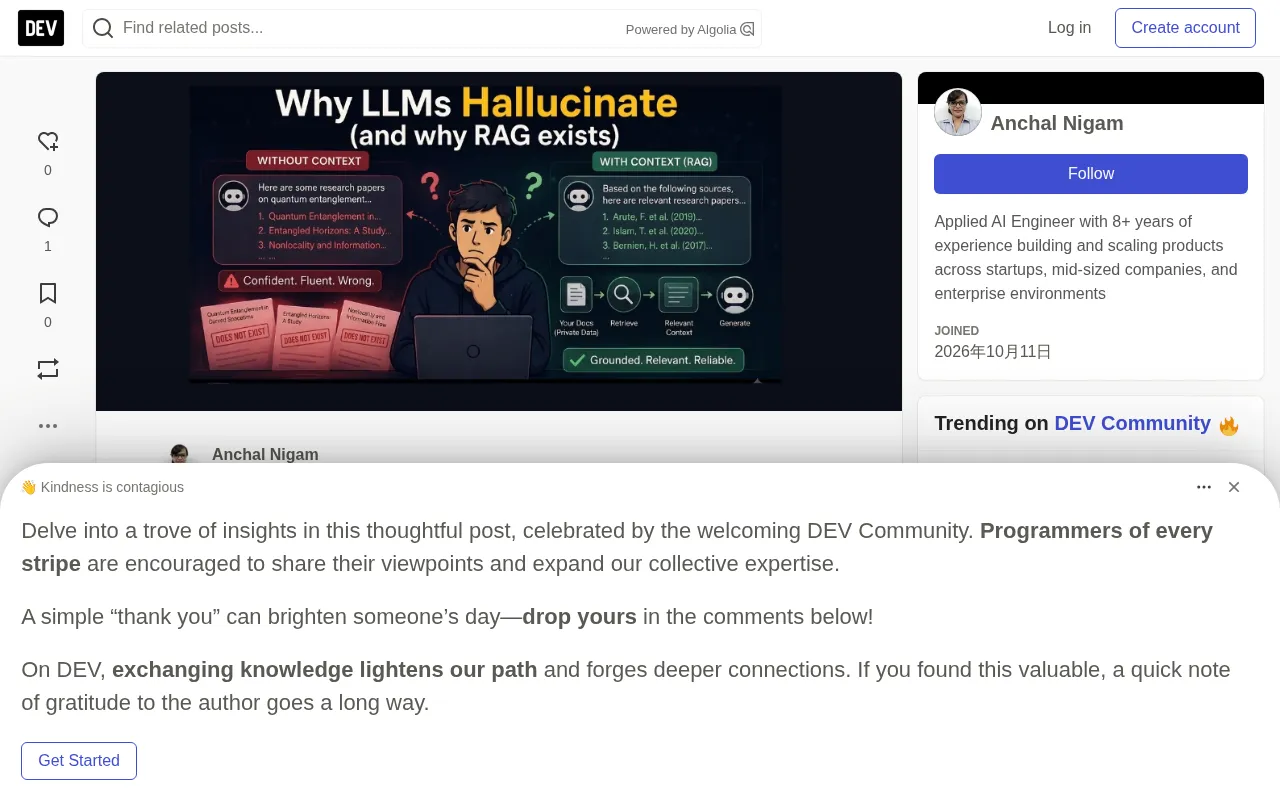
Why Do LLMs Hallucinate? Understanding the Fundamental Reason RAG Exists
Why do LLMs hallucinate? This article explains the root cause — token prediction without fact verification — and how RAG solves it by grounding generation in real context.

7 Free LLM APIs Tested: No Credit Card Required
Tested 7 free LLM APIs including Hugging Face, Ollama, Groq, and Gemini — no credit card required. Includes Python code samples, throughput benchmarks, and tips to avoid silent quota exhaustion.