#隐私保护
96 related articles

PFR: A New Paradigm for Scaling Differential Privacy Noise to Typical Sensitivity
Differential privacy noise is often held hostage by worst-case records. Propose-Filter-Release (PFR) upgrades mechanisms that protect typical record additions/deletions into a general differential privacy primitive through a private filtering step, supporting scenarios such as scalar statistics, principal component subspaces, graph effective resistance, and treatment rule selection.

Diffusion Model Membership Inference: A New Approach to Difficulty Calibration Along the Time Dimension
New membership inference method for diffusion models: calibrating image difficulty along training and diffusion time axes, with RMC and TSC outperforming state-of-the-art and generalizing across parameterizations.

41,000 DHS Employee Records Leaked, Including Undercover ICE Agents
Data breach exposes 41,000 DHS employees, including undercover ICE agents. Analysis of sensitive data risks, law enforcement security gaps, and protection measures like access control and auditing.

bytemail: The Privacy-Focused Email Client That Puts Your Inbox in the MacBook Notch
bytemail is a natively Swift-built Mac email client supporting any IMAP account like Gmail, iCloud, and Outlook. It shows new mail and verification codes in the MacBook notch, blocks tracking pixels, promises emails never pass through its own servers, and includes a built-in MCP server for AI apps like Claude.

Opera Launches WebAI: Browser-Local AI Opened Up for Websites to Call
Opera launches WebAI on Product Hunt, letting websites call local AI models running on users' computers without third-party extensions, emphasizing privacy and developer-built browser capabilities.

Off Grid AI: Private AI on Your Phone and Computer, Works Offline, Open Source and Free
Off Grid AI is an open-source, free local AI app for iOS, Android, macOS, Windows, and Linux. It lets you chat, read documents, and generate images offline with no account, plus meeting transcription and device-to-device collaboration, all with a focus on privacy.

Information-Theoretic Secure Aggregation: A New Privacy Solution for Federated Learning under Heterogeneous Quantization
An information-theoretic secure aggregation scheme tackles privacy leakage from heterogeneous client quantization in federated learning, tolerating dropouts and collusion via threshold secret sharing.

Reversible Pseudonymisation for External LLM Documents: An Open-Source Bilingual Benchmark and Engine
An open-source bilingual benchmark evaluates five reversible pseudonymisation tools; the best leaks full values in 61% of Russian and 58% of British English documents. A new engine cuts leakage to 0.3% and 0.2%, but Russian name restoration is only 94.6%.

New Framework for Nonlinear Concept Erasure: Conditional Autoencoder Enables Precise Erasure and Steering
This paper proposes a conditional autoencoder framework that provides formal guarantees for nonlinear concept erasure, achieving a better utility-erasure trade-off without target-task labels and unlocking representation steering with faster convergence.

River Writer: A Quiet, Anti-Cloud Writing Tool for the Mac
River Writer is a free, open-source Mac writing app for screenplays, stage plays, and novels—plain text with live preview, built-in Git, no account, no cloud, no AI, no network.

Gerty: An Auto-Configuring Private ChatGPT Alternative and Offline AI Assistant for Mac
Gerty is a private AI assistant that runs entirely locally on Mac, auto-detects hardware and configures the best open-source models, and supports chat, writing, code, and image tasks with no account required, offline use, and a one-time 49 CHF fee.

Differentially Private Sparse Reward Estimation: A New Breakthrough in RLHF Privacy Protection
New RLHF privacy research proposes a differentially private sparse reward estimation framework, achieving a better privacy-utility trade-off under sparsity assumptions, with theoretical error bounds significantly outperforming dense methods, validated on sentiment generation and safety alignment tasks.

ChatGPT Chat Lock Feature Launches: A New Move for Privacy Protection
ChatGPT launches Chat Lock, letting users lock sensitive conversations to prevent privacy leaks when lending devices. This article analyzes use cases, protection boundaries, and the industry trend toward layered privacy design in AI assistants.

Umbra Mail: The Open-Source Plugin That Turns Gmail Into Chat Threads
Umbra Mail is an open-source Chrome extension that turns Gmail into chat threads, aggregates newsletters, and offers no tracking, no servers, and optional AI for a calmer, more private email experience.

Teaching Code Agents to Ask Questions Without Leaking Private Code
Research proposes Utility-Verified Abstraction (UVA) to train local code agents to describe private entities by role and type when querying cloud models, avoiding source code leakage. Experiments show problem resolution rate rises from 25.3% to 37.6%, with 3.7x less private entity disclosure.
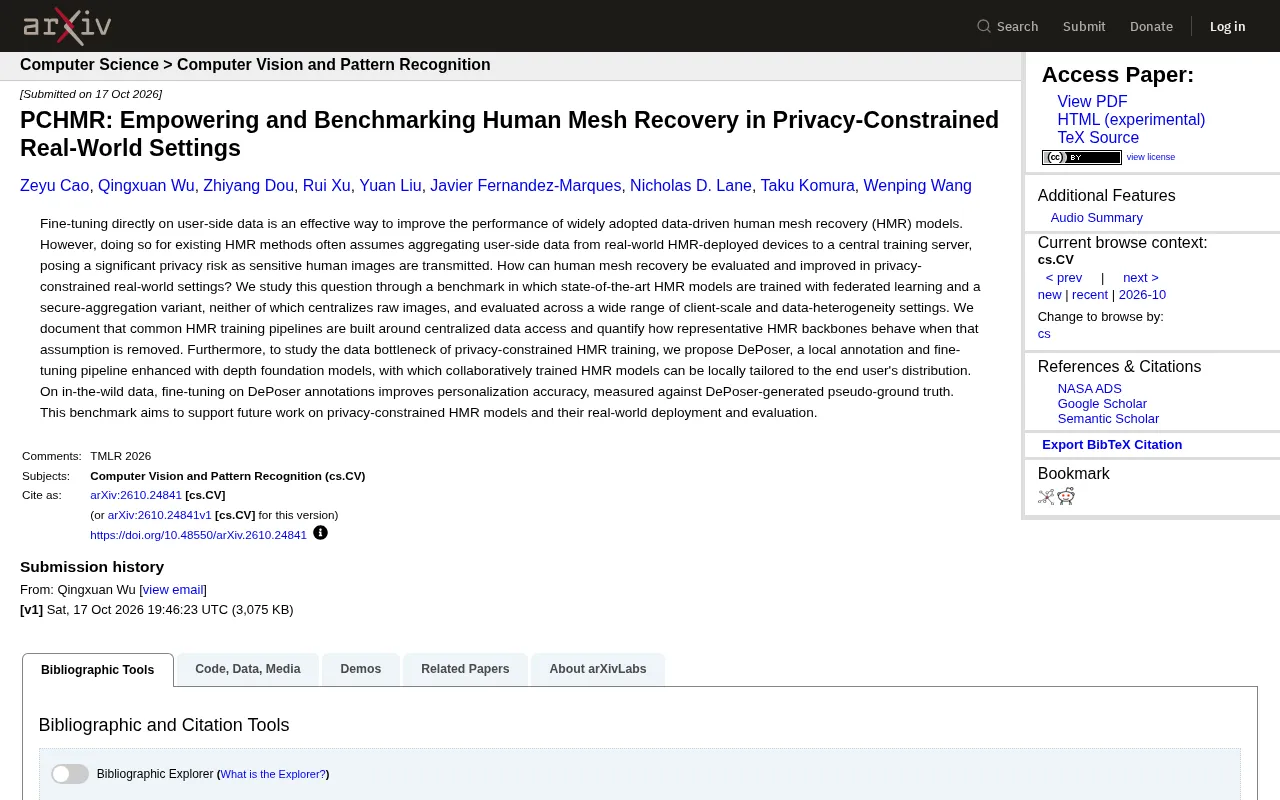
PCHMR Benchmark: Federated Learning for Human Mesh Recovery Under Privacy Constraints
PCHMR benchmark trains human mesh recovery (HMR) models with federated learning and secure aggregation, evaluating performance degradation without centralizing raw images, and proposes the DePoser local annotation and fine-tuning pipeline to improve personalized accuracy.

Tested: The $99 Car OBD Plugin That Tracks Location and Offers Emergency Rescue, Promising Not to Sell Data
Hands-on test of the $99 Miles Plug car OBD plugin: location tracking, teen driving habit monitoring, automatic crash assistance, and a promise not to sell user data. We analyze its features, privacy trade-offs, and buying advice.

Kernel Stein Method Provides Task-Aware Certificates for Rényi Differential Privacy
This paper introduces a Rényi differential privacy certificate method based on Kernel Stein Discrepancy, using escort distributions and task-aware kernel design to provide exact or bounded privacy guarantees for Gaussian, Laplacian, and exponential mechanisms, validated on real data.

ScopeGuard: A Local-First Open Source AI Tool That Takes Aim at Freelancer Scope Creep
ScopeGuard is a local-first open source AI tool that helps freelancers detect client scope creep, cite contract clauses, and generate boundary-setting replies and change order quotations—all running locally to protect NDA privacy.

SoloBooks AI: How a Local-First Financial Assistant Solves Freelancers' Privacy Pain Points
SoloBooks AI is a local-first financial assistant for freelancers using Ollama, Tesseract.js OCR, and SQLite for private, zero-API-cost invoice extraction and deterministic bookkeeping.