#Agent开发
127 related articles

Write Functions First, Then Use Frameworks: Best Practices for AI Agent Development
Start building AI Agents with plain functions, and decide whether to introduce a framework based on real pain points. Drawing on LlamaIndex founder Jerry Liu's views, it offers criteria and comparison methods across structured output, debuggability, and state management.

Agent Context Engineering: Caching, Compaction, and Subagent in Practice
Explore five core context engineering strategies for AI Agents: Prompt Caching, Compaction, Tool-result Clearing, Retrieval, and Subagents, with practical Anthropic and OpenAI API parameters and trade-off analysis.

Claude Agent SDK New Features Explained: Subagents, Skills, and Permissions
Claude Agent SDK 2026 update explained: nested subagent caps, SessionStore persistence, skills and plugin layering, structured output, tighter permission defaults, and a path from a minimum viable agent.

Claude Agent SDK in Practice: Building a Log-Debugged AI Agent from Scratch
Based on a hands-on Bilibili tutorial, this guide covers Claude Agent SDK setup, tool invocation, and stop reasons, plus wrapping a log parser library and reverse-debugging AI Agent behavior with logs, with reusable practical advice.

LangChain in Practice: A Complete Path to Building a Production-Ready Agent from Scratch
Based on a Bilibili hands-on video, this article systematically covers building a production-ready Agent from scratch with LangChain: model integration, system prompts, tools and internet search, short-term and long-term memory, RAG knowledge base, FastAPI service exposure, and the key pitfall of memory persistence in multi-worker deployments.

10 Rounds of Prompts + 8 Skills: DeepSeek Harness Industrial-Grade Knowledge Base in Action
DeepSeek Harness practical tutorial: Build an industrial-grade LMWiki knowledge base from scratch with just 10 rounds of prompts, 8 Skills, and Agent presets — complete workflow analysis included.

Learning Agent Development from Scratch: Breaking Down Bilibili's 100-Episode Course
Breaking down Bilibili's 100-episode AI Agent development course: from core concepts and the ReAct paradigm to multi-agent collaboration, analyzing its structure, differentiated positioning, and target audience.

Full-Stack Agent Development Learning Roadmap: Three Stages from Beginner to Production
A practical three-stage Agent full-stack learning roadmap: Python fundamentals, LLM theory and hands-on practice, and mainstream framework projects—plus the core stability challenges of production Agent deployment.

AI Agent Development Engineer: A Complete Learning Path for Career Switchers with Zero Foundation
Agent development engineers are becoming a scarce role in AI implementation. This article analyzes the core skills required and provides a three-month zero-foundation learning path covering framework selection, tool calling, and business decomposition.

Is AI Agent Development Forgetting Software Engineering Fundamentals?
Reddit debate: AI Agent developers are forgetting software engineering fundamentals like input validation, data modeling, and access control. Why engineering skills are the prerequisite for working with AI.

A Complete Breakdown of the Agent Development Learning Path: From Theory to Enterprise-Level Practice
Agent development is now a core competitiveness in the LLM field. This article breaks down a four-stage learning path: from foundational Agent components and theory, to classic paradigms like ReAct and CoT, to optimization through reinforcement learning and multi-agent collaboration, and finally to real-world deployment through enterprise-level projects. Suitable for zero-foundation learners who want to systematically learn Agent development.
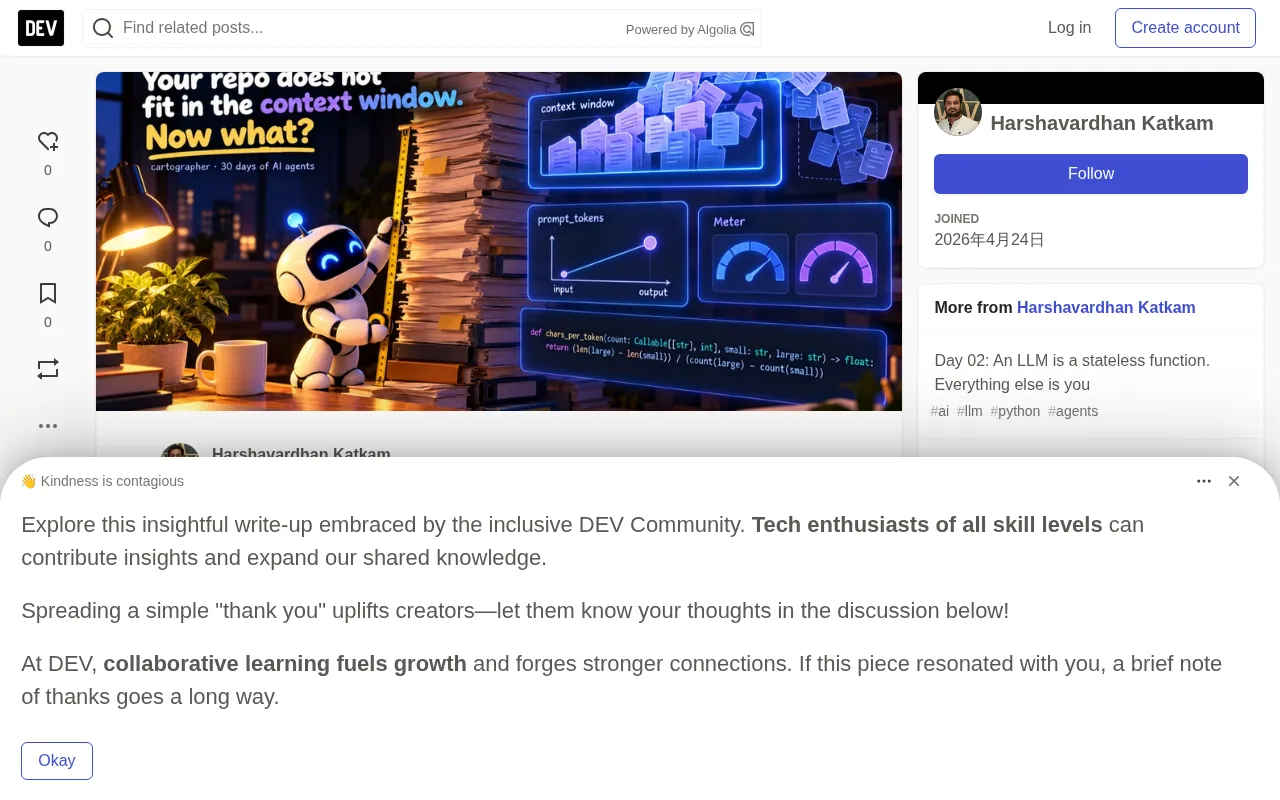
Your Repo Doesn't Fit in the Context Window? Measure Tokens Before You Design
How to fit a repo into the context window in AI agent development: Day 03 of cartographer covers char-to-token ratios, calibrating via two API calls and subtraction, separate input/output billing, and three paths to make repos fit.

The Most Complete Agent App Development Roadmap on Bilibili: Five Steps from Zero to Engineering-Grade
A five-stage roadmap distilled from Bilibili's 748-episode Agent tutorial: math, deep learning, Transformer, the three pillars of LLM engineering, and Agent practice, plus RAG vs. fine-tuning and common learning pitfalls.

Self-Taught AI Agent Development in Four Steps: From Zero to Landing an R&D Job Offer
A Bilibili creator shares a four-step AI Agent learning path: build foundations, use ReAct to understand the Agent loop, add memory and tools, then tackle multi-agent projects—job-ready in three months.

Zep v4 Launches: Making AI Agents Truly Fluent in Graph Navigation
Zep v4 makes graph navigation a first-class tool for AI Agents: list neighbors, find hubs by degree, and pull bounded subgraphs in one call—with boundary awareness. This article breaks down its SDK and MCP Server rollout.
LangGraph in Practice: Building Stateful Multi-Step AI Agents
LangGraph in Practice: a deep dive into building stateful multi-step AI agents with graph orchestration—covering State/Node/Edge concepts, ReAct agents, memory persistence, Human-in-the-Loop approval, multi-agent collaboration, and a production readiness checklist.

Claude Agent SDK in 90 Seconds: From Hello World to Automatic Bug Fixing
Build an AI Agent with Claude Agent SDK in just two setup steps. This guide covers everything from Hello World to automatically finding and fixing bugs in code.

Build Your First AI Agent from Scratch: Using MCP to Break the LLM Knowledge Cutoff
A hands-on guide to building your first AI Agent using MCP and FastMCP, with a live stock price example covering JSON-RPC, stdio vs HTTP transport, tools, resources, and security guardrails.

Java or Python for AI App Development? The Answer Is: You Need Both
Java or Python for AI development? This article breaks down how Java handles high-concurrency core business logic while Python powers AI Agent modules, and how they communicate via RESTful APIs, MQ, and microservice gateways.

OpenAI Agents Python SDK v0.23.1 Released: Patch Update and Release Pipeline Fixes Explained
OpenAI Agents Python SDK v0.23.1 fixes release tests and readiness checks. As the first 0.23.x PyPI release, upgraders from 0.22.3 must also handle all 0.23.0 behavioral changes.