Cursor vs Codex In-Depth Comparison: Where Should You Spend Your $200?
A real-world comparison of Cursor and Codex to help you decide where to invest your $200 AI coding budget.
This article provides a hands-on comparison of Cursor and Codex, two leading AI programming tools. Cursor excels as a traditional IDE with precise code control and VS Code ecosystem integration, while Codex stands out as a super Agent capable of deployment, debugging, and long-task automation. The verdict: if you can only pick one, Codex delivers a more transformative experience for engineering workflows.
Introduction: Tools Are Just the Entry Point — Thinking Is What Matters
In the world of AI programming (Vibe Coding), choosing the right IDE matters, but it's not the deciding factor. What truly matters comes down to two things: whether the model is capable enough, and whether you have the ability to harness AI effectively.
Vibe Coding is a concept proposed by OpenAI co-founder Andrej Karpathy in early 2025. It refers to a programming approach where developers describe their requirements in natural language and let AI handle most or even all of the code writing. Unlike traditional programming, Vibe Coding emphasizes "if it feels right, it's good enough" — developers take on more of a product manager and quality reviewer role rather than writing code line by line. The popularity of this concept reflects a paradigm shift in AI programming tools from "assisted completion" to "autonomous generation."
The IDE determines how you collaborate with AI, model capability determines what AI can achieve, and your own thinking determines the final output quality. This article is based on extensive real-world experience with both Cursor and Codex, analyzing their strengths, weaknesses, and ideal use cases to help you make a smarter choice.


Cursor: A Mature First-Tier AI IDE
Product Positioning and Core Strengths
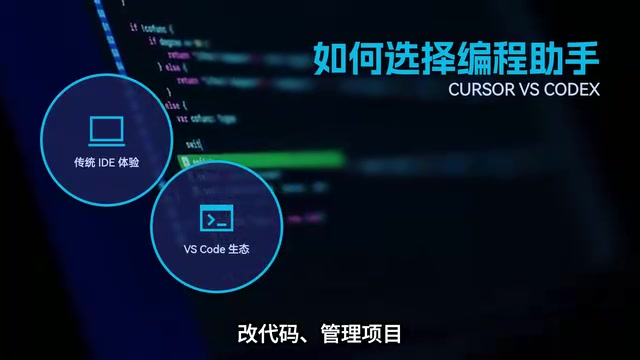
Cursor is one of the earliest products in the AI IDE space, built as a secondary development on top of VS Code, making it extremely developer-friendly. Think of it as a VS Code with deeply integrated AI capabilities.
The reason it's built on VS Code is that VS Code itself is Microsoft's open-source lightweight code editor with over 70,000 extensions, making it the most widely used editor among developers worldwide. This means Cursor inherits VS Code's massive plugin ecosystem, keyboard shortcut system, and workspace management capabilities — migration costs are extremely low. Your existing configurations, plugins, and themes can be transferred almost seamlessly, and developers don't need to relearn their workflow habits.
Cursor's core strength lies in its control capabilities as an IDE:
- Smooth editing experience with precise file navigation
- Strong context understanding that accurately grasps project structure
- Controllable scope of code modifications — won't cause cascading changes
- Stable in-project operations, suitable for continuous iteration
For professional programmers, AI-generated code isn't just about model output — it's about whether the AI can reliably understand project structure, modify the correct files, and control the scope of changes. Cursor excels at this.
Cursor's Shortcomings
However, Cursor has notable weaknesses. Its proprietary model experience isn't particularly stable — the early Composer 1.x performed reasonably well, and as long as plans were clearly defined, code output generally didn't have major issues. But after upgrading to 2.x, both coding ability and comprehension showed fluctuations, frequently producing confusing results.
That said, this doesn't affect Cursor's first-tier status, since the issues are more about the model than the IDE itself. Moreover, Cursor supports connecting to third-party models like GPT and Claude, offering high flexibility.
Cursor's Cost Considerations
If you rely entirely on Cursor for development and heavily use third-party premium models, costs aren't cheap. Based on real experience, a $200 quota used entirely for premium model calls will be exhausted in about two weeks.
However, if you make good use of Auto mode, it's perfectly sufficient for developing mini-programs, websites, standard admin panels, and other lightweight projects. Auto mode is Cursor's intelligent model scheduling mechanism — the system automatically selects the appropriate model based on the current task's complexity. Simple code completions use lightweight models (consuming less quota), while complex architectural design or multi-file refactoring calls premium models. This tiered scheduling strategy ensures smooth daily development while providing powerful reasoning capabilities at critical moments, effectively controlling API call costs.
Codex: The Super Agent Engineering Assistant
Product Positioning and Core Strengths
Describing Codex as "mind-blowing" is no exaggeration. Its greatest strength isn't the IDE itself, but the capabilities of the underlying model and its overall execution ability as an Agent tool.
Strictly speaking, Codex isn't like a traditional IDE — it's more like a super Agent app. In the AI field, an Agent refers to an AI system capable of autonomously perceiving its environment, formulating plans, executing actions, and adjusting strategies based on feedback. Unlike traditional "Q&A-style" AI, Agents can continuously execute multi-step tasks — they can invoke tools, access file systems, execute terminal commands, read execution results, and decide next steps accordingly. The core of this capability lies in the "act-observe-reflect" loop mechanism, transforming AI from passive response to active progression.
Codex's Agent capabilities mean it can not only generate code text but actually "get hands-on" with the computing environment:
- Operate environments, execute commands
- Read logs, run tests
- Start services, deploy projects
- Continuously advance long-running tasks when given sufficient permissions
This is the biggest difference between Codex and ordinary AI IDEs — it possesses genuine Agent capabilities.
Real-World Codex Use Cases
Here are several typical Codex usage scenarios:
Frontend UI Development: Writing code while simultaneously launching the page, adjusting designs, and continuing modifications based on runtime results. The entire workflow requires no manual window switching.
Hardware Project Development: Writing code while automatically flashing firmware, deploying, and opening log monitoring. When developing the Beatle project, before each version release, you can have it open QQ for testing, monitor logs, analyze issues, and modify code on its own.
Remote Service Deployment: Taking a Raspberry Pi deployment as an example, you only need to provide the LAN IP, password, and official documentation. Codex can then log in, configure the environment, install drivers, deploy the project, and set up auto-start on boot — all by itself. The entire process ran for three hours, during which it also redesigned some inadequate functional code.
Raspberry Pi is a credit-card-sized single-board computer widely used in IoT, edge computing, and embedded development scenarios. In this deployment scenario, Codex remotely logs into the Raspberry Pi via SSH, configures the Linux environment, installs hardware drivers, and sets up systemd auto-start services — spanning multiple technical domains including Linux system administration, network configuration, and driver compilation. Traditionally, these operations require solid Linux operations expertise, but AI Agent intervention significantly lowers this barrier.
Codex's Billing Model
Codex's billing works more like a package model, calculated based on a combination of quota, time windows, and usage volume. Heavy usage depletes quota faster, but for most regular users, a week's quota may not be fully consumed. After the 5-hour window is used up, it automatically recovers — essentially a forced rest mechanism.
Beyond Writing Code: More Possibilities for AI Engineering Assistants
Whether it's Cursor or Codex, their capabilities extend far beyond writing code. In daily use, they can also help you:
- Clean up your computer, analyze disk space
- Install software, configure development environments
- Run scripts, organize files
- Troubleshoot service issues
- Read READMEs, analyze deployment steps, install dependencies, fix errors
In today's world where open-source projects are everywhere, "open source" doesn't equal "ready to use out of the box." While open-source software has publicly available free code, there's often a huge gap between source code and a running service. A typical deployment process includes: installing runtime environments (like Node.js, Python), managing dependency version conflicts, configuring environment variables, handling OS differences, resolving compilation errors, and more. The Issues sections of countless GitHub projects are filled with "installation failed" help requests — this problem is known in the industry as the "works on my machine" dilemma. You often need to install dependencies, configure environments, and handle errors yourself. For non-programmers, these steps are extremely discouraging, but with an AI programming assistant that can read documentation, analyze error logs, and attempt fixes to bridge this gap, many things become much simpler.
Of course, the prerequisite is that you know what you want it to do, and you know which permissions to grant and which operations require caution. AI can execute for you, but it can't assess all risks on your behalf.
Recommendations: Where Should Your $200 Go?
Choose Cursor If:
- You value traditional IDE experience and precise code control
- You want to work within the familiar VS Code ecosystem
- Daily coding, quick completions, local refactoring
- Continuous iterative development of small-to-medium projects
Choose Codex If:
- You value Agent capabilities and automated execution
- You need AI to run commands, deploy services, and check logs
- Long-running tasks, complex environment configuration
- Hardware debugging, multi-step engineering projects
Final Recommendation
If you can only choose one, the $200 is better spent on Codex. The reason is simple: Cursor works great for writing ordinary projects, but if you want to truly experience AI as an engineering assistant — long-task execution, environment operations, log analysis, and automated progression — Codex delivers a far more impressive experience.
Final Thoughts: The Core Skill of Harnessing AI
Regardless of which tool you choose, don't assume that installing a tool equals mastering Vibe Coding. What truly determines whether you can effectively use AI programming tools comes down to four core abilities:
- Requirement articulation: Can you clearly communicate what you need?
- Task decomposition: Can you break complex tasks into executable steps?
- Architecture judgment: Can you assess whether the AI's proposed architecture is sound?
- Acceptance testing: Can you verify the quality of AI-generated code?
If you can't plan, AI will write chaotically; if you can't verify, AI will hide problems in your project; if you can't judge architecture, AI might make your project increasingly messy.
Model capability determines AI's upper limit. Your thinking ability determines whether you can actually reach that upper limit. This is the true core of AI programming.
Related articles

Claude Code for Test Development in Practice: An AI Programming Workflow That Doubles Your Efficiency
A practical guide to Claude Code for test development: auto-generating test scripts, Plan Mode workflows, MCP + Playwright integration, and Subagent parallel tasks to build systematic AI-assisted workflows.

Hermes Agent Hands-On Review: An AI Efficiency Revolution for Indie Game Developers
Indie game developer reviews Hermes Agent vs OpenClaude: intelligent context compression, real-time Memory, remote control via Telegram, and practical use cases in game dev, social media, and email.
Vibe Coding Beginner's Guide: Tool Selection Across Three Categories with Practical Examples
A comprehensive guide to Vibe Coding's three tool categories: Agent frameworks, CLI Coding, and IDE tools, with practical examples including Snake game and data analysis workbench.