Google AI Studio Mobile App Coming Soon: Full Vibe Coding Development Workflow on Your Phone
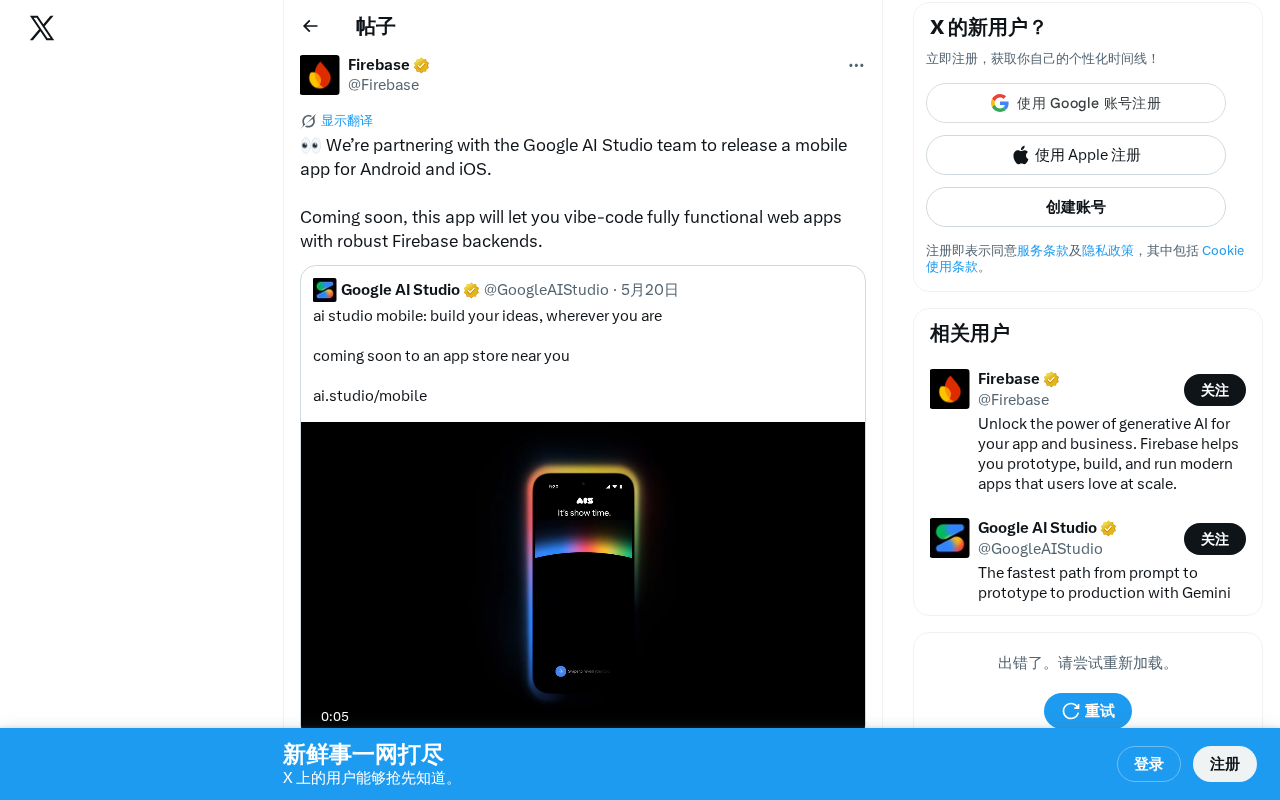
Google AI Studio mobile app brings Vibe Coding and Firebase-backed web app development to your phone.
Google AI Studio is launching mobile apps for Android and iOS that let users build complete web applications through Vibe Coding directly on their phones. With deep Firebase backend integration, the app enables end-to-end development from concept to deployment. This move extends AI-assisted programming to mobile, lowers development barriers, and positions Google strategically in the competitive AI coding landscape.
Google AI Studio Mobile App Is on the Way
The Google AI Studio team recently announced an exciting collaboration plan — a mobile application for both Android and iOS is coming soon. This app will allow users to build fully functional web applications directly on their phones through "Vibe Coding," backed by robust Firebase backend support.
While the announcement was brief, it was packed with significance. It marks the official expansion of AI-assisted programming from desktop to mobile, while also revealing Google's strategic vision for its AI development tool ecosystem.
What Is Vibe Coding? And Why Does It Fit Mobile?
"Vibe Coding" is a concept that recently emerged in the AI programming space, originally coined by Andrej Karpathy. Karpathy — former Tesla AI Director and co-founder of OpenAI — introduced the concept in early 2024, describing an entirely new paradigm for human-AI collaborative programming. The core idea: developers no longer need to write code line by line. Instead, they describe their requirements in natural language, letting the AI understand their "vibe" and automatically generate complete, runnable code.
In traditional programming, developers need precise mastery of syntax, API calls, and architecture design. In Vibe Coding mode, developers act more like "product directors" — describing feature requirements, interaction logic, and visual style in natural language, while large language models (LLMs) translate these high-level intentions into executable code. The rise of this concept is closely tied to the leaps in code generation capabilities from models like GPT-4, Gemini, and Claude — models that can not only generate syntactically correct code snippets but also understand context, handle multi-file project structures, and even auto-debug errors.
Bringing Vibe Coding to mobile means several key changes:
- Develop anytime, anywhere: No longer confined to sitting at a computer — you can quickly build app prototypes during your commute or at a coffee shop
- Lower the barrier to entry: Even people without professional programming backgrounds can create web applications through conversational interaction on their phones
- Rapidly validate ideas: The time from spark of inspiration to working prototype is dramatically compressed
Firebase Backend Integration: A Complete Mobile Development Experience
One particularly noteworthy aspect of this announcement is the mention of "robust Firebase backends." This means the apps created through this mobile tool won't just be static pages or simple front-end demos — they'll be applications with full backend capabilities.
Firebase was originally created by Firebase Inc. in 2011 and acquired by Google in 2014, gradually evolving into a core platform for app developers within Google's cloud ecosystem. As Google's Backend-as-a-Service (BaaS) platform, Firebase provides a complete suite of services including databases, authentication, cloud functions, storage, and hosting. The core value of the BaaS model is freeing developers from managing servers, database operations, and scaling concerns, allowing them to focus on front-end and business logic development.
Specifically, Firebase's core components include: Firestore (a NoSQL real-time document database supporting offline sync and real-time listeners), Firebase Authentication (supporting multiple OAuth 2.0 providers like Google, Apple, and GitHub, plus email/phone login), Cloud Functions for Firebase (event-driven serverless computing running on Google Cloud Run), Firebase Hosting (globally CDN-accelerated static resource hosting with custom domain and SSL support), and Cloud Storage (for storing user-uploaded images, videos, and other large files).
With deep integration between Firebase and AI code generation, users can expect:
- Automatic database configuration: AI designs data structures and connects to Firestore based on application requirements
- Built-in user authentication: No need to manually configure OAuth flows — AI automatically generates login and registration modules
- One-click deployment: Generated applications can be deployed directly to Firebase Hosting with a shareable link
This end-to-end development experience makes the complete "zero to live" workflow possible right from your phone.
Google's Strategic AI Development Tool Landscape
Viewing this move in a broader context, Google is building a multi-layered AI development tool ecosystem:
- Gemini API / AI Studio: A model invocation and experimentation platform for developers
- Firebase Genkit: An AI application development framework
- Project IDX: A cloud-based IDE with integrated AI assistance
- Mobile AI Studio App: The newly announced product, extending AI programming capabilities to mobile scenarios
Project IDX is a browser-based cloud integrated development environment (IDE) launched by Google in 2023. Built on VS Code's open-source core, it features built-in Gemini AI assistance and supports full-stack development with frameworks like Flutter, Angular, React, and Next.js, with direct preview capabilities for Android and iOS apps. Firebase Genkit, released in 2024, is an open-source AI application development framework designed specifically for building LLM-powered applications, offering core capabilities like prompt management, Retrieval-Augmented Generation (RAG), model orchestration, and observability, with support for Node.js and Go runtimes. These two products address "where to develop" and "how to build AI-native applications" respectively, forming a complete toolchain loop — from experimentation to development to deployment — alongside the AI Studio mobile app.
The logic behind this layout is clear: make AI-assisted development ubiquitous while locking users into Google's cloud service ecosystem. Every application generated through AI Studio naturally runs on Google's infrastructure, creating a powerful growth flywheel.
Real-World Impact on Developers and the Industry
New Opportunities for Independent Developers
This could be a game-changer for indie developers and entrepreneurs. The cost of rapidly validating an MVP (Minimum Viable Product) will drop even further — a single person can complete the entire workflow from concept to launch right on their phone.
MVP is a core concept in lean startup methodology, systematically articulated by Eric Ries in The Lean Startup. The core idea is to build a product version that validates key assumptions with minimal resources and time, then iterate quickly based on real user feedback. Before AI programming tools, building an MVP typically took an independent developer days to weeks, involving front-end development, backend setup, database design, deployment, and operations. In recent years, with the rise of No-Code/Low-Code platforms (like Bubble and Webflow) and AI programming tools, MVP build cycles have been compressed from "weeks" to "hours" or even "minutes" — fundamentally changing how startups and product validation work. The Google AI Studio mobile app has the potential to push this trend to new extremes.
Transforming Traditional Development Workflows
The emergence of mobile Vibe Coding will further blur the line between "developers" and "non-developers." Product managers, designers, and even business professionals could become direct creators of applications. This aligns with the long-standing "Citizen Developer" trend in the software industry — Gartner predicted years ago that by 2025, over 70% of new enterprise applications would be built with low-code/no-code tools. The addition of AI programming tools makes the path to realizing this prediction much clearer.
The Competitive Landscape of AI Programming
Competition in the AI programming space is already fierce. The current landscape can be broken down into several tiers: Cursor and Windsurf (formerly Codeium) are "AI-enhanced IDEs" that deeply integrate AI capabilities into traditional code editors, targeting professional developers. Bolt.new (by StackBlitz) and Lovable (formerly GPT Engineer) are "AI app generators" where users describe what they want in natural language to generate complete web applications — much closer to the Vibe Coding philosophy. Additionally, products like Replit Agent, GitHub Copilot Workspace, and Vercel v0 each occupy different niches in the ecosystem.
Notably, nearly all of these products focus exclusively on desktop or browser experiences — mobile AI programming is virtually uncharted territory. Google's decision to enter through mobile is a differentiation strategy that not only sidesteps the red-ocean competition on desktop but also leverages the natural advantages of the Android ecosystem, along with the seamless integration of Google's account system and Firebase infrastructure.
Key Questions to Watch
While the information released so far is limited and still marked as "Coming soon," the direction itself is exciting enough. Several questions worth watching include:
- How will the mobile interaction experience be designed? Purely conversational, or will there be a visual editor? Given the constraints of phone screen sizes, presenting conversation input, code preview, and app output simultaneously within limited interface space will be a significant UX design challenge.
- What about generated code quality and customizability? Whether AI-generated code follows best practices and maintains good maintainability will directly determine if this tool can evolve from "prototype validation" to "production-grade development."
- Will it support exporting projects to a local IDE for continued development? This relates to the tool's positioning within professional developer workflows — is it a standalone creation tool, or a starting point within a larger development process?
Regardless, the shift of AI programming from desktop to mobile is an irreversible trend. Google's early move in this direction deserves the attention of the entire industry.
Key Takeaways
Related articles

Claude Code for Test Development in Practice: An AI Programming Workflow That Doubles Your Efficiency
A practical guide to Claude Code for test development: auto-generating test scripts, Plan Mode workflows, MCP + Playwright integration, and Subagent parallel tasks to build systematic AI-assisted workflows.

Hermes Agent Hands-On Review: An AI Efficiency Revolution for Indie Game Developers
Indie game developer reviews Hermes Agent vs OpenClaude: intelligent context compression, real-time Memory, remote control via Telegram, and practical use cases in game dev, social media, and email.
Vibe Coding Beginner's Guide: Tool Selection Across Three Categories with Practical Examples
A comprehensive guide to Vibe Coding's three tool categories: Agent frameworks, CLI Coding, and IDE tools, with practical examples including Snake game and data analysis workbench.