A Deep Dive into Claude Fable 5: AI Programming Reaches a Tipping Point
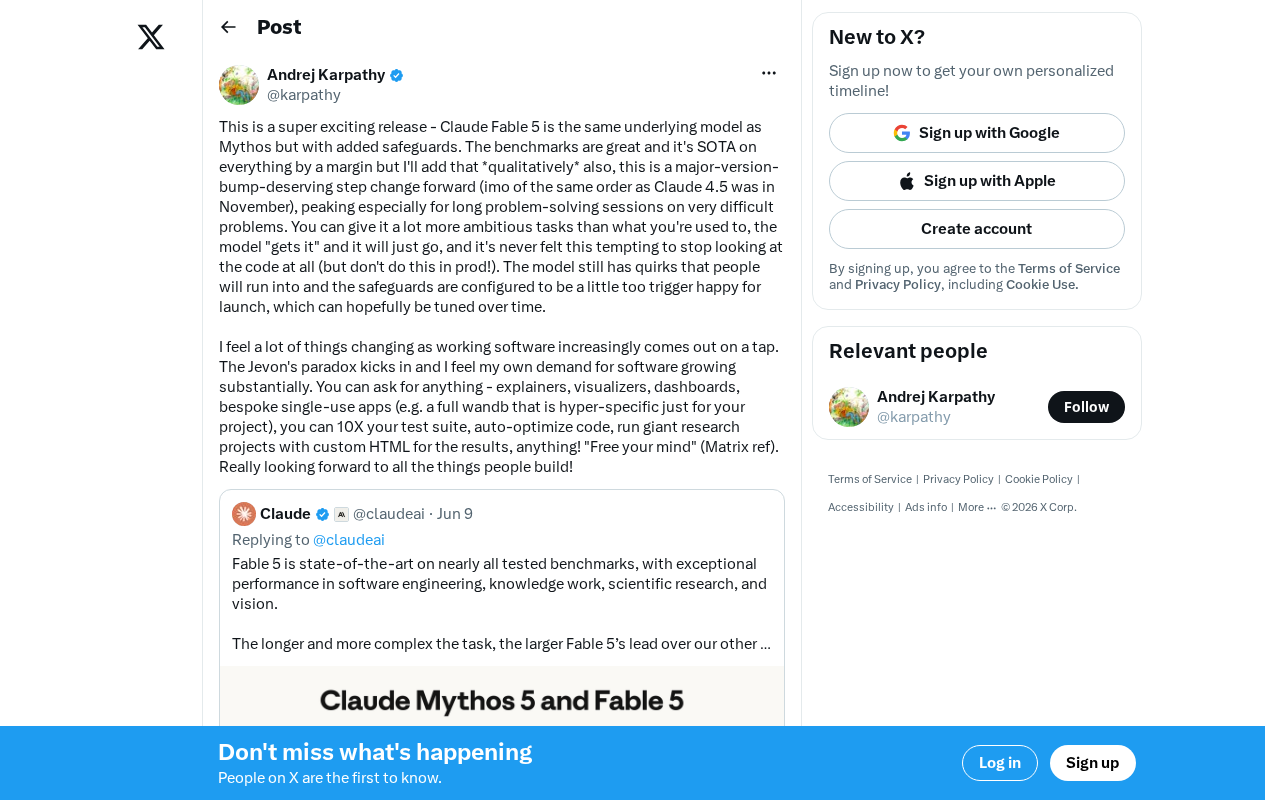
Karpathy calls Claude Fable 5 a step-function leap in AI coding, triggering a Jevons Paradox in software development.
Andrej Karpathy shares his in-depth experience with Anthropic's Claude Fable 5, calling it a qualitative leap beyond benchmark dominance. The model excels in long, high-difficulty coding sessions, understanding intent and sustaining complex tasks. Karpathy invokes the Jevons Paradox to explain how easier software creation is driving explosive demand, and notes that while safety guardrails are initially over-tuned, the model marks a new phase in AI-assisted development.
Anthropic's latest release, Claude Fable 5, has sparked intense interest across the AI developer community. As a model that shares the same foundation as Mythos but with added safety guardrails, Fable 5 doesn't just lead across benchmarks — it delivers a qualitative leap in real-world programming experience. Andrej Karpathy, former OpenAI researcher and one of AI's most prominent voices, shared his in-depth impressions almost immediately.
Andrej Karpathy is one of the most influential figures in deep learning. A former PhD student in Fei-Fei Li's lab at Stanford, he went on to hold core technical roles at both OpenAI and Tesla — where he led the neural network architecture design for Autopilot. His deep learning tutorial series on YouTube has accumulated tens of millions of views. With both top-tier research credentials and extensive engineering experience, his assessments of AI programming tools carry exceptional weight in the developer community.
Beyond Benchmark Scores — The Qualitative Shift Is What Matters
Karpathy made it clear that Claude Fable 5 achieves SOTA (State of the Art) across all benchmarks by a significant margin, but what truly excited him wasn't the numbers — it was the qualitative leap in experience.
SOTA is the core standard for measuring model capability in AI, referring to the best performance achieved on a given benchmark. AI models are typically evaluated across multiple dimensions including coding ability (e.g., SWE-bench, which simulates real GitHub issue fixes), mathematical reasoning (e.g., MATH benchmark), and code generation (e.g., HumanEval). However, the industry increasingly recognizes a significant gap between benchmark scores and actual user experience — a model might excel on standardized tests yet perform mediocrely on open-ended, long-context real-world programming tasks. This is precisely why Karpathy emphasizes that "qualitative experience" matters more than "quantitative scores."
He compared this upgrade to the release of Claude 4.5 last November, calling it a "step-function improvement worthy of a major version bump." This is an extraordinarily strong endorsement, given that Claude 4.5 was already widely regarded as a major breakthrough in AI programming capability. As a model sharing the same foundation as Mythos, Fable 5 inherits the core architecture and training data of Anthropic's latest-generation base model, with an additional safety alignment layer on top. Anthropic has long centered its approach on Constitutional AI methodology, achieving safety alignment by having models self-evaluate and self-correct, giving the Claude series a distinctive technical path balancing safety and usefulness. Fable 5 delivers yet another capability leap of comparable magnitude on this foundation.
Specifically, Fable 5's peak performance emerges during long, high-difficulty problem-solving sessions. Users can assign far more ambitious tasks than before, and the model genuinely "understands intent" and keeps pushing forward, rather than losing its way or drifting off course in complex tasks. Karpathy even admitted that using this model made him "never want to look at the code" more than ever — though he quickly cautioned against actually doing that in production.
The Jevons Paradox of Software Development Is Playing Out
Even more noteworthy is Karpathy's macro-level insight into AI programming trends. He invoked the Jevons Paradox from economics to describe the current shift: when the efficiency of using a resource improves, total demand for that resource increases rather than decreases.
This paradox was first articulated by British economist William Stanley Jevons in his 1865 work The Coal Question. He observed that James Watt's improvements to the steam engine dramatically increased coal efficiency, yet Britain's total coal consumption rose rather than fell — because improved efficiency lowered the unit cost of energy, making previously uneconomical applications viable and triggering explosive growth in total demand. This paradox has recurred throughout technological history: LED bulbs are 90% more efficient than incandescent ones, yet global electricity consumption for lighting continues to grow; cloud computing reduced server costs, but total energy consumption by data centers worldwide has been surging.
In the context of AI programming, this means: as AI makes software development increasingly easy, demand for software isn't shrinking — it's exploding. Karpathy described the demand expansion he's personally experiencing:
- Explainers and visualization tools: Casually generating interactive tools for understanding complex concepts
- Custom dashboards: No longer relying on generic solutions, but building bespoke ones for specific projects
- One-off purpose-built apps: For example, generating a "super-customized WandB" for a particular project (a machine learning experiment tracking tool)
- 10x expansion of test suites: Dramatically improving code quality assurance
- Automated code optimization: Having AI continuously improve existing code
- Large research projects: Complete with custom HTML presentations for research results
WandB (Weights & Biases), mentioned above, is one of the most popular experiment tracking and visualization platforms in machine learning, widely used by companies like OpenAI, NVIDIA, and Meta. Its core features include automatically logging loss curves during training, comparing results across different experimental configurations, and managing model and dataset versions. Karpathy's mention of generating a "super-customized WandB" for a specific project means developers no longer need to adapt to the constraints of general-purpose tools — instead, AI can rapidly generate a fully tailored experiment tracking system based on a project's unique requirements. This shift from "adapting to tools" to "tools adapting to you" is precisely the paradigm shift enabled by improved AI programming capabilities.
The metaphor of "software as a faucet" is wonderfully apt — turn it on and it flows, use it whenever you need it. Software is no longer a product requiring careful planning and significant investment, but a tool that can be generated on demand, instantly.
Safety Guardrails: Necessary but Still Need Tuning
Karpathy also candidly pointed out the current version's shortcomings. Fable 5's safety guardrails were configured to be somewhat "trigger happy" at launch, meaning users may encounter unnecessary refusals or restrictions in certain legitimate use cases.
AI model safety guardrails are a multi-layered defense mechanism that typically includes RLHF (Reinforcement Learning from Human Feedback) alignment during training, output filters during inference, and specialized detection modules for specific risk categories (such as generating malicious code or leaking private information). The "trigger happy" problem is known in the industry as "over-refusal" — where the model misclassifies legitimate requests as harmful and refuses to respond. For example, security researchers requesting analysis of malware samples, or medical researchers discussing drug toxicity mechanisms, might trigger overly conservative safety policies. This is fundamentally a classic precision-recall tradeoff: lowering the false refusal rate may simultaneously reduce the interception rate for genuinely harmful requests.
Anthropic typically employs a "tight first, loosen later" strategy — setting higher safety thresholds at launch and gradually calibrating based on real user feedback data. Karpathy is optimistic about this, believing these issues "will likely be tuned over time." Additionally, the model still has some "quirks" that users will gradually discover during use.
What This Means for Developers
From Karpathy's assessment, we can distill several key signals:
First, the capability curve of AI programming assistants is accelerating upward. From Claude 4.5 to Fable 5, each iteration delivers not incremental improvement but step-function breakthroughs. Developers need to continuously update their understanding of AI's capability boundaries.
Second, "giving AI bigger tasks" is becoming the new best practice. In the past, we were accustomed to breaking tasks into small pieces to feed to AI, but models at the Fable 5 level can now handle grander, more complex task chains. This means the way developers collaborate with AI needs to shift from "micro-instructions" to "macro-intent expression" — describing the goal you want to achieve, rather than specifying the implementation path step by step.
Third, the economics of software development are being rewritten. When the marginal cost of generating software approaches zero, the entire industry's value chain, business models, and ways of working will face restructuring. As the Jevons Paradox reveals, this won't lead to developer unemployment — instead, it will give rise to a software ecosystem an order of magnitude larger. It's just that the form, lifecycle, and creation methods of software will undergo fundamental change. As Karpathy put it — "Free your mind."
This isn't merely a model release — it's a landmark event signaling that AI-assisted development has entered a new phase.
Related articles
Claude Fable 5 Hands-On: Is Doubling the Tokens Worth It? A Rust Programming Comparison with Opus 4.8
Hands-on Rust project comparison of Claude Fable 5 vs Opus 4.8. Fable 5 uses 2x tokens for only marginal quality gains and has stability issues.

Compile First: Using AI to Revive the Dormant Files on Your Hard Drive
Explore how the open-source LLM Wiki project uses a compile-first paradigm to turn dormant local files into a searchable AI knowledge base, compared with traditional RAG approaches.

Replicating Slay the Spire with AI and Zero Code: A Complete Walkthrough from Architecture to Art
A Bilibili creator used Godot and AI tools to replicate Slay the Spire with zero hand-written code. Full walkthrough of architecture-first AI coding and batch art generation.