Career Transition Guide for AI Product Managers: Pick the Right Track Across Three Industry Layers

A strategic guide for traditional PMs to transition into AI product management via the application layer.
This article breaks down the AI industry into three layers — infrastructure, large models, and applications — and explains why the application layer is the best entry point for traditional product managers transitioning to AI. It covers key misconceptions, essential skills like prompt engineering and RAG, and a practical roadmap that leverages existing industry experience as a competitive moat.
AI Product Manager Isn't a Single Role — It's a Cluster of Career Tracks
AI product manager has become one of the hottest career transition targets. But many people's understanding of this role is stuck in the past — they assume that knowing how to create wireframes and do requirements analysis is enough to make a lateral move. In reality, as large language model technology has rapidly evolved, AI PM has branched into four or five completely different directions, each with vastly different salaries, entry barriers, and career trajectories.
Recently, a Chinese tech content creator published an in-depth analysis video on transitioning to AI product management, systematically breaking down the core tracks and the optimal entry paths for the average professional based on the latest hiring trends. This article expands on that analysis to help readers considering a career switch get clarity on direction.
The AI Industry Pyramid: Three Layers That Determine Your Ceiling
To understand the landscape of AI product manager roles, you first need to grasp the three-layer pyramid structure of today's AI industry. These three layers directly determine your salary ceiling and the difficulty of breaking in.
This pyramid isn't an arbitrary classification — it's the natural result of how the technology supply chain has evolved, similar to the IaaS-PaaS-SaaS architecture from the early internet era. The bottom layer provides foundational capabilities, the middle layer packages core technology, and the top layer creates commercial value for end users. Understanding this structure is essential for accurately identifying your entry point.
Layer 1: The Infrastructure Layer — Off-Limits for Most People
This layer covers chips, compute clusters, data centers, and other foundational infrastructure. NVIDIA and the compute infrastructure buildouts of major tech companies all fall into this category. The core work revolves around hardware, compute scheduling, and low-level architecture, and practitioners are primarily top-tier scientists and hardware engineers.
The current global compute arms race has pushed investment in this layer to the scale of hundreds of billions of dollars. NVIDIA's GPUs (such as the H100 and B200) and Google's TPUs are the core hardware for AI training and inference — a single H100 once commanded a market price exceeding $40,000. The technical barriers in this layer are extremely high, involving chip design, high-bandwidth memory, distributed computing, and other deep hard-tech domains.
The conclusion is clear: there are virtually no product manager positions at this layer. Zero-background career switchers should not waste time here.
Layer 2: The Large Model Layer — High Pay, High Barriers
This is the core track for large model companies, encompassing general-purpose models as well as vertical models for finance, healthcare, and other industries. The corresponding roles are primarily model strategy PMs and data PMs, whose core work involves evaluating model performance, optimizing data cleaning rules, and balancing model capabilities against cost and business objectives.
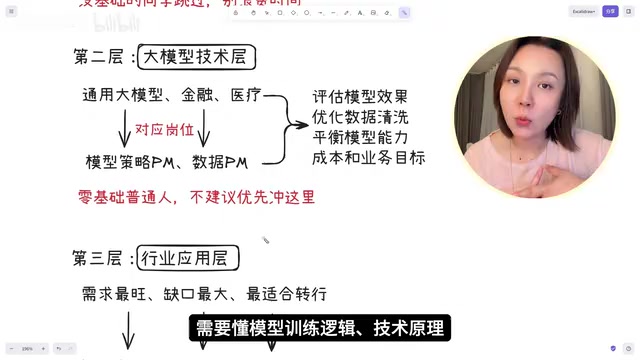
Salaries on this track are indeed high, but the barriers are equally steep. Companies strongly prefer candidates with algorithm backgrounds — many researchers even double as product managers. If you come from a pure business background with zero technical foundation, rushing toward this layer will most likely end in rejection. Representative companies at this layer include OpenAI, Anthropic, and Google DeepMind overseas, as well as Zhipu AI, Moonshot AI, and Baichuan Intelligence in China. A single large model training run can easily cost tens of millions of dollars, which explains why these companies set such high technical requirements for talent.
Layer 3: The Application Layer — The Golden Track for Career Switchers
This is the track with the highest demand, the biggest talent gap, and the best fit for career transitions — bar none.
AI has moved past the "model competition" phase and entered the era of real-world deployment and monetization. Intelligent customer service, AI-powered office tools, Agent workflows, financial risk management, medical triage, educational Q&A, e-commerce marketing — these are all application-layer use cases.
Among these, Agent (intelligent agent) has been one of the most important technical paradigms in the application layer since 2024. Unlike traditional single-turn conversations, Agents can autonomously plan task steps, invoke external tools, perform multi-turn reasoning, and ultimately accomplish complex goals. Typical Agent frameworks like LangChain, AutoGPT, and CrewAI allow large models to be chained together with search engines, code executors, databases, and other tools to form automated workflows. Understanding the capability boundaries of Agents — which tasks are suitable for full automation and which require human intervention — is one of the core competitive advantages of an application-layer AI product manager.
The core logic of this layer is: understand the business first, then apply AI to enhance it. If you have experience in finance, healthcare, education, e-commerce, or any other industry, your transition advantage is far greater than that of a pure internet PM. This is also the talent type companies need most right now: hybrid AI product managers who understand the industry, understand AI's capability boundaries, and can ship real projects.
The Biggest Misconception When Traditional PMs Transition to AI
Many traditional product managers believe that because they can create wireframes and do requirements analysis, they can directly transfer to an AI product role. This is an extremely dangerous misconception.
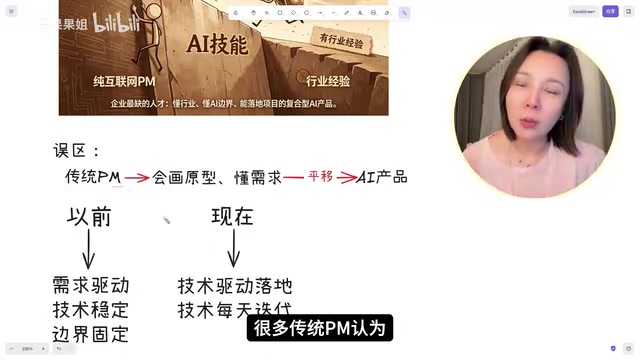
In the mobile internet era, product work was demand-driven: the technology was stable, boundaries were fixed, and you just needed to nail the feature design. But today's AI products are technology-driven: the tech iterates daily, and features that are impossible today might have open-source solutions everywhere tomorrow.
Here's a concrete example: In early 2023, getting AI to accurately analyze a 50-page PDF was still a technical challenge. By 2024, with the maturation of long-context window models and multimodal capabilities, this had become a basic feature. If a product manager doesn't keep up with these technical changes, they might spend three months designing an elaborate document segmentation solution, only to find at launch that a competitor solved it with a single API call using a newer model.
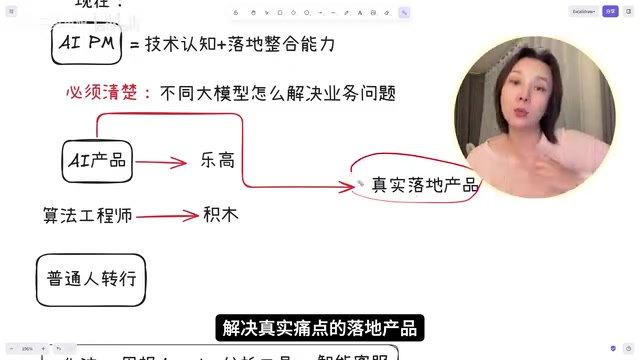
Without understanding AI's capability boundaries and keeping up with technology trends, the product solutions you design will likely be outdated and ineffective. Today's AI PMs compete not on how fast they can create mockups, but on technical awareness + implementation integration skills.
Here's a critical distinction to emphasize:
- You don't need to: understand model internals, write code, or grind through algorithms
- You must: know what different large models and Agent tools can do, where their weaknesses are, and how to combine them to solve business problems
Here's a helpful analogy: AI product development is like playing with LEGO. Algorithm engineers build the bricks. Your core value is selecting the right bricks and assembling them into a product that solves real pain points.
The Optimal Path for Career Switchers to Become AI Product Managers
Once the direction is clear, how do you actually execute? Here's a highly practical transition roadmap.
Core Principle: Prioritize Hands-On Practice, Skip the Theory Grind
If you're switching careers, don't grind algorithms or obsess over low-level principles. The fastest way to grow is to jump straight into building real workflows:
- Build a weekly report summarization Agent
- Create an industry research report analysis tool
- Design an intelligent customer service workflow
Through hands-on practice, progressively master these core competencies:
-
Prompt Engineering: This is the fundamental skill of an AI PM, determining whether you can effectively drive a large model to produce high-quality outputs. Prompt engineering is far more than just "writing a good instruction" — it's a systematic methodology for interacting with AI models, encompassing role assignment, task decomposition, output format constraints, few-shot example design, Chain-of-Thought guidance, and many other techniques. Excellent prompt engineering can multiply the output quality of the same model several times over, and in some tasks can even make a small model rival the performance of a large one. For AI product managers, this skill directly determines the user experience — for the same feature, the difference between good and bad prompt design can result in a 50%+ gap in user satisfaction.
-
Context Management: Understand the context window limitations of large models and learn to design effective information-passing mechanisms. The context window refers to the maximum text length a large model can process in a single call, typically measured in tokens (one Chinese character ≈ 1.5–2 tokens). Currently, GPT-4 Turbo supports 128K tokens, Claude 3 supports 200K tokens, and Gemini 1.5 Pro supports 1 million tokens. Context window size directly impacts product design — for example, if a document analysis tool receives a document that exceeds the window limit, you'll need to design chunking strategies, sliding windows, or RAG-based solutions to handle it.
-
Model Tuning and Selection: Choose different models for different scenarios, balancing performance, cost, and response speed. For instance, using GPT-4 for simple text classification is overkill — a fine-tuned small model might be both faster and cheaper. Complex multi-step reasoning tasks, on the other hand, might require the most powerful reasoning model available. AI PMs need to build a cost-effectiveness evaluation framework to select the optimal model solution for each functional module.
-
RAG (Retrieval-Augmented Generation): This is one of the most critical technical architectures for enterprise AI applications today, and you must understand its principles and application boundaries. RAG works by retrieving relevant document fragments from an external knowledge base before the large model generates its answer, injecting those fragments into the prompt as context, and then having the model generate responses based on this real information. This architecture allows enterprises to enable AI to provide accurate answers based on internal documents, product manuals, customer records, and other proprietary data — without retraining the model — while significantly reducing the probability of model "hallucinations" (fabricating facts). Vector databases (such as Pinecone, Milvus, and Weaviate) are key components in RAG architectures, responsible for converting documents into mathematical vectors and performing semantic retrieval.
Your Industry Experience Is Your Moat
This point cannot be overstated. The biggest bottleneck in the AI application layer right now isn't technology — it's deep understanding of business scenarios. A product manager with five years in the finance industry transitioning to financial AI products has a natural competitive advantage over someone who only understands technology but not the business.
The logic behind this: large models themselves are general-purpose capabilities. Real value creation happens at the intersection of "general capability × vertical scenario." Someone who understands financial compliance requirements knows which parts of an AI-generated investment research report need human review. Someone who understands the medical diagnostic process knows what accuracy thresholds AI-assisted triage outputs must meet before they can be used in actual clinical practice.
What you need to do is: repackage your industry experience, cross-map it with AI capabilities, and identify those scenarios where "AI can significantly improve efficiency but the problem hasn't been well-solved yet" as your entry point.
A Clear-Eyed View of the Trend: Career Transition Strategy Summary
AI product manager is indeed a direction full of opportunity, but the word "trend" also implies a bubble. The market is flooded with crash courses and fragmented tutorials that leave you unable to build a complete project or present a portfolio in interviews — ultimately just paying a "knowledge tax."
The truly effective transition strategy is: Pick the right track (application layer) → Build technical awareness (not coding) → Combine industry experience with hands-on projects → Let your portfolio speak for you. There are no shortcuts on this path, but when the direction is right, every step counts.
For those who have already accumulated industry experience in traditional PM roles, right now may be the best window for transitioning to AI product management — application-layer demand is exploding, while talent who truly understands both business and AI boundaries remains scarce. The key is: don't let anxiety drive you, don't blindly follow the crowd. Find your differentiated advantage and take each step with intention.
Related articles

Xiaomi MIMO vs. Huawei Pangu AI Strategy Comparison: The Android vs. iOS Battle of the Agent Era
Xiaomi releases open-source MIMO Code while Huawei enters the Agent era with Pangu. Compare their AI strategies: Xiaomi's Android-like open ecosystem vs. Huawei's iOS-like vertical integration.
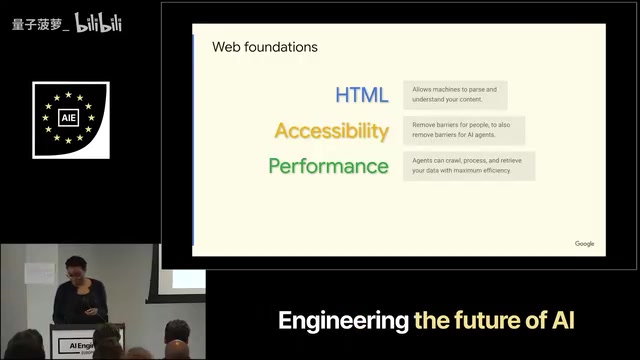
What Is Google WebMCP? A Deep Dive into the New Standard for AI Agents to Directly Invoke Web Functionality
A deep dive into Google WebMCP (Web Model Context Protocol): how it works, its technical implementation, and use cases. Learn how WebMCP lets AI Agents directly invoke web tools.
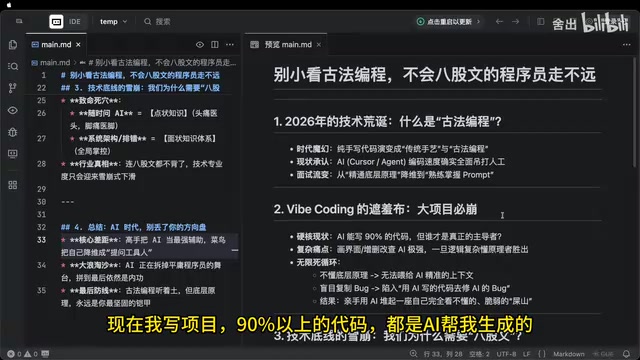
AI Can't Kill Old-School Programming: Why Fundamentals Are Still a Developer's Moat
Vibe Coding is trending, but can it replace solid fundamentals? A deep analysis of why core principles, systems thinking, and knowledge frameworks remain a developer's moat in the AI era.