Claude Code + Codex: The Best Practice of One-Writes-One-Reviews AI Programming
Use Claude Code to write code and Codex to review it — a cross-validation workflow for better AI programming.
This article presents a best practice for AI-assisted programming where Claude Code handles code writing and Codex handles code review. It covers a five-step closed-loop workflow: planning, implementation with self-verification, cross-Agent review, feedback reconciliation, and re-review before merging. The core principle is that different AI perspectives catch blind spots that self-review misses.
Why You Shouldn't Pick Just One
Many developers tend to "pick sides" when using AI programming tools — going all-in on either Claude Code or Codex. But in practice, a more efficient approach is to let two Agents each play their own role: one writes, the other reviews.
The core value of this pairing isn't about using one more tool — it's about placing two Agents in different positions: one responsible for getting things done, the other standing aside to find problems.
In reality, many bugs don't happen because an Agent can't write code, but because no one seriously reviews it after it's written. Human review is ideal, of course, but Agents now produce code so fast that relying solely on humans to read every line simply can't keep up.
Having the same Agent write code and then self-review is essentially a manifestation of "Confirmation Bias" from cognitive psychology mapped onto AI systems. When a large language model generates code, it forms a Chain of Thought, and subsequent self-checks tend to follow the same reasoning path, making it difficult to step outside the existing logical framework to spot blind spots. This is similar to the mechanism where human developers "can't see bugs in their own code." In software engineering practice, Code Review is considered a core quality assurance step precisely because it introduces an independent second perspective. Migrating this principle to multi-Agent collaboration — using different models and different context windows for cross-validation — effectively breaks the limitations of a single reasoning chain.
Claude Code: Best Suited as the Primary Worker
What Tasks to Give Claude Code
If the task is building a feature from scratch, or requires continuously modifying files, running commands, and checking errors within the current project, prioritize Claude Code. Its advantages include:
- Reads the project first, then breaks down the plan — when requirements are ambiguous, it stops to ask for clarification rather than guessing
- Supports WorkTree, allowing parallel processing of different tasks in isolated workspaces within the same repository
- Strong long-task context management, suitable for migrations, refactoring, and cross-module transformations
WorkTree (git worktree) is a feature introduced in Git 2.5 that allows developers to create multiple independent working directories under the same repository, each checking out a different branch. In the traditional approach, if you want to work on two feature branches simultaneously, you either frequently switch branches (stash/checkout) or clone multiple copies of the repository. WorkTree solves this problem: multiple workspaces share the same .git directory, saving disk space and avoiding context loss from branch switching. Claude Code's support for WorkTree means it can work on Feature A in one workspace while handling Feature B in another, without interference — particularly suitable for scenarios requiring parallel progress on multiple tasks.
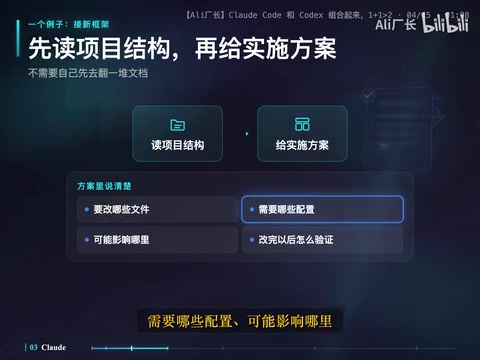
For example, if you need to integrate a new framework, you don't need to dig through piles of documentation yourself. Just tell Claude Code: read the project structure first, then provide an implementation plan. The plan should specify which files to modify, what configurations are needed, what might be affected, and how to verify after the changes.
Key Principles for Using Claude Code
First, plan before acting. For complex tasks, don't let the Agent jump straight into modifications — have it clarify the boundaries first. Otherwise, a small requirement can easily snowball into a major project.
Second, have it document the process, not just the result. Specifically, require it to record:
- Why this file was modified
- What was left unchanged
- What commands were run for verification and what the results were
- What remains unconfirmed
This is extremely important. When you later hand things off to Codex for review, it receives not just a pile of changes, but the intent behind those changes. A diff with intent produces a completely different quality of review.
Codex: Positioned as the Second Gate for Code Review
Why Use a Different Agent for Review
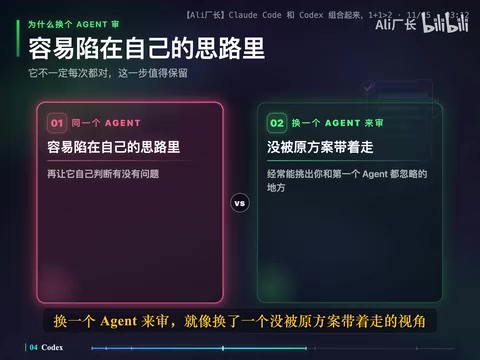
When the same Agent writes code and then judges whether there are problems, it easily gets trapped in its own thinking. Switching to a different Agent for review is like bringing in a perspective that hasn't been led by the original plan. It won't always be right, but it frequently catches things that both you and the first Agent overlooked.
How Codex Reviews in Practice
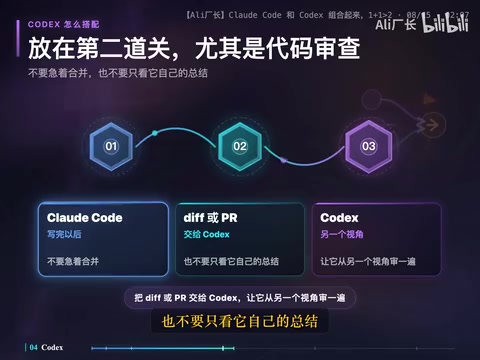
After Claude Code finishes writing, don't rush to merge, and don't just look at its own summary. Hand the diff or PR to Codex for review from a different perspective.
A diff (difference comparison) is the basic unit for displaying code changes in version control systems, precisely marking which lines were added, deleted, or modified. A PR (Pull Request) is a collaboration workflow built on top of diffs by platforms like GitHub — it contains not only code differences but also change descriptions, discussion records, CI check results, and review comments. Using diffs or PRs as input for Agent review, rather than having the Agent re-read the entire codebase, has two key benefits: first, it dramatically reduces context noise, letting the Agent focus on actual changes; second, it preserves intent information (commit messages, PR descriptions), enabling review that goes beyond syntax-level checking to semantic-level evaluation aligned with business objectives.
If you use GitHub, you can connect Codex to the repository to review PRs. A common approach is to @Codex in a PR to trigger a review, or configure it to review automatically per team settings.
If you're not using GitHub for now, you can also feed the current diff, task objectives, and Claude Code's summary to Codex together for an offline review.
Review Focus Must Be Specific
Don't let Codex vaguely comment on whether "the code is good or not" — have it watch for specific risks:
- Obvious bugs and edge cases
- Whether existing functionality is affected
- Whether necessary tests are missing
- Whether there's unnecessary refactoring
Going further, review focus should follow the business context. For example:
- Login flow → watch for authentication, redirects, expiration states, failure recovery
- Payment or orders → watch for amounts, state transitions, duplicate submissions, exception rollbacks
When you clearly specify the review focus, the Agent's review quality improves significantly.
Complete Workflow: Five-Step Closed Loop
Putting the above thinking together, the recommended workflow looks like this:
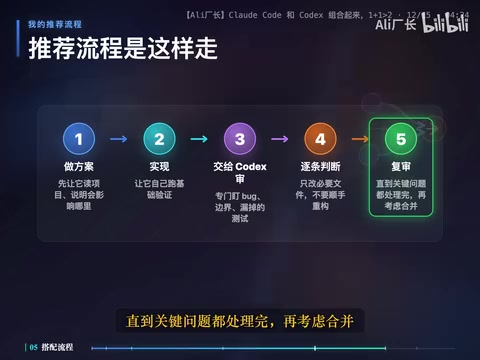
Step 1: Claude Code creates the plan. Have it read the project first, explain what will be affected, and how it plans to verify. After you confirm the plan isn't off track, let it proceed with changes.
Step 2: Claude Code implements and self-verifies. After making changes, have it run basic verification — Lint, TypeCheck, unit tests, build — or perform manual verification as appropriate for the project. Don't just take its word that it's "done" — look at which files it actually changed and what the verification results are.
These four verification items represent four progressive levels of code quality assurance. Lint (e.g., ESLint, Pylint) performs static code style and potential error checking — the lightest form of verification. TypeCheck (e.g., TypeScript's tsc --noEmit) validates at the type system level, catching type mismatches, interface incompatibilities, and other compile-time errors. Unit tests verify the correctness of specific business logic. Build is end-to-end integration verification, ensuring all modules compile and package correctly. These four layers progress from fast to slow, shallow to deep, forming a pyramid structure. Running these four layers sequentially after the Agent completes code modifications catches problems at different granularities, preventing obvious low-level errors from reaching subsequent human review stages.
Step 3: Hand the changes to Codex for review. This can be a GitHub PR or the current diff. Have Codex specifically watch for bugs, edge cases, missing tests, and unnecessary changes.
Step 4: Feed Codex's feedback back to Claude Code. This step is most critical — don't just have Claude Code blindly implement everything. First have it evaluate each item: Does this problem actually exist? If so, how should it be fixed? If not, explain why. Confirm the plan before making changes, and only modify necessary files — no opportunistic refactoring.
Step 5: Have Codex re-review after fixes. Only consider merging once all critical issues are addressed.
This workflow sounds like an extra step, but it's far better than dealing with production issues and tracing back later.
Key Details in Step 4: Who Has the Final Say
Feedback from Codex doesn't mean you must accept everything wholesale, and things Claude Code disagrees with aren't necessarily correct either. A better approach is to have both Agents align around the same diff:
- Does the problem exist?
- Why does it exist?
- Are only necessary parts being changed?
- Has verification been added?
What requires your judgment are these decisions, not re-reading every line of code from scratch. The human role shifts from "reviewing code line by line" to "referee" — much more efficient.
When You Don't Need This Workflow
This workflow is suited for risky changes, not for running through every small modification. If you're just changing a title or adjusting a button, having Claude Code make the change and check it itself is sufficient.
Additionally, the Agent space evolves extremely fast. Today Claude Code may be stronger in certain workflows; tomorrow Codex might catch up. Today Codex may be more suitable for reviews; later, better tools might emerge. So the core of this workflow isn't tool-binding — it's the collaborative mindset of "one writes, one reviews, cross-validation." Tools will change, but the logic of having different perspectives verify each other will most likely remain effective indefinitely.
The "one writes, one reviews, cross-validation" collaboration model has deep theoretical roots in engineering. In high-reliability industries like aerospace and nuclear power, "Independent Verification and Validation" (IV&V) is a mandatory quality assurance process — the development team and verification team must be different teams, even different organizations. In software engineering, this thinking manifests as code review, Pair Programming, and the "red-green-refactor" cycle in Test-Driven Development (TDD). Multi-Agent collaboration essentially automates this engineering practice validated over decades: executing at AI speed while maintaining quality through the principle of independent perspectives. This is also why tools will keep iterating, but the logic of cross-validation will remain effective — because it addresses a fundamental cognitive problem, not the limitations of any specific tool.
Key Takeaways
Related articles

Claude Code for Test Development in Practice: An AI Programming Workflow That Doubles Your Efficiency
A practical guide to Claude Code for test development: auto-generating test scripts, Plan Mode workflows, MCP + Playwright integration, and Subagent parallel tasks to build systematic AI-assisted workflows.

Hermes Agent Hands-On Review: An AI Efficiency Revolution for Indie Game Developers
Indie game developer reviews Hermes Agent vs OpenClaude: intelligent context compression, real-time Memory, remote control via Telegram, and practical use cases in game dev, social media, and email.
Vibe Coding Beginner's Guide: Tool Selection Across Three Categories with Practical Examples
A comprehensive guide to Vibe Coding's three tool categories: Agent frameworks, CLI Coding, and IDE tools, with practical examples including Snake game and data analysis workbench.