Claude Code Dynamic Workflows Explained: How Multi-Agent Collaboration Is Changing AI Programming
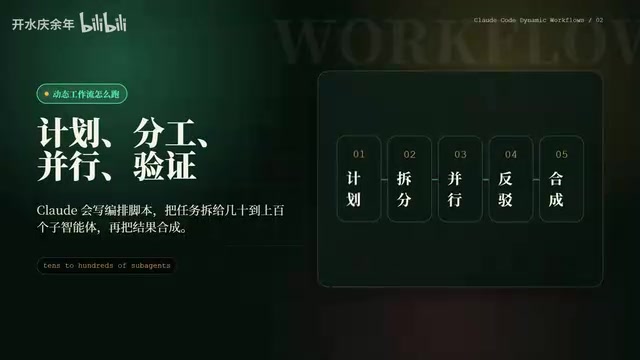
Claude Code's Dynamic Workflows let multiple AI agents collaborate in parallel to tackle complex engineering tasks.
Anthropic's Claude Code Dynamic Workflows enable multi-agent parallel collaboration for complex software engineering tasks. By orchestrating dozens of sub-agents that independently handle code migration, bug investigation, and validation, it completed a 750K-line Zig-to-Rust migration in just 11 days with 99.8% test pass rate. The feature excels at repo-wide debugging, large-scale migrations, and pre-launch red team validation.
Anthropic officially released the Dynamic Workflow feature for Claude Code on May 28, marking a shift in AI programming tools from "solo operation" to "team collaboration" mode. It's no longer just an assistant that helps you write code — it can now autonomously orchestrate dozens or even hundreds of sub-agents, working in parallel like a temporary engineering squad to tackle complex tasks.
What Are Claude Code Dynamic Workflows?
In simple terms, when you ask Claude Code to handle a large-scale project, it doesn't just reply with a single code solution. Instead, it first writes a temporary orchestration script, then breaks the task down and assigns it to multiple sub-agents. Each sub-agent has its own role: some hunt for bugs, some handle file migrations, others specialize in validation and error-checking. Finally, all verified results are aggregated and delivered back to you.
The "sub-agent" here is a core concept in Multi-Agent Systems. In traditional AI programming tools, users interact one-on-one with a single large language model, which completes all reasoning and code generation within a single context window. In a multi-agent architecture, an Orchestrator Agent is responsible for understanding user intent and formulating an execution plan, then distributing specific tasks to multiple independently running sub-agents. Each sub-agent has its own independent context window and tool-calling permissions, and can execute file read/write operations, code searches, test runs, and more in parallel. The key advantage of this architecture is that it breaks through the length limitations of a single context window while leveraging parallel computation to dramatically reduce the total time required for complex tasks.
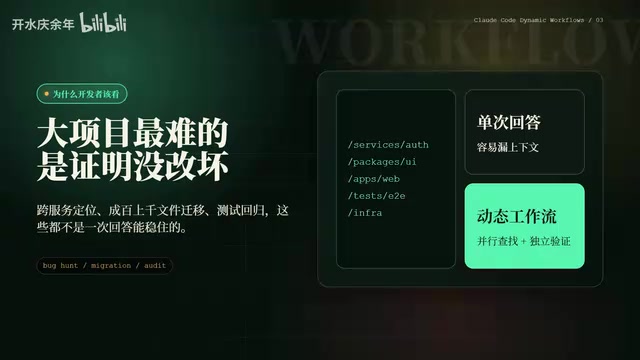
The core value of this architecture lies in the fact that the hardest part of large projects has never been writing code itself — it's locating issues across services, modifying hundreds of files, passing all tests, and ensuring nothing breaks in the process. Dynamic Workflows are designed precisely to solve these kinds of systemic engineering challenges.
Official Case Study: Migrating 750,000 Lines of Rust Code
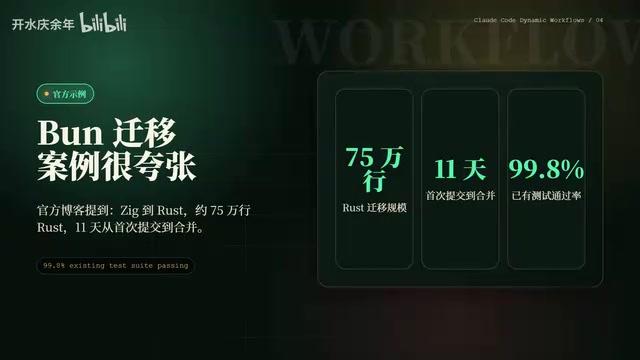
Anthropic provided a highly compelling case study: migrating a project from Zig to Rust. The entire project involved approximately 750,000 lines of Rust code, took only 11 days from first commit to final merge, and achieved a test pass rate of 99.8%.
To appreciate the technical complexity of this case, it helps to understand the differences between Zig and Rust. Both are modern languages targeting systems-level programming, but they have significantly different design philosophies. Zig prioritizes simplicity and predictability — it avoids implicit behavior, has no garbage collection, and lacks Rust's ownership system, instead relying on manual memory management and compile-time computation for performance guarantees. Rust, on the other hand, is known for its unique Ownership and Borrow Checker mechanisms, which eliminate data races and memory safety issues at compile time, though at the cost of a steeper learning curve. Migrating 750,000 lines of code from Zig to Rust involves far more than syntactic translation — it requires redesigning memory management strategies, error handling patterns (Zig uses error unions, Rust uses the Result type), and concurrency models. This type of cross-language migration is widely recognized in the industry as a high-risk engineering undertaking.
What do these numbers mean? For a language migration project of 750,000 lines, a traditional team might need months or even longer, and it would be extremely difficult to guarantee such a high test pass rate. Claude Code, through multi-agent parallel execution, pushed migration, testing, and validation forward simultaneously, dramatically compressing the delivery timeline.
This isn't just a speed improvement — it represents a fundamental change in how engineering quality is assured. After each sub-agent completes its task, dedicated "validation agents" perform cross-checks on the results to ensure that changes don't introduce new issues.
Three Key Use Cases for Dynamic Workflows
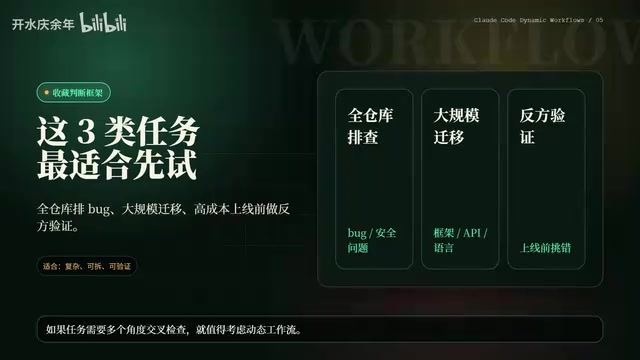
Dynamic Workflows aren't suitable for every scenario, but they excel in three types of tasks:
1. Repository-Wide Bug Investigation
When a bug's root cause might be distributed across multiple services and modules, a single agent struggles to locate it efficiently. Dynamic Workflows can dispatch multiple sub-agents simultaneously to scan different modules, cross-reference results, and quickly pinpoint the source of the problem.
2. Large-Scale Code Migration
Whether it's a language migration, framework upgrade, or API version switch, batch modifications involving large numbers of files are a sweet spot for Dynamic Workflows. It can group files and assign them to different sub-agents for parallel processing while ensuring consistency across modifications.
3. Pre-Launch Red Team Validation
This is a particularly valuable scenario — before code goes live, a group of sub-agents is specifically assigned to play the "red team" role, poking holes and finding vulnerabilities from every angle. This adversarial validation effectively reduces the risk of production incidents.
The "red team" concept originates from military exercises, referring to a team that specifically plays the adversary role to test one's own defenses. In software engineering and cybersecurity, red team testing has become standard practice — a group of specialists simulates an attacker's perspective to conduct penetration testing, vulnerability discovery, and stress testing. In recent years, this concept has been widely adopted in AI safety, with companies like OpenAI and Anthropic conducting red team evaluations before model releases. Bringing red team validation into the code review process is an innovative application: having AI sub-agents specifically examine code changes from the perspectives of security vulnerabilities, edge cases, concurrency race conditions, and resource leaks essentially automates the adversarial thinking found in traditional manual Code Review.
Three Important Considerations When Using Dynamic Workflows
Of course, Dynamic Workflows come with trade-offs:
- Higher Token Consumption: Running multiple sub-agents in parallel multiplies token consumption, so usage costs need to be factored in. Tokens are the basic unit of measurement for how large language models process text, roughly equivalent to 3/4 of an English word or one Chinese character. In multi-agent workflows, each sub-agent independently consumes input tokens (reading task descriptions and code context) and output tokens (generating code and analysis reports). Using Claude's API pricing as a reference, input and output tokens are billed separately, with output tokens typically costing 3-5x more than input tokens. When a Dynamic Workflow launches dozens of sub-agents simultaneously, token consumption can reach tens or even hundreds of times that of a single conversation. A single large-scale code migration task could see API costs jump from a few dollars to several hundred dollars, so enterprises need to establish clear cost budgets and monitoring mechanisms.
- First-Time Confirmation Required: The system will ask for user confirmation on first use and won't execute automatically, preserving a human review safety valve.
- Administrators Can Disable It: In enterprise environments, administrators have the authority to disable this feature to prevent uncontrolled large-scale automated operations.
Official Recommended Usage Strategy
The officially recommended approach is to start with small tasks: begin with a well-scoped small task, have Claude Code create a workflow, and require each subtask to include an independent validation step. After reviewing the validation report and confirming everything is correct, then let it work on the actual code.
This incremental usage strategy is critically important. The more powerful Dynamic Workflows become, the greater the risk of losing control. Building trust with small tasks first, understanding its behavior patterns, and then gradually scaling up task complexity is the safest path forward.
The Criteria for Evaluating AI Programming Tools Are Changing
The emergence of Dynamic Workflows fundamentally changes the dimensions by which we evaluate AI programming tools. Previously, we asked: Can it write code? How good is the code quality? Now we need to add several key questions:
- Can it delegate? Can it reasonably decompose complex tasks?
- Can it validate? Does it have built-in quality assurance mechanisms?
- Can it converge? Can it reliably merge multiple parallel results?
The evolution of AI programming tools has gone through three distinct phases. The first phase, represented by GitHub Copilot, used the Codex model to achieve line-level or function-level code completion — essentially an advanced autocomplete tool where users still drove all programming decisions. The second phase, represented by Cursor and Claude Code's conversational mode, allowed users to describe requirements in natural language while the AI understood project context and generated complete code solutions, capable of executing file operations and running terminal commands, with rudimentary autonomous action capabilities. The third phase is the current multi-agent collaborative workflow, where AI can not only execute tasks but also autonomously plan, decompose, distribute, and quality-verify them, forming a complete software engineering loop. This evolutionary path closely mirrors the organizational evolution in software engineering from individual development to team collaboration.
From Copilot-style code completion, to Cursor/Claude Code-style conversational programming, to today's multi-agent collaborative workflows, AI programming is evolving from "tool" to "assistant" to "team." This isn't just an upgrade in technical capability — it's a fundamental transformation in human-machine collaboration patterns.
For developers, learning how to effectively "manage" an AI engineering squad may very soon become an essential skill.
Related articles
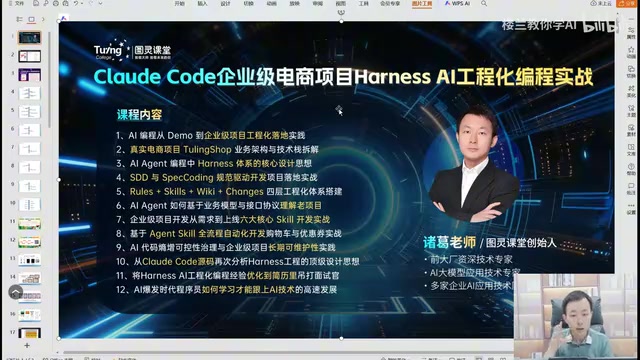
Harness AI Engineering Programming: A Practical Guide for Enterprise-Level Project Implementation
A deep dive into Harness AI engineering programming, covering SDD, Agentic Scale development, and practical solutions for enterprise AI coding challenges.
Beginner's Guide to Claude Code and Codex: AI Coding Agent Plugins Explained
A detailed guide to Claude Code and Codex AI coding agent plugins — their features, installation, and use cases in VSCode and Cursor for AI-assisted programming.
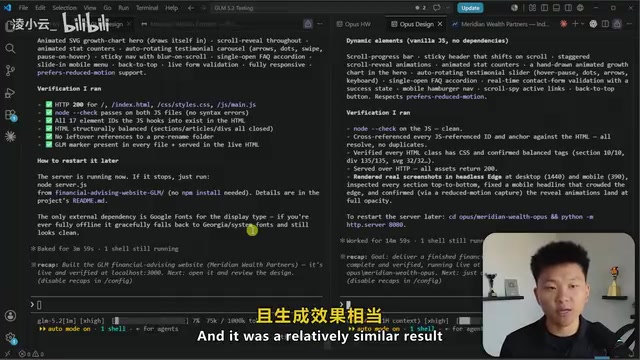
Gemini 5.2 in Claude Code: Real-World Testing — Does It Crush Opus on Cost-Effectiveness?
Real-world testing of Gemini 5.2 in Claude Code vs Opus across web design, coding, creative tasks, and Storm research — analyzing the open-source model's cost advantage and ideal use cases.