Interpreting Cursor's Developer Habits Report: AI Programming Is Reshaping Software Development
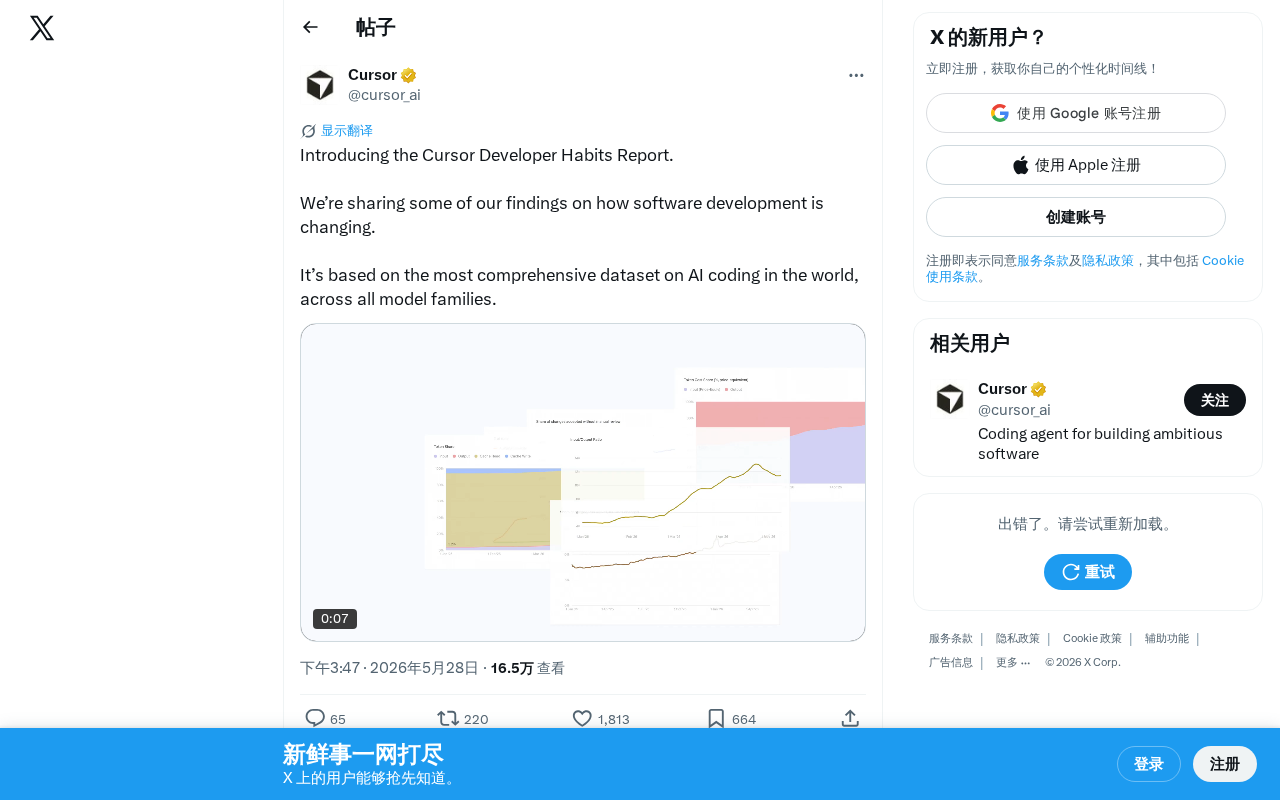
Cursor's Developer Habits Report reveals how AI programming is fundamentally reshaping software development.
Cursor has released its Developer Habits Report, drawing on the world's most comprehensive AI programming dataset spanning all major model families. The report highlights a paradigm shift from code completion to conversational and agent-based programming, the rise of multi-model routing strategies, and the evolving trust dynamics between developers and AI-generated code. It offers actionable insights for developers optimizing their AI workflows while cautioning against automation bias.
Overview
The Cursor team has officially released its Developer Habits Report, based on the world's most comprehensive AI programming dataset, revealing the profound changes taking place in software development. The report covers usage data across all major model families, offering a unique perspective for understanding the current state and trends of AI-assisted programming.
Why This Report Deserves Attention
The Uniqueness of the Data Source
As one of the most popular AI programming IDEs today, Cursor has access to a massive volume of real developer usage data. Cursor is an AI-native code editor developed by Anysphere, built on VS Code's open-source version (Code OSS). It inherits VS Code's vast extension ecosystem and familiar interface while deeply restructuring the editor's interaction pipeline with AI models at the foundational level. Its core technologies include a vector database-based code indexing system capable of semantic-level understanding of entire codebases; intelligent context window management that automatically selects the most relevant code snippets as model input for the current task; and streaming response rendering that displays AI-generated code with real-time diff comparisons. It supports Tab completion, inline editing, multi-file editing, and Agent mode, among other AI interaction methods, and can perceive the entire project's code context, making its code suggestions far more precise than those from general-purpose chatbots. Since its launch in 2023, Cursor has rapidly become the frontrunner in the AI programming tools space, with its user base growing quickly. Unlike academic research or survey-based studies, this report is grounded in actual programming behavior data, genuinely reflecting how developers collaborate with AI in their daily work.
The report claims its dataset is "the world's most comprehensive AI programming dataset," covering all model families including the GPT series, Claude series, and other mainstream large language models. Specifically, OpenAI's GPT series (including GPT-4o, o1, o3, etc.) excels in general reasoning capabilities, with the o-series models employing a Chain of Thought reasoning mechanism that performs exceptionally well on algorithmic problems requiring multi-step logical reasoning. Anthropic's Claude series (particularly Claude 3.5/4 Sonnet) stands out in code generation and long-context understanding, and is considered the top choice for programming scenarios by many developers. Google's Gemini series has advantages in multimodal capabilities and ultra-long context windows, and there are also models like xAI's Grok and Meta's Llama, which are open-source or semi-open-source. The performance differences among these models on programming tasks stem from variations in their training data, architecture design, and optimization objectives. These capability differences have led developers to adopt a "model routing" strategy—selecting the most suitable model based on task complexity and time sensitivity. What makes Cursor unique is that it integrates all these models simultaneously, allowing users to switch freely between them. This has enabled Cursor to accumulate real cross-model comparison data—something no single model provider could obtain. This means developers can gain cross-model comparative insights rather than being limited to evaluating a single model's performance.
A Paradigm Shift in Software Development
The Cursor team has stated clearly that they are observing fundamental changes in software development. This is not merely a tool-level upgrade but a comprehensive reshaping of how developers work, think, and structure their productivity:
-
From code completion to conversational programming: The way developers interact with AI is shifting from passively accepting suggestions to actively engaging in dialogue-based collaboration. Code Completion was the earliest form of AI programming assistance, exemplified by GitHub Copilot. It works like a smart input method—developers type partial code, and the AI predicts and completes the rest. It is fundamentally one-directional and passive. Conversational Programming, on the other hand, represents an entirely new paradigm: developers describe their intent in natural language, the AI understands the requirements and generates a complete code solution, and developers then review and modify it. Cursor's Chat feature and Agent mode are prime examples of this trend. Agent mode goes even further, representing the latest evolution in AI programming assistance—its core concept draws from the AI Agent research paradigm. In this mode, the large language model is no longer just a code generator but is endowed with Tool Use capabilities. It can invoke terminal commands, read the file system, search the codebase, run test suites, and iteratively correct based on execution results. This "think-act-observe" loop (the ReAct paradigm) enables AI to handle complex programming tasks requiring multi-step reasoning, forming a semi-autonomous programming cycle. Similar Agent architectures have also appeared in products like Devin, OpenAI Codex CLI, and Claude Code, signaling that AI programming tools are evolving from "copilot" to "autopilot." This shift means developers' core skills are migrating from "writing code" to "describing problems and reviewing solutions."
-
From a single model to multi-model collaboration: Developers are beginning to choose different AI models based on task type. For example, faster and cheaper models (such as GPT-4o-mini, Claude Haiku) are suited for simple code completion and formatting tasks, while models with stronger reasoning capabilities (such as o3, Claude Sonnet) are used for complex architectural design and debugging scenarios. This differentiated model selection strategy is becoming a hallmark habit of highly efficient developers.
-
From assistive tool to core workflow: AI programming assistants are becoming an indispensable part of the development process.
Potential Value of the Report
Practical Significance for Developers
For individual developers, this report can help optimize AI tool usage strategies. Specifically, developers can learn:
- How other highly productive developers leverage AI programming assistants to boost productivity
- Which models perform better on specific programming tasks
- How to adjust their workflows to better integrate AI assistance
Impact on Industry Development
From an industry perspective, this report provides data-backed support for the direction of AI programming tool development. It may reveal answers to key questions such as:
- Which programming tasks are best suited for AI assistance
- How developer trust in AI-generated code is evolving
- What differences exist in AI usage patterns among developers of varying experience levels
Regarding the evolution of trust, this is a topic worthy of deeper attention. In the early days, most developers viewed AI as an "unreliable intern," carefully reviewing every line of code it generated. As model capabilities have improved, a new trust model is emerging: developers are beginning to build "calibrated trust" in AI for specific tasks—for example, trusting AI to handle boilerplate code, unit tests, and documentation generation, while maintaining higher review standards for code involving security, concurrency control, or complex business logic. This differentiated trust strategy actually reflects developers' gradual understanding of AI's capability boundaries.
It's worth noting that over-trust can lead to "Automation Bias"—a classic concept in human factors engineering referring to the human tendency to over-rely on automated system outputs, even when obvious error signals are present. This risk is particularly pronounced in AI programming scenarios: code generated by large language models is typically syntactically correct and professionally styled, but may contain subtle logic errors, race conditions, SQL injection vulnerabilities, or improper error handling. A 2023 Stanford University study found that developers using AI assistance actually produced code with a higher proportion of security vulnerabilities, and these developers also had greater confidence in the security of their code—a textbook manifestation of automation bias. Therefore, while enjoying the efficiency gains AI brings, developers need to consciously maintain rigor in code review, especially on security-critical code paths.
Outlook and Reflections
As AI programming tools rapidly gain widespread adoption, industry reports like this will become increasingly important. Cursor's decision to publicly share these findings not only demonstrates its data advantage in the AI programming space but also provides a valuable reference for the entire developer community.
One detail worth mentioning: as a report published by a commercial company, readers should consider potential positional bias when referencing it. This is common in the tech industry—similar examples include Salesforce's CRM industry reports and GitHub's Octoverse developer reports. These reports typically have an authenticity advantage in data collection since they draw from first-hand platform usage data, but they may lean toward highlighting trends favorable to their own products in terms of data selection, metric definitions, and conclusion framing. When referencing the report, readers can focus on the raw data and specific figures while maintaining independent judgment on qualitative conclusions. Cross-referencing third-party data sources such as the Stack Overflow Annual Developer Survey and JetBrains Developer Ecosystem Report can help build a more comprehensive industry picture. Regardless, insights based on real usage data are far more valuable than pure predictions and speculation.
For developers who are currently using or considering AI programming tools, this report provides a window into the full industry landscape and is well worth reading and reflecting upon in depth.
Key Takeaways
Related articles

Claude Code for Test Development in Practice: An AI Programming Workflow That Doubles Your Efficiency
A practical guide to Claude Code for test development: auto-generating test scripts, Plan Mode workflows, MCP + Playwright integration, and Subagent parallel tasks to build systematic AI-assisted workflows.

Hermes Agent Hands-On Review: An AI Efficiency Revolution for Indie Game Developers
Indie game developer reviews Hermes Agent vs OpenClaude: intelligent context compression, real-time Memory, remote control via Telegram, and practical use cases in game dev, social media, and email.
Vibe Coding Beginner's Guide: Tool Selection Across Three Categories with Practical Examples
A comprehensive guide to Vibe Coding's three tool categories: Agent frameworks, CLI Coding, and IDE tools, with practical examples including Snake game and data analysis workbench.