Karpathy's Advanced Claude Code Methodology: Building a Self-Evolving AI Work Environment
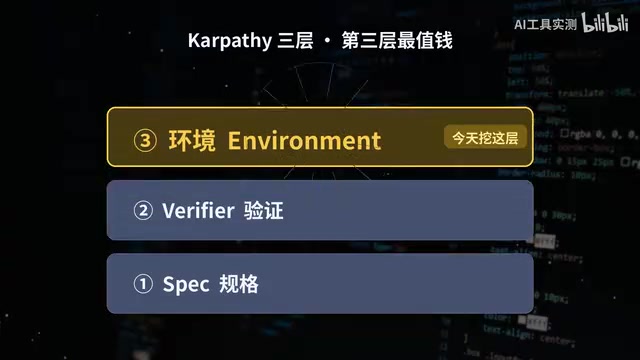
Karpathy's four-part framework turns Claude Code from a disposable chat tool into a self-evolving AI work system.
Andrej Karpathy argues most people use Claude Code wrong by treating it as a one-off chat tool. His three-layer architecture centers on the Environment Layer — a persistent system built from four components: CLAUDE.md (working guidelines), a knowledge base (grounded information), Skills (compound-interest automation), and Hook guardrails (hard safety constraints). Built once, this system grows stronger with every use, shifting AI from disposable tool to continuously evolving work environment.
Former Tesla and OpenAI AI lead Andrej Karpathy recently made a sharp observation: Almost everyone is using Claude Code the wrong way. How so? They treat it as a disposable chat tool — open a conversation, toss in a task, and start from scratch next time. That's like rebuilding your workshop from the ground up every single time, trapping yourself in an endless cycle of inefficiency.
Karpathy is one of the most influential practitioners in deep learning. He studied under computer vision pioneer Fei-Fei Li at Stanford, focusing his doctoral research on the intersection of images and natural language. In 2017, he joined Tesla as Director of AI and Autopilot Vision, spearheading the pure-vision approach to autonomous driving. In 2023, he briefly joined OpenAI before departing again to focus on AI education and the open-source community. His YouTube neural network tutorial series has accumulated over ten million views, earning him the reputation of "the AI scientist who teaches best." It's precisely this unique background spanning academia, industry, and education that makes his insights on AI tool methodology resonate with everyone from beginners to senior engineers.
Karpathy's methodology is a three-layer architecture. The first two layers (basic conversation and prompt optimization) have already been widely discussed. But the truly overlooked layer with the highest returns is Layer Three: the Environment Layer — build it once, and it gets stronger the more you use it.
He also shared a deeper insight worth remembering: You can outsource thinking, but you can't outsource understanding. This means the real leverage isn't in writing better prompts — it's in building an environment for AI that crystallizes your understanding.
What Is an AI Work Environment?
An environment is essentially a workspace where AI "lives." It's not a one-off prompt but a persistent rule system that makes AI automatically follow your preset working guidelines every time it starts up.
The core idea behind this methodology is: Crystallize your understanding once into rules that AI follows every day, instead of repeating the same instructions in every conversation. This concept applies to anyone using AI coding tools, whether you're on Claude Code, Cursor, or a domestic solution powered by DeepSeek.
It's worth explaining Claude Code's technical positioning here. It's a command-line AI coding tool from Anthropic that's fundamentally different from traditional chat-based AI assistants. It runs directly in your terminal environment, can read, create, and modify local files, execute shell commands, and deeply integrate with development toolchains like Git. This means it doesn't just "answer questions" — it can actually "get things done" by operating directly in your code repository. Similar tools include GitHub Copilot's CLI mode and Cursor's built-in AI Agent. What makes Claude Code unique is its configurability: through mechanisms like CLAUDE.md, developers can deeply customize AI behavior patterns — this is the technical foundation that makes Karpathy's "environment layer" possible.
Specifically, Karpathy's environment system consists of four core components, which I call the "Four Essentials."
CLAUDE.md — AI's Working Guidelines
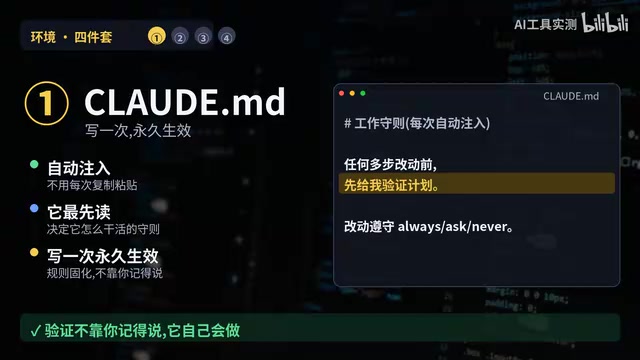
CLAUDE.md is Claude Code's configuration file. Every time you start a conversation, its contents are automatically injected at the very beginning of the context, becoming the first working guidelines the AI reads.
To understand why this works, you need to know about the "context window" mechanism of large language models. Each time you chat with AI, the total amount of information the model can process is limited (Claude currently supports a context window of approximately 200K tokens, roughly equivalent to 150,000 words). The model generates responses based on all information in the context, and content at the very beginning of the context typically has stronger guiding power — this is academically known as the "Primacy Effect." CLAUDE.md's design leverages exactly this characteristic: its content is automatically injected at the front of the context at the start of every conversation, essentially implanting a set of persistent behavioral guidelines into AI's "working memory." Compared to manually pasting instructions at the beginning of each conversation, this not only eliminates repetitive operations but also ensures consistency and completeness of rules.
For example, you only need to write one rule:
"Before any multi-file changes, show me a verification plan first."
From then on, the verification process no longer depends on you remembering to remind the AI every time — it executes automatically. The barrier to entry is much lower than you'd think. This isn't exclusive to programmers — anyone who needs AI assistance with repetitive work can get started.
Knowledge Base — A Moat Others Can't Copy
Karpathy shared a viral idea on Twitter: Organize your own materials into a structure where AI instantly knows where to find things.
The specific approach is to structurally organize your documents, specifications, and past projects, then feed them to the AI. The result: AI stops guessing and hallucinating, and instead draws answers from your actual materials.
Here's why a knowledge base effectively addresses AI "hallucination." AI hallucination is one of the most well-known flaws of large language models — the model outputs completely fabricated information with extreme confidence. The root cause is that language models are fundamentally probability prediction systems: they predict "the most likely next word," not "the most correct next word." When the model lacks sufficient contextual information, it tends to "fill in the blanks" using statistical patterns from training data, producing output that seems plausible but is actually wrong. Karpathy's knowledge base approach is essentially a lightweight RAG (Retrieval-Augmented Generation) strategy: by directly providing real, accurate private documents to the model, it has evidence to rely on when generating answers rather than fabricating from thin air. This method has been widely validated in enterprise applications, reducing hallucination rates by 60%-80%.
Guidelines (CLAUDE.md) tell AI "how to work"; the knowledge base tells AI "what to work with." Combined, AI output quality takes a qualitative leap. More importantly, this knowledge base is your unique accumulation — a competitive moat that others cannot replicate.
Skills — A Compound Interest System That Improves with Use
Here's a simple rule of thumb: Anything you need to do repeatedly should be turned into a Skill.
A Skill is essentially an operations manual for AI on "how to do this specific thing." The key is its compound interest effect — the more you use it, the more you discover what needs to be supplemented and optimized, and the system automatically appreciates over time.
Karpathy uses "compound interest" to describe the value growth pattern of the Skill system, and this analogy precisely captures the core principle of knowledge management. In software engineering, this pattern is called "Incremental Improvement," sharing the same philosophy as Continuous Integration/Continuous Deployment (CI/CD). Each Skill might only cover 80% of scenarios when first created, but every actual use exposes edge cases. After patching, coverage gradually climbs to 95%, then 99%. This mirrors the logic of model fine-tuning in machine learning — rather than pursuing perfection in one shot, you approach the optimal solution through continuous feedback loops. More importantly, the accumulation of Skills has network effects: once the number of Skills reaches a certain scale, they can be combined and called upon each other, generating value far exceeding the simple sum of individual Skills.
As the saying goes: "The best way to find leaks in a hose is to run water through it." Skills work the same way — real-world use continuously exposes problems, continuous patching eventually polishes them into highly reliable standardized processes.
For example, the process of registering a new service can be completed in seconds once turned into a Skill, ready to be called directly next time. All repetitive labor gets absorbed into the system once and for all.
Hook Guardrails — The Critical Leap from "Obedient" to "Reliable"
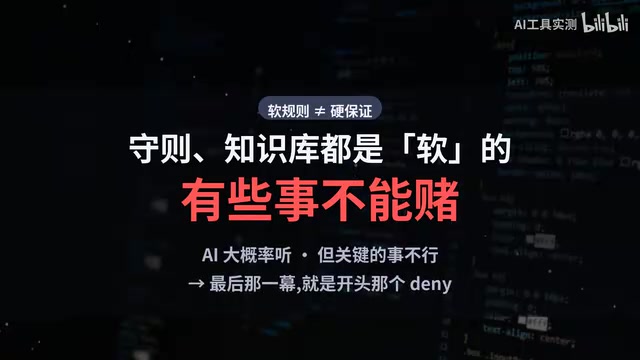
The first three components (CLAUDE.md, Knowledge Base, Skills) are essentially "soft constraints" — AI will most likely comply, but for some things, you can't bet on "most likely."
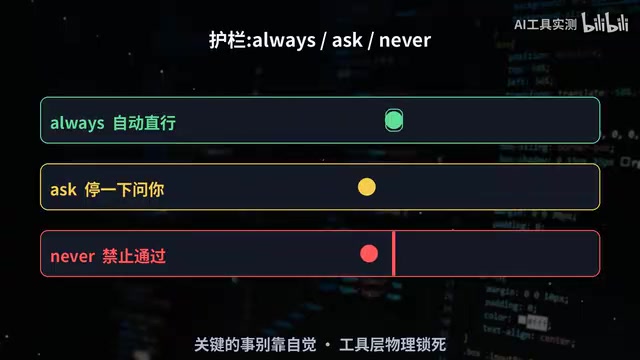
The guardrail design categorizes all operations into three levels:
- Always: Execute automatically, no confirmation needed
- Ask: Ask you first, execute only after permission
- Never: Absolutely off-limits, physically isolated
Why "Don't Touch This Folder" in CLAUDE.md Isn't Enough
Because that's merely a request — AI still has the ability to touch it. Protecting critical assets can't rely on AI's self-discipline.
The real lock is the Pre-tool-use Hook. Here's how it works: before Claude modifies any file, the operation passes through an interception layer. Once it detects the target is a protected directory, the operation is flatly rejected — this is a block at the tool level, not a suggestion at the prompt level, but a physical impossibility to modify.
Hooks are not a new concept in AI — they originate from a long-standing design pattern in software engineering. In Git version control, pre-commit hooks can automatically run check scripts before code commits, preventing non-compliant code from entering the repository. In web development, middleware plays a similar role, intercepting and filtering requests before they reach business logic. Claude Code's Pre-tool-use Hook extends this approach: it inserts an interception layer before AI calls any system tool (such as file editing or command execution) to perform rule matching on the operation. If the operation touches a protected resource, the Hook directly returns a rejection signal — the entire process occurs at the tool execution level, not the prompt level. This "hard constraint" complements the "soft constraints" in CLAUDE.md — the former is a physical lock, the latter is a behavioral norm, and together they form a complete security system.
Meanwhile, for regular files, Hooks let operations pass through normally — fast where it should be fast, locked down where it must be locked. This layer is what truly upgrades the environment from "obedient" to "reliable."
Core Takeaway: From Tool Usage to System Building
Looking back at Karpathy's complete methodology, its essence lies in a mindset shift: Stop treating AI as a disposable tool and start building it as a system that requires continuous optimization.
The hierarchy of the Four Essentials is crystal clear:
- CLAUDE.md solves "what rules should AI follow"
- Knowledge Base solves "what information should AI use"
- Skills solve "how should AI work efficiently" and continuously evolve
- Hook Guardrails solve "what AI absolutely must never do" — the safety baseline
The beauty of this system is: building it is a one-time cost, but the returns compound continuously. Every additional day of use makes the system a little stronger than yesterday. This is the real personal competitive advantage in the AI era — it's not about who writes fancier prompts, but who has built a deeper AI work environment.
It's worth noting that the underlying logic of this methodology is highly consistent with the "Infrastructure as Code" philosophy in software engineering: codifying and versioning all environment configurations, workflows, and security rules to make them reproducible, iterable, and auditable. This means your AI work environment itself can be version-managed with Git, shared and collaboratively improved among team members, giving the entire system engineering-grade scalability.
For readers looking to get started, I recommend beginning with the simplest step — CLAUDE.md: write down the three rules you most frequently repeat, and save them as a configuration file. This single step alone will deliver an immediate efficiency boost. Then gradually build up your knowledge base, accumulate Skills, and finally add Hook guardrails — and your very own AI work system is complete.
Related articles
GLM 5.2 & Zcode Hands-On Review: A Deep Dive into the Free AI Coding Tool with 5 Million Tokens/Day
In-depth review of Zhipu's GLM 5.2 model and Zcode programming tool: interface experience, coding benchmarks, and long-horizon Agent performance compared to GPT and Opus. 5M free tokens/day with MIT license.
Devin Review Security Audit Feature Explained: How AI Code Review Detects Deep Security Vulnerabilities
Devin Review adds AI security audit to auto-detect auth bypasses, logic flaws & deep vulnerabilities in every PR, with full remediation from finding to fix.
Founders Fund Invests in Shinkei: The Business Logic Behind a Humane Fish-Slaughter Robot
Founders Fund bets on Shinkei, a humane fish-slaughter robotics company. Its Poseidon robot automates Japan's Ikejime technique. Analyzing the tech moat, market opportunity, and food tech trends.