Moonshot K2.7 Code Released: 30% Fewer Reasoning Tokens, Comprehensive Coding Performance Improvements
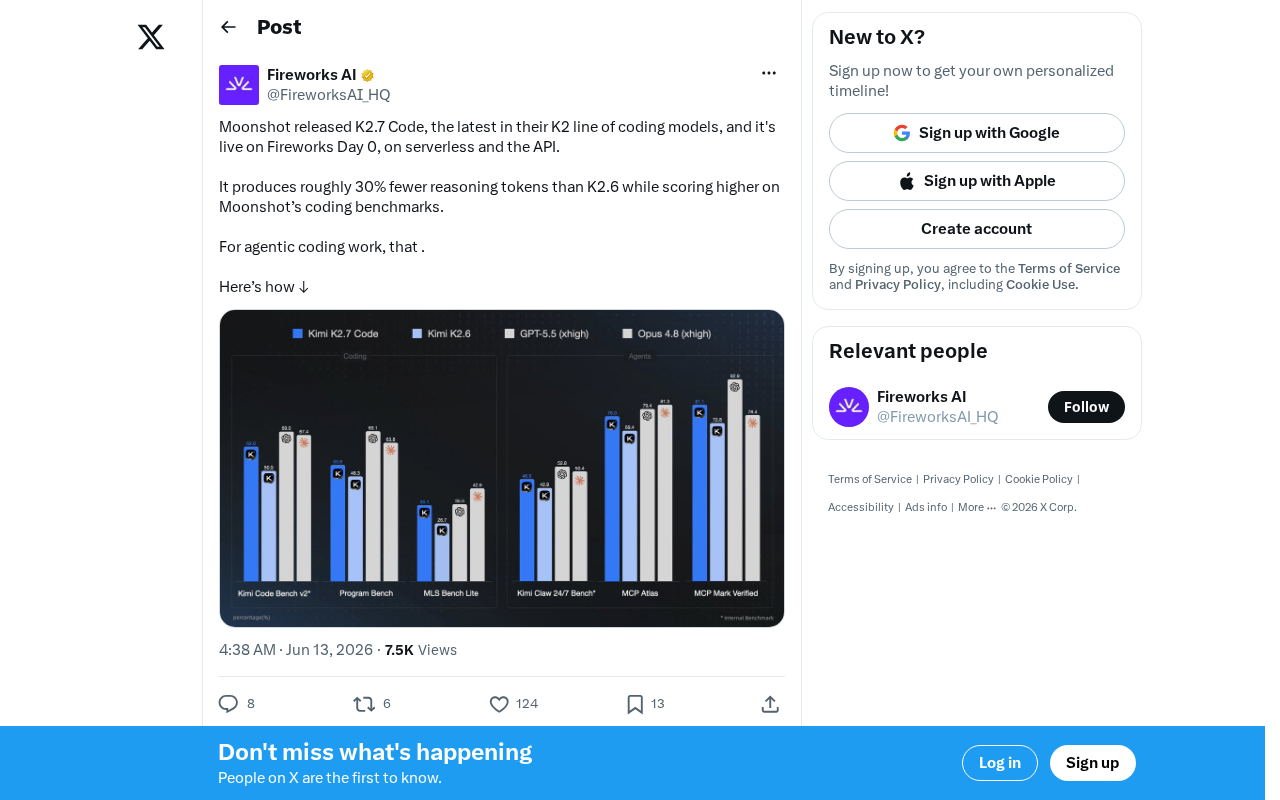
Moonshot's K2.7 Code cuts reasoning tokens by 30% while improving coding benchmark scores.
Moonshot has released K2.7 Code, the latest in its K2 coding model series, now available on the Fireworks platform. Compared to K2.6, the new model reduces reasoning token consumption by ~30% while achieving higher coding benchmark scores. This efficiency gain is especially impactful for agentic coding workflows, where cumulative token savings across dozens of interaction rounds translate into significant cost reductions and faster task completion.
Overview
Moonshot recently released K2.7 Code, the latest version of its K2 series coding models. The model is now live on the Fireworks platform, supporting serverless deployment and API access. Compared to its predecessor K2.6, K2.7 Code reduces reasoning token consumption by approximately 30% while achieving higher scores on coding benchmarks — a significant advancement for agentic coding workflows.
Moonshot (月之暗面) is an AI company founded in 2023 by Yang Zhilin, a Tsinghua University alumnus. Known for its long-context processing capabilities, the company's consumer product Kimi has a broad user base in the Chinese market. The K2 series is Moonshot's coding-specific model line targeting professional developers and enterprise markets, positioned to compete directly with products like Anthropic's Claude Code and OpenAI's Codex. The K2 series has maintained a rapid iteration pace, with a short upgrade cycle from K2.6 to K2.7, reflecting the intense competition in the coding model space. The decision to launch on overseas inference platforms like Fireworks also signals Moonshot's strategic intent to expand into the global developer market.
Core Upgrades: Fewer Tokens, Higher Performance
Significant Improvement in Reasoning Efficiency
The most notable improvement in K2.7 Code is the dramatic boost in reasoning efficiency. Compared to K2.6, the new model generates approximately 30% fewer reasoning tokens. This means the model requires fewer "thinking steps" to complete the same coding tasks, resulting in faster response times and correspondingly lower computational costs.
To understand the technical significance of this improvement, it helps to understand what reasoning tokens actually are. Reasoning tokens are the intermediate tokens generated during the model's internal step-by-step reasoning process before producing the final answer. This mechanism originates from Chain-of-Thought (CoT) techniques, first systematically proposed by the Google Brain team in their 2022 research. Under the CoT paradigm, instead of directly outputting an answer, the model first generates a series of intermediate reasoning steps before reaching a conclusion. This approach significantly improves accuracy on complex tasks, but at the cost of substantially increased token consumption. OpenAI's o1 series models took this approach to its extreme by introducing a dedicated "thinking tokens" concept. Therefore, K2.7 Code's ability to reduce reasoning tokens by 30% without sacrificing performance essentially means the model has learned more efficient reasoning path compression — skipping redundant intermediate steps and going straight to critical reasoning nodes.
For teams and enterprises that use coding models at scale, a 30% token reduction translates directly into significant cost savings and latency optimization. Under token-based API billing models, the economic value of this improvement cannot be overlooked.
Higher Coding Benchmark Scores
Notably, the reduction in token count does not come at the expense of performance. According to Moonshot's official coding benchmark results, K2.7 Code actually scores higher than K2.6. This indicates a qualitative leap in reasoning quality — achieving better coding results through more refined reasoning paths.
K2.7 Code's Impact on Agentic Coding
Why Token Efficiency Is Critical for Agentic Coding
In agentic coding scenarios, AI models need to perform multi-round iterative operations: analyzing codebases, formulating plans, writing code, debugging, running tests, and more. Each round of interaction consumes a large number of tokens, and a complete coding task may involve dozens or even hundreds of such interactions.
Agentic coding has been one of the most important paradigm shifts in AI-assisted development since 2024. Unlike traditional code completion (such as GitHub Copilot's early mode), agentic coding gives AI models autonomous planning and execution capabilities: the model can independently read files, execute terminal commands, run tests, and iteratively fix code based on error messages. Representative products include Cursor's Agent mode, Claude Code, Devin, and OpenAI's Codex. In this mode, a single user request may trigger dozens of tool calls and context switches, each involving substantial token input and output. As a result, single-round reasoning token efficiency is amplified by orders of magnitude, becoming a critical factor in determining practical usability and economic viability.
In this context, saving 30% of reasoning tokens per interaction round produces a staggering cumulative effect. Assuming a complex coding task requires 50 rounds of interaction, the token savings accumulate linearly, potentially saving tens or even hundreds of thousands of tokens in total. This not only reduces costs but also accelerates overall task completion time.
Practical Use Cases
For developers using AI coding assistants for the following tasks, K2.7 Code's efficiency improvements are particularly impactful:
- Large-scale code refactoring: Requiring the model to understand overall architecture and progressively modify multiple files
- Automated test generation: Requiring multiple iterations to ensure test coverage
- Bug fix workflows: The complete pipeline from identifying issues to verifying fixes
- Multi-file collaborative development: Requiring consistent context across different files
Immediately Available on Fireworks
K2.7 Code is now live through Fireworks' Day 0 program, and developers can start using it immediately via serverless deployment and standard APIs. This rapid deployment model means developers can integrate the latest model into their existing workflows without delay.
Fireworks AI is a company focused on large model inference infrastructure, founded by former core members of Meta's PyTorch team. Its core competitive advantage lies in FireAttention, a high-performance model inference engine that achieves high throughput while maintaining low latency. The serverless deployment model means developers don't need to manage GPU instances, handle scaling, or deal with load balancing and other operational tasks — they simply call the API and pay based on actual token consumption. Fireworks' Day 0 program is a rapid launch mechanism in partnership with model providers, ensuring new models are available to developers on the platform the same day they're released. This model dramatically shortens the gap between model release and production readiness.
Industry Trend Observations
The release of K2.7 Code reflects an important trend in AI coding model development: dramatically optimizing reasoning efficiency while maintaining or improving performance. As agentic coding becomes the mainstream development paradigm, a model's token efficiency will become a competitive dimension equally important as accuracy.
Going forward, we can expect more model providers to compete on "reasoning density" — the amount of effective information produced per token. Reasoning density is emerging as a new dimension for evaluating reasoning models. Traditionally, model competition has primarily revolved around benchmark scores, but as reasoning models become widespread, the industry has gradually recognized that "how much computational cost it takes to reach a certain performance level" is equally important. DeepSeek-R1's success is partly attributed to achieving reasoning capabilities close to top-tier models at lower computational costs. Similarly, Anthropic demonstrated with Claude 3.5 Sonnet a path to improving efficiency through model architecture optimization rather than simply scaling up. The underlying logic of this trend is clear: as model capabilities converge, efficiency and cost will become the core battleground for differentiation — especially in enterprise-scale deployment scenarios.
Key Takeaways
Related articles

Frontend to AI Agent Architect: A Complete 3-Month Learning Roadmap
How can frontend engineers transition to AI Agent development? A systematic 3-month roadmap covering AI concepts, model selection, team productivity, and Agent architecture.

Replit CEO on the Rise of AI-Native Developers: Future Companies Will Have Only Builders and Sellers
Replit closes $400M Series D at $9B valuation. CEO Amjad shares insights on vibe coding, Agent 4 parallel agents, cross-platform deployment, and how AI is reshaping companies and software development.
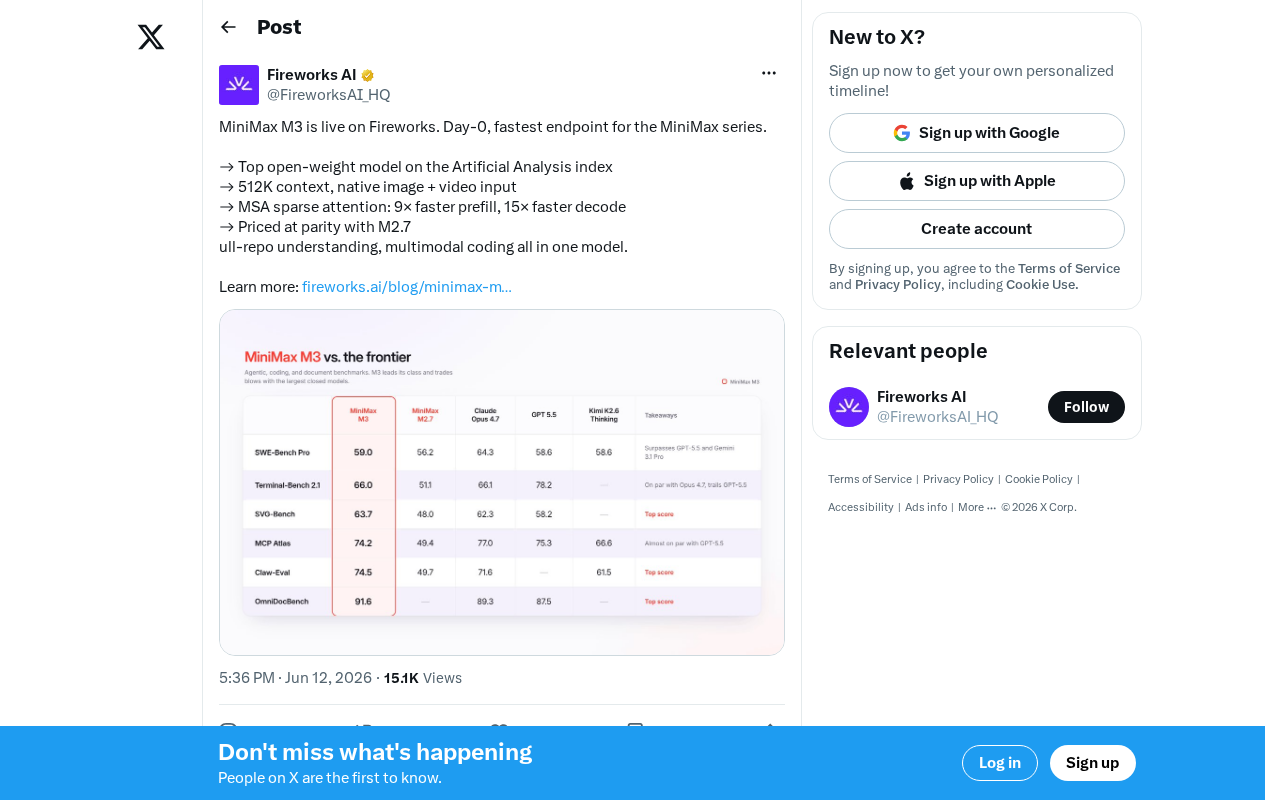
MiniMax M3 Launches on Fireworks: 512K Context and MSA Sparse Attention Explained
MiniMax M3 launches on Fireworks with 512K context and multimodal input. MSA sparse attention delivers 9x prefill and 15x decode speedups. Deep dive into architecture, pricing, and open-model competition.