n8n from Beginner to Expert: A Complete Guide to Workflow Automation and AI Agent Development
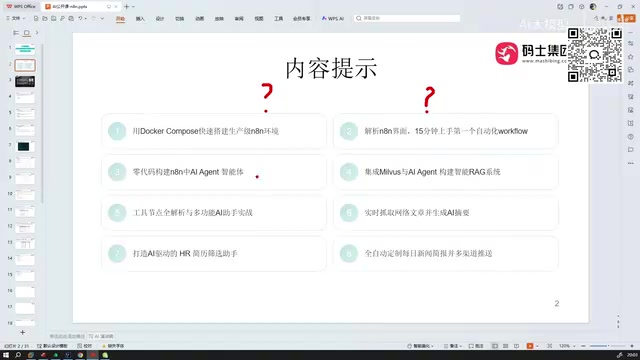
A comprehensive guide to n8n workflow automation, AI Agent building, and RAG system development.
This guide provides an in-depth look at n8n, an open-source low-code workflow automation platform with 500+ integration nodes. It covers n8n's three core strengths — powerful integrations, flexible logic orchestration, and deep AI capabilities including AI Agents, Chain nodes, and RAG systems. The article also addresses localization challenges for Chinese users and offers practical workarounds, along with recommendations on when n8n is the right choice.
What Is n8n? Far More Than Just an AI Workflow Tool
When people hear about n8n, their first reaction is often "just another AI workflow tool." But in reality, n8n is fundamentally a general-purpose low-code workflow automation platform whose capabilities extend far beyond AI.
Low-code platforms have become a major trend in software development in recent years. The core idea is to replace traditional hand-written code with visual drag-and-drop configuration, enabling non-developers to build applications. Gartner predicts that by 2025, 70% of new applications will be developed using low-code/no-code technologies. n8n competes in the workflow automation space alongside products like Zapier, Make (formerly Integromat), and Power Automate, but its biggest differentiator is its open-source nature — users can self-host, maintaining full control over their data and runtime environment, which is especially important for data-sensitive organizations.
Data cleaning, web scraping, video publishing, comment analysis — tasks that have nothing to do with AI — n8n handles them all with ease. Think of it as a "universal glue" that binds different services, data sources, and operational logic together into automated workflows.
Of course, with the explosive growth of AI, n8n has also made significant improvements in AI integration, supporting the construction of AI Agents and RAG (Retrieval-Augmented Generation) systems, which has quickly made it popular among AI developers.
Three Core Features of n8n
Powerful Integration Capabilities: 500+ Node Ecosystem
n8n workflows are composed of individual "nodes," each responsible for a specific function — some nodes scrape data from web pages, others publish content to video platforms, and still others fetch news from media sites.
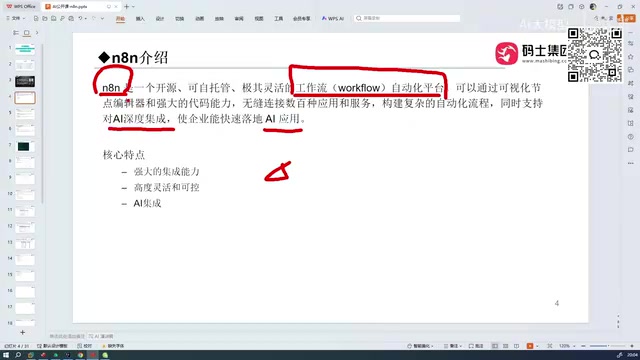
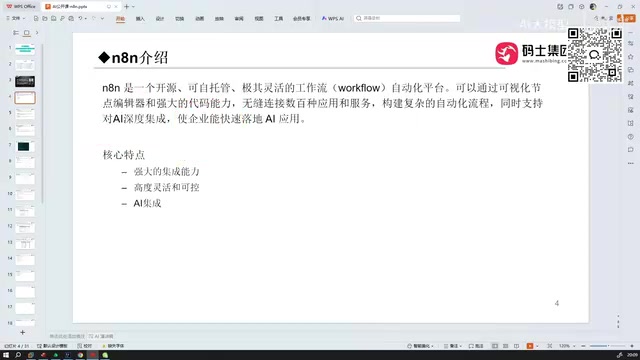
Currently, n8n officially supports at least 500+ nodes, with some estimates putting the number above 1,000. By comparison, platforms commonly used in China such as Dify and Coze still have a gap in node richness. Dify is an open-source LLMOps platform developed by a Chinese team, with native support for domestic large models like Tongyi Qianwen, ERNIE Bot, and Zhipu GLM, offering better adaptation for Chinese-language scenarios. Coze is an AI Bot development platform launched by ByteDance, deeply integrated with the Doubao large model and ByteDance's product ecosystem. Compared to n8n, both platforms are more focused on AI scenarios but relatively limited in general workflow automation capabilities. For users in China, if the focus is on AI applications targeting the domestic market, Dify/Coze may be more suitable; if you need extensive third-party service integration targeting global markets, n8n has the advantage.
n8n's massive node ecosystem means you can integrate virtually any mainstream online service into your workflows.
Highly Flexible and Controllable: Orchestrate Complex Logic at Will
n8n's second major advantage lies in workflow flexibility. It supports:
- Branch nodes: Route to different processing paths based on conditions
- Loop nodes: Batch process data
- Error handling: Fallback strategies for exceptional situations
- Data transformation: Freely convert between different formats
This means you can implement highly complex business logic within a single workflow, rather than being limited to simple linear "trigger → execute" flows.
Deep AI Integration: Agent + RAG + Chain
n8n's core AI capabilities can be summarized into three major modules:
- AI Agent: Build AI agents capable of autonomous decision-making and tool invocation
- Chain nodes: Three types of chain nodes for handling different AI tasks
- Tool nodes (Tools): Various tools that Agents can call upon — the key to making AI capabilities actionable
These three components form n8n's core competitive advantage in the AI space and represent the most worthwhile area to explore in depth when learning n8n.
n8n's "Localization Challenges" in China
If n8n is so powerful, why isn't it widely adopted by Chinese enterprises? This question deserves careful consideration.
The Geographic Divide in Node Ecosystem
n8n is an international platform, and its 500+ node ecosystem primarily serves overseas use cases. This creates an awkward reality:
| Supported Internationally | Missing for China |
|---|---|
| YouTube video publishing | No Bilibili/Douyin nodes |
| Telegram messaging | No WeChat/WeCom nodes |
| Google Sheets data writing | No Feishu Sheets nodes |
| Airtable online database | No domestic database nodes |
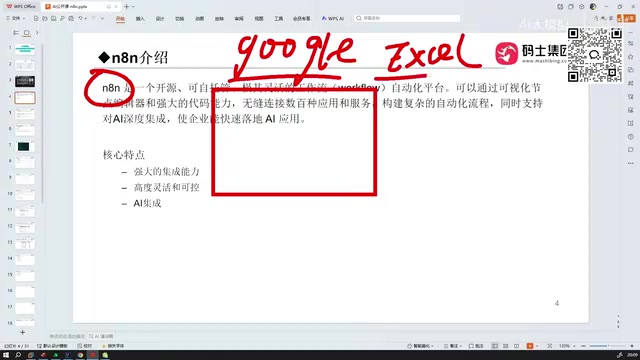
Here's a concrete example: n8n can directly write data to Google Sheets via a built-in node, but if you want to write to Feishu Sheets or Tencent Docs, there are no official nodes available. Similarly, n8n supports sending messages to Telegram but doesn't natively support WeChat integration.
Workarounds: HTTP Request + Webhook
Although n8n lacks native nodes for Chinese services, this doesn't mean it's completely unusable. Through HTTP Request nodes and Webhooks, you can manually integrate any Chinese service that provides an API.
A Webhook is a lightweight integration mechanism based on HTTP callbacks, often called a "reverse API." Traditional APIs follow a Pull model where the client actively requests data from the server, while Webhooks follow a Push model where the server proactively sends data to a preset URL when a specific event occurs. For example, when a GitHub repository receives a new Pull Request, a Webhook can automatically notify n8n to trigger a code review workflow. n8n's built-in Webhook node generates a unique URL endpoint — any external system capable of sending HTTP requests can trigger a workflow in n8n. This is also the primary workaround for integrating Chinese services (such as Feishu, DingTalk, and other platforms with open APIs) with n8n.
However, this approach requires a certain level of technical expertise, sacrificing the convenience of "low-code."
Additionally, n8n supports custom node development — if you have Node.js development skills, you can build dedicated nodes for Chinese services.
Deep Dive into n8n's Three Core AI Development Modules
AI Agent: Teaching LLMs to "Use Tools"
The AI Agent is n8n's most essential AI capability. In simple terms, it enables large language models to go beyond just "chatting" — they can autonomously decide which tools to invoke to complete tasks based on user needs.
The core concept behind AI Agents originates from the ReAct (Reasoning + Acting) framework, proposed by Google Research and Princeton University in 2022. Traditional large language models can only generate text, but in Agent mode, the model enters a "Think → Act → Observe" loop: it first reasons about what to do, then calls external tools to execute actions, and then decides the next step based on the returned results. OpenAI's Function Calling and Tool Use mechanisms provide standardized interfaces for this paradigm, enabling LLMs to declare and invoke tools in a structured manner. n8n leverages this mechanism by encapsulating tool invocation as visual nodes, significantly lowering the barrier to Agent development.
To build an AI Agent in n8n, you need to:
- Choose an LLM (such as GPT-4, Claude, etc.) as the "brain"
- Configure available tool nodes (such as search, database queries, API calls, etc.)
- Set system prompts to define the Agent's behavioral boundaries
Chain Nodes: Structured AI Task Processing
Chain nodes provide three types of chain-based processing capabilities suited for different AI task scenarios. Unlike an Agent's "autonomous decision-making," Chains are more like predefined AI processing pipelines — input data passes through multiple AI processing stages in a fixed sequence to produce the final output.
n8n's Chain node design is heavily influenced by the LangChain framework. LangChain is an open-source project initiated by Harrison Chase in late 2022 that abstracts common patterns in LLM application development into the concept of "Chains" — each chain is a processing unit, and multiple chains can be linked together to form complex processing pipelines. For example, a typical summarization chain first splits a long document into chunks, generates a summary for each chunk, and then consolidates all summaries into a final one. n8n transforms this programming paradigm into visual nodes, enabling users unfamiliar with Python to build similar AI processing pipelines.
This pattern is ideal for scenarios with clearly defined processes that don't require autonomous AI judgment, such as text summarization, translation, and format conversion.
RAG System: Giving AI "Private Knowledge"
n8n supports building complete RAG (Retrieval-Augmented Generation) systems, one of the hottest directions in enterprise AI applications today. With RAG, you can enable AI to answer questions based on your private documents and knowledge bases, rather than relying solely on the model's pre-trained knowledge.
RAG was first proposed by Meta AI in 2020 to address two major pain points of large language models: knowledge cutoff date limitations and hallucination problems. It works by retrieving the most relevant document fragments from an external knowledge base before generating an answer, then injecting those fragments as context into the prompt to guide the model toward generating responses based on factual information. Vectorization is a key technical component of RAG — Embedding models (such as OpenAI's text-embedding-3-small) convert text into high-dimensional vectors stored in specialized vector databases, and queries use algorithms like cosine similarity to quickly find the most semantically similar content. This architecture allows enterprises to make AI "understand" internal documents without fine-tuning the model.
A typical RAG system workflow in n8n includes:
- Document loading and chunking: Import documents in formats like PDF, Word, or web pages, and split them into smaller text chunks by semantic meaning or fixed length (typically 500-1,000 tokens each) for precise retrieval later
- Vectorization and storage: Convert text chunks into vectors using an Embedding model and store them in a vector database. n8n supports mainstream vector databases like Pinecone and Qdrant. Pinecone is one of the earliest cloud-native vector databases, offered as a managed service and ideal for quick starts; Qdrant is an open-source high-performance vector search engine that supports self-hosted deployment, making it more popular in privacy-sensitive scenarios. Other options include Weaviate, Milvus, and Chroma
- Semantic retrieval at query time: Vectorize the user's question and find the most similar text chunks in the vector database
- Inject retrieval results into the LLM for final answer generation: Send the retrieved relevant document fragments along with the user's question to the large model to generate fact-based responses
Summary: Who Should Use n8n?
As an open-source workflow automation platform, n8n's greatest value lies in visualizing complex automation logic and lowering the technical barrier. For AI developers, n8n provides a way to rapidly build AI Agents and RAG systems without writing code from scratch.
Scenarios well-suited for n8n:
- Rapid prototyping and validation of AI applications
- Business processes involving integration of multiple international SaaS services
- Teams with limited technical capabilities that need to build automated workflows
- Individual developers building personal AI assistants or automation tools
Scenarios requiring careful consideration:
- Businesses heavily dependent on China's domestic service ecosystem (WeChat, Feishu, DingTalk, etc.)
- Production environments with high performance and concurrency requirements
- Enterprise-grade AI applications requiring deep customization
Overall, n8n is a tool well worth investing time to learn, especially its capabilities in AI Agent and RAG development, which offer developers a "what you see is what you get" AI application development experience. Even if you don't use it in production, understanding workflow automation and AI agent design principles through n8n is inherently valuable.
Related articles

AI Large Model Learning Roadmap Breakdown: Three Stages from Application Development to Model Fine-Tuning
Deep breakdown of a popular AI large model learning roadmap covering LangChain, RAG, Agent, and LoRA fine-tuning across three stages, with analysis of its strengths and limitations for career changers.
AI Agent Development: A Complete 6-Week Systematic Learning Roadmap
A 6-week systematic learning roadmap for AI Agent development, covering core architecture, ReAct principles, multi-agent collaboration, RAG integration, and deployment.
Four Core Advantages Frontend Developers Have When Transitioning to AI Agent Development
Frontend developers have key advantages for AI Agent development: TypeScript ecosystem fit, low-barrier full-stack bridging, and state management isomorphism. Learn the transition path here.