One Person + AI Agent Team: Building a Web Game from Idea to Finished Product
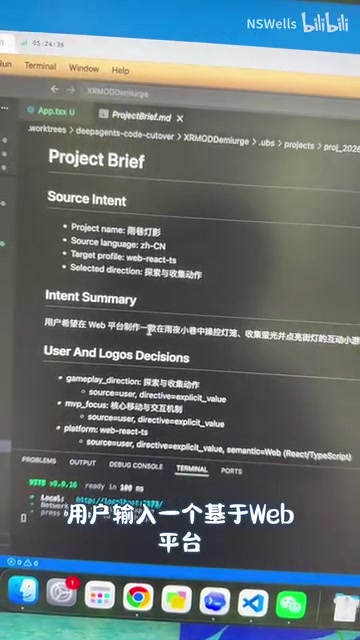
One developer uses a Multi-Agent AI system to turn a single idea into a fully playable Web game.
A developer demonstrated a self-built Multi-Agent AI system that takes a one-sentence game concept and automatically generates a complete Game Design Document (GDD) and a fully playable Web game — with no human intervention in between. The system uses multiple AI Agents handling planning, frontend development, and logic implementation, showcasing that end-to-end automated game development is now practically feasible for small-scale Web games.
One Person + AI Agent Team = A Complete Game
In the context of Bilibili's AI Creation Open Competition, a developer showcased an exciting practical achievement: starting with nothing more than a single creative idea, they used a self-built AI Agent team to automatically generate a fully playable Web game. This isn't a concept demo — it's a complete closed loop from design documentation to an interactive finished product.
The core value of this case lies in the proof that collaborative AI Agent game development has moved from "theoretical discussion" to "practical implementation."
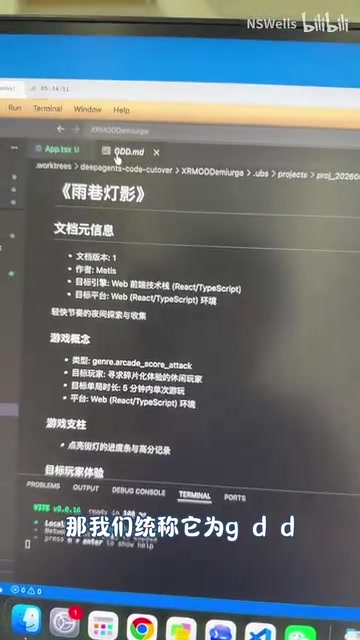
From a One-Sentence Idea to a Playable Game: The Fully Automated AI Agent Development Pipeline
Input: A One-Sentence Game Concept
The starting point of the entire pipeline is remarkably simple. The developer only needs to input a game concept description — in this case, the idea was:
A Web-based interactive mini-game where the player controls a character named "Denglong" (Rising Dragon) in a cloudy night alley, collecting fireflies and lighting up lanterns.
That's the entirety of the human input. No detailed requirements document, no technical specifications — just a simple game concept.
Middle Layer: AI Agent Auto-Generates a GDD
After receiving the creative input, the AI Agent team first automatically generates a GDD (Game Design Document). A GDD is a standard document in the game development industry, typically covering game mechanics, level design, art style, interaction logic, and other core elements.
To appreciate the significance of this step, you need to understand the role of a GDD in the game industry. A GDD is as important to game development as construction blueprints are to architecture — it serves as the action plan for the entire development team. A complete GDD typically covers multiple dimensions including the core gameplay loop, character design and ability systems, level design and difficulty curves, UI/UX interaction specifications, art style references (Art Bible), sound and music design direction, and technical constraints and platform adaptation requirements. In AAA game projects, a GDD can run hundreds of pages and undergoes continuous iteration throughout the development cycle. The fact that an AI Agent can automatically generate a structured GDD means it not only understands the fundamental paradigms of game design but can also transform vague creative descriptions into executable development specifications — a non-trivial capability in itself.
In traditional development, a proper GDD often requires days or even weeks of work from a planning team. In this AI Agent system, the entire step is fully automated — the Agent independently breaks down requirements, plans feature modules, and generates a complete design plan based on the input concept.
Output: A Runnable Web Game
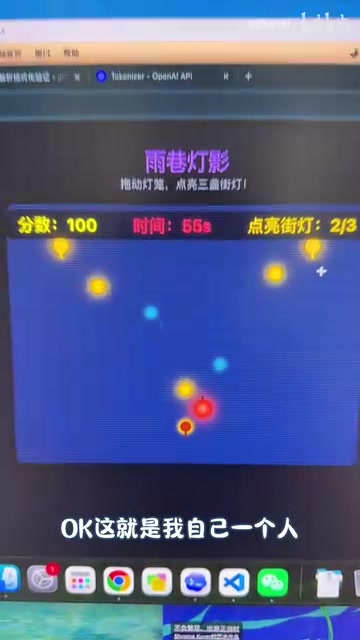
The final output is a fully playable Web-based game. Based on the demo:
- Players click "Start Game" to enter the scene
- The character "Denglong" can move freely through the cloudy night alley
- The core gameplay involves controlling the character to collect fireflies and light up lanterns along the road one by one
- Basic game interaction feedback is present (lantern state changes upon lighting, etc.)

While the visual fidelity suggests this is still a prototype-level product, it features a complete game loop (goal → action → feedback), which already surpasses the "static page" stage where most AI-generated games remain. The game loop is a foundational concept in game design theory, systematically described by game design masters like Jesse Schell in their works. A complete game loop consists of three core elements: Goal — a clear objective the player needs to achieve; Action — the operations the player performs to reach the goal; Feedback — the system's response and rewards for the player's actions. Only when these three elements form a closed loop can sustained player engagement be created. Many AI-generated "games" are actually just static web pages or interactive pages lacking feedback mechanisms, without a true game loop. This makes the implementation of a complete game loop in this case an important quality watershed.
Technical Path Analysis: Web Coding + Multi-Agent Role-Based Collaboration
The developer mentioned that the entire project was implemented through Web Coding, powered by a self-built Multi-Agent collaboration system.
Choosing a Web tech stack as the game platform involves deep technical considerations. The Web platform's rendering capabilities based on HTML5 Canvas or WebGL can already support 2D and even lightweight 3D games; the JavaScript/TypeScript ecosystem includes mature game development frameworks like Phaser, PixiJS, Three.js, and Babylon.js; Web games inherently offer cross-platform compatibility, accessible through browsers without installation. More critically, for AI Agents, the Web tech stack has a unique advantage — current mainstream large language models already have quite mature code generation capabilities for HTML/CSS/JavaScript, with training data containing massive amounts of Web development examples. This makes the technical barrier for AI to generate runnable Web games significantly lower than generating Unity C# or Unreal C++ projects.
Based on currently available information, the key characteristics of this system include:
- Multi-Agent division of labor: Rather than a single large model handling all tasks, multiple Agents are responsible for different stages such as planning, frontend development, and logic implementation
- End-to-end automation: From GDD generation to code writing, no human intervention is required in between
- Web-native output: The final product is a Web application that runs directly in the browser, lowering the barriers for deployment and user experience
This Multi-Agent architecture aligns with the mainstream exploration direction in the industry — open-source projects like MetaGPT and ChatDev are both attempting to simulate software development teams with multiple Agents, while this developer has focused the approach on the game development vertical, making it more targeted.
The core concept of Multi-Agent systems originates from distributed artificial intelligence research. The fundamental idea is to decompose complex tasks into multiple subtasks, each handled by intelligent agents with different specializations, then integrate the outputs through communication protocols and coordination mechanisms. In the software development domain, MetaGPT assigns different Agents roles such as product manager, architect, engineer, and QA to simulate the collaboration workflow of a real software team; ChatDev introduces stage divisions from the waterfall development process including design, coding, testing, and documentation. The common challenges for these systems lie in context-passing efficiency between Agents, conflict resolution mechanisms, and global consistency guarantees. Applying Multi-Agent architecture to game development scenarios requires additional handling of game-specific complexities such as art asset generation, game logic state management, and real-time interactive feedback — which is precisely where the technical difficulty of this case lies.
Breakthroughs and Limitations of AI Agent Game Development
Noteworthy Breakthroughs
The greatest significance of this case isn't the quality of the game itself, but rather the validation of end-to-end automated development feasibility. It answers a key question: Can AI Agents independently complete the entire development of an interactive game starting from a single sentence of creative input? The answer is yes — at least within the scope of small Web games.
For indie developers and small teams, this means the cost of game prototype validation could be dramatically reduced. A prototype that previously required a small team spending weeks to complete might in the future be produced in just minutes through AI Agent collaboration.
Issues Still Worth Watching
Of course, based on the demo video, this project is still in its early stages, and several questions deserve continued attention:
- Complexity ceiling: The current case is a mini-game with extremely simple mechanics. Can the Agent team handle more complex game mechanics (such as physics engines, multiplayer networking, complex AI behaviors)?
- Art quality bottleneck: The game's visual presentation is currently quite basic. The quality of generated art assets remains another key weakness in AI game development.
- Controllability and iteration capability: After the initial one-shot generation, how can developers make precise adjustments and iterative optimizations to the details?
The developer also mentioned that follow-up videos will provide detailed introductions to the Agent team's specific functional architecture, which will be key information for assessing the true capability ceiling of this system.
Industry Landscape: Multiple Technical Paths in AI Game Development
Viewing this case against the broader industry backdrop, AI-assisted game development has become an industry hotspot since 2024. Beyond the Multi-Agent code generation path, several parallel technical routes are rapidly evolving. Scenario, Leonardo, and similar tools focus on AI generation of game art assets, capable of batch-producing style-consistent character illustrations, scene concept art, and UI elements; Inworld AI focuses on intelligent NPC dialogue and behavior, enabling non-player characters to engage in natural language interaction; Google DeepMind's GENIE project attempts to generate interactive 2D game worlds directly from video; Nvidia's ACE technology aims to give game characters more natural facial expressions and voice interaction capabilities. Meanwhile, mainstream engines like Unity and Unreal are actively integrating AI-assisted features, such as Unity's Muse tool suite and Epic Games' exploration of AI workflows. The entire industry is evolving from "AI assisting individual stages" toward "AI driving the full pipeline," and this case represents an early but complete practical sample of the latter.
Final Thoughts
AI Agent collaborative game development is transitioning from the "can it be done" stage to the "how far can it go" stage. This developer's practice provides a real reference sample — while there's still a long road ahead before reaching commercial-grade game development, the "one person + AI Agent team" development model is already producing runnable results, which in itself is a milestone worth documenting.
For developers interested in AI game development, indie game creation, or Multi-Agent applications, this case showcases not just a small game, but the embryonic form of an entirely new game production paradigm.
Related articles
Hand-Written VBA Code vs. AI Voice Programming: How Big Is the Efficiency Gap Really?
A real-world Excel case comparing formulas, hand-written VBA, and AI voice programming for merging names by department — revealing massive efficiency gaps.

Android App Earning $100K/Month: A 6-Step Google Ads Growth Methodology
An AI calorie counter grew from under $1K to $125K/month on Android in 18 months. Learn the 6-step Google Ads growth formula and low-cost tech stack.

Getting Started with Claude Code: Core Advantages, Tool Comparisons, and Installation Guide
Deep dive into Claude Code's core strengths: full project context understanding, top-tier code accuracy, and plugin-based integration. Compares Cursor, Copilot, Trae, and covers setup essentials.