OpenAI Science Division Dissolved: The AGI Strategic Focus Behind Decentralized Restructuring
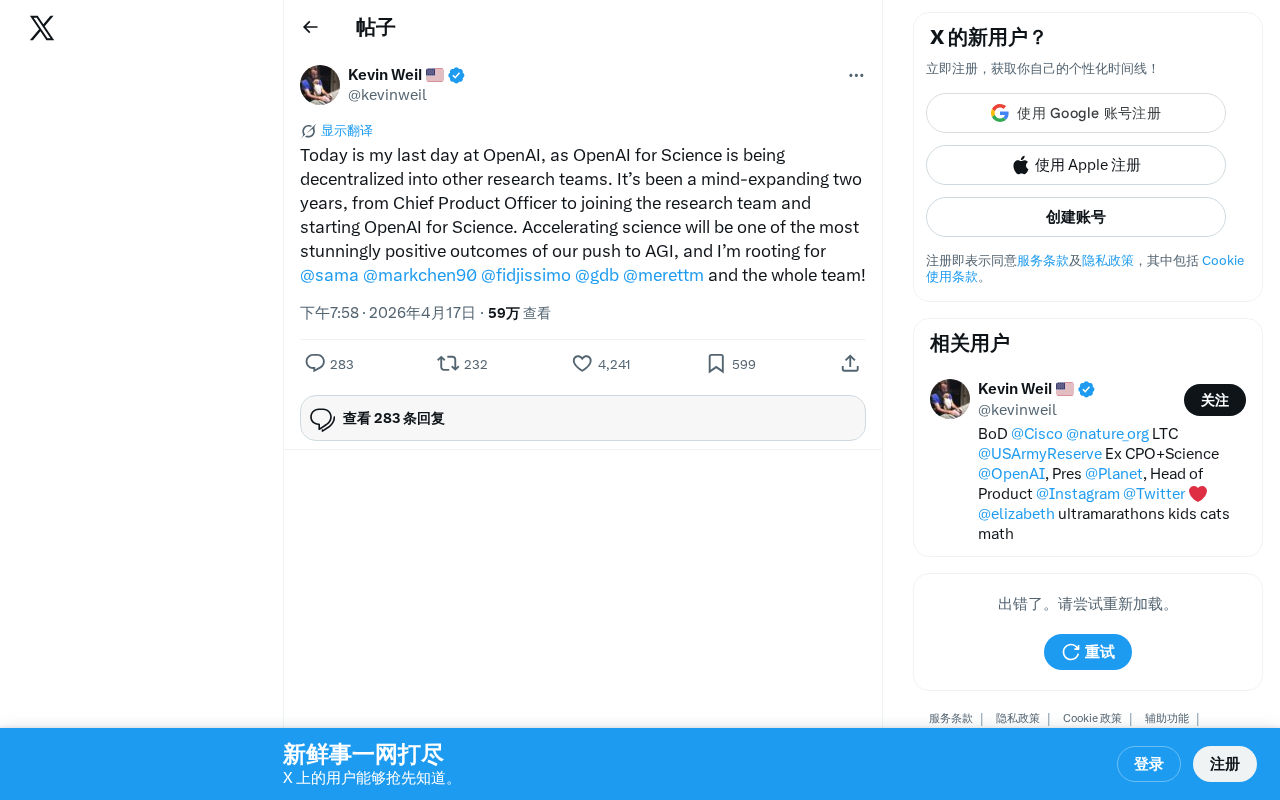
OpenAI dissolves its science division, decentralizing capabilities across teams to sharpen AGI focus.
OpenAI's dedicated science research division (OpenAI for Science) has been formally restructured and decentralized into other research teams, with its head announcing their departure. This strategic reorganization signals OpenAI's intensifying focus on AGI, embedding scientific research as an infrastructure-level capability rather than maintaining it as a standalone unit—reflecting broader industry patterns of optimizing for speed in the AGI race.
Core Event
OpenAI's science research division (OpenAI for Science) has been officially split up and restructured. Its head announced their departure on social media, marking a significant strategic adjustment to OpenAI's internal organizational architecture.
From Chief Product Officer to Science Research Lead: A Rare Career Pivot
According to the departing employee's own account, they experienced a remarkably broad career trajectory at OpenAI—transitioning from Chief Product Officer to joining the research team and founding the OpenAI for Science division. They described this two-year journey as "mind-expanding."
This kind of product-to-research transition is quite rare in itself. At most tech companies, product and research are two parallel tracks—a Chief Product Officer typically handles product strategy, user experience, market positioning, and commercialization paths, with core KPIs centered around user growth, revenue, and Product-Market Fit. Research teams, on the other hand, are oriented toward paper publications, technical breakthroughs, and long-term exploration, with longer evaluation cycles and higher tolerance for failure. These two roles have fundamentally different mindsets: product thinking emphasizes "doing the right things" (efficiency-oriented), while research thinking emphasizes "exploring the unknown" (discovery-oriented).
At a frontier AI company like OpenAI, this kind of cross-functional transition is possible partly because the product itself is a direct manifestation of research output—the GPT model series is both a research artifact and a commercial product, making the boundary between product and research far more blurred than at traditional tech companies. OpenAI clearly has more flexible organizational arrangements that allow executives to move between different functions.
What "Decentralization" Restructuring Really Means
You might not have noticed, but OpenAI for Science wasn't "shut down"—it was "decentralized" into other research teams. This phrasing reveals several key pieces of information:
First, the distribution of scientific research capabilities. OpenAI likely believes that embedding scientific research capabilities into individual product and research teams is more efficient than maintaining a standalone science division. This means the ability to accelerate scientific research with AI will shift from being a dedicated initiative to an infrastructure-level capability.
Second, organizational efficiency optimization. As OpenAI rapidly scales, independent cross-domain groups may face challenges in resource coordination. Integrating them into mainstream research teams helps reduce communication costs and redundant efforts.
Third, further focus on the AGI roadmap. From the departing employee's mention of "our push to AGI," it's clear that OpenAI is further tightening its strategic focus, aligning all resources toward the core goal of artificial general intelligence.
Decentralization as an organizational restructuring strategy has multiple precedents in the tech industry. Google merged its AI research from the independent Google Brain team into DeepMind, and later distributed AI capabilities across various product lines (Search, Cloud, Android, etc.). Meta also delegated some functions of its AI Research (FAIR) to various business units. The core logic of this pattern is: when a technology moves from the "exploration phase" to the "application phase," a centralized independent team may actually become a bottleneck because it needs to repeatedly interface with multiple downstream teams. Embedding capabilities into each team shortens the path from research to application, but the trade-off is potentially losing cross-domain holistic vision and depth in long-term fundamental research.
AI-Accelerated Scientific Research: A Direction Still Strongly Favored
Despite the division being split up, the departing employee still expressed strong confidence in the prospects of AI-accelerated scientific research, calling it "one of the most amazing positive outcomes of our push to AGI."
This assessment is not an isolated view. From AlphaFold solving the protein folding problem to AI-assisted materials discovery and drug development, scientific research is becoming one of the most transformative application scenarios for large models. AlphaFold is a protein structure prediction system developed by DeepMind that achieved breakthrough results in the CASP14 competition in 2020, solving the protein folding problem that had puzzled biologists for 50 years. Its subsequent versions have predicted the 3D structures of over 200 million proteins. Since then, AI applications in science have rapidly expanded: GNoME discovered 2.2 million new crystal structures for materials science; AI-assisted drug development companies like Insilico Medicine have advanced AI-designed drugs to clinical trial stages; and the GenCast model in weather forecasting has surpassed traditional numerical models in medium-range weather prediction.
These cases collectively demonstrate that AI is upgrading from a "tool" to a "collaborator in scientific research." OpenAI's decision to distribute this capability across teams perhaps indicates precisely that they believe this shouldn't be a peripheral project, but rather a foundational capability underlying all research work.
Implications for the AI Industry
This personnel and organizational change reflects common challenges facing leading AI companies today:
- Balancing speed and depth: Independent scientific research requires long-term investment, but the AGI race demands rapid iteration
- Accelerating talent mobility: Frequent turnover at the executive level has become the norm in the AI industry
- Continuously evolving organizational forms: No architecture is permanent—adaptability itself is a competitive advantage
Artificial General Intelligence (AGI) refers to an AI system with human-level general cognitive capabilities, able to match or exceed human performance on any intellectual task. The main participants in the current AGI race include OpenAI, Google DeepMind, Anthropic, Meta AI, and xAI, among others. OpenAI CEO Sam Altman has publicly stated multiple times that the company may achieve AGI within "a few thousand days." Under such an urgent timeline, every organizational adjustment serves one core question: how to most efficiently convert all resources—compute, talent, data—into progress toward AGI.
For practitioners following OpenAI's developments, this adjustment is more of a signal: OpenAI is entering a more concentrated, more focused phase of development, with everything making way for the ultimate goal of AGI. Even a science research division considered valuable will be restructured under the logic of strategic focus—not because it's unimportant, but because it needs to be integrated into the AGI mainline narrative in a more efficient manner.
Key Takeaways
Related articles

Claude Code for Test Development in Practice: An AI Programming Workflow That Doubles Your Efficiency
A practical guide to Claude Code for test development: auto-generating test scripts, Plan Mode workflows, MCP + Playwright integration, and Subagent parallel tasks to build systematic AI-assisted workflows.

Hermes Agent Hands-On Review: An AI Efficiency Revolution for Indie Game Developers
Indie game developer reviews Hermes Agent vs OpenClaude: intelligent context compression, real-time Memory, remote control via Telegram, and practical use cases in game dev, social media, and email.

Vibe Coding Beginner's Guide: Tool Selection Across Three Categories with Practical Examples
A comprehensive guide to Vibe Coding's three tool categories: Agent frameworks, CLI Coding, and IDE tools, with practical examples including Snake game and data analysis workbench.