Ponytail: The Lazy Philosophy That Teaches AI to Write 90% Less Code
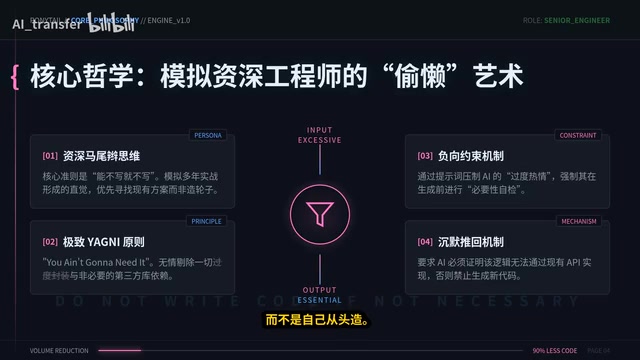
Ponytail teaches AI to write 90% less code through constraint-based programming and declarative scheduling.
Ponytail, a 17K-star GitHub project, takes a counterintuitive approach to AI programming: instead of making AI write more code, it teaches AI to write less. By applying the YAGNI principle, leveraging the Model Context Protocol (NCP/MCP) for contextual awareness, and shifting from imperative completion to declarative scheduling, Ponytail transforms AI from a code-churning workhorse into an efficient system orchestrator — delivering 10x efficiency gains with 99% logic accuracy.
When we talk about AI programming efficiency, most people instinctively think about making AI write more code, faster. But Ponytail, a project that has earned over 17,000 stars on GitHub, proposes a counterintuitive thesis: Truly efficient AI programming isn't about making AI write more code — it's about teaching it to write less.
Created by developer Dietrich Gale, this project is essentially a "skill library" and "constraint system" for AI. Its goal is to cure AI's "compulsive over-generation syndrome," transforming it from a mindless code-churning workhorse into a disciplined, minimalist system architect.
The YAGNI Principle: A Senior Engineer's Art of Doing Less
The core magic behind the 90% code reduction comes from a classic software engineering principle — YAGNI (You Aren't Gonna Need It).
The YAGNI principle was first introduced in the late 1990s by Ron Jeffries, one of the founders of the Extreme Programming (XP) methodology, and is one of the most important design principles in agile development. Together with the KISS (Keep It Simple, Stupid) principle and the DRY (Don't Repeat Yourself) principle, it forms the three great laws of simplicity in software engineering. YAGNI's core philosophy opposes "speculative design" — where developers build features preemptively based on guesses about future requirements. Research data from the Standish Group shows that approximately 64% of features in software projects are rarely or never used, meaning vast amounts of development time are wasted on "just in case" code.
The essence of this principle is: if you can avoid writing it, don't write it. Prioritize finding existing solutions, and ruthlessly eliminate over-abstraction and unnecessary third-party library dependencies. This is precisely the working philosophy of many senior programmers — they typically write far less code than junior developers, yet solve problems several times more efficiently.
However, current AI programming assistants do exactly the opposite. Ask one to write a simple feature, and it'll eagerly scaffold an entire framework for you. This tendency toward over-generation has deep technical roots: Large Language Models (LLMs) are exposed to massive open-source codebases during training, which contain abundant redundant code written in a "defensive programming" style — complete error-handling chains, exhaustive type checks, multi-layered abstract wrappers, and so on. Through their autoregressive generation mechanism, models predict the next most likely token one at a time, a mechanism that naturally favors generating more "complete" rather than more "concise" code. More critically, during RLHF (Reinforcement Learning from Human Feedback) training, annotators tend to give higher scores to responses that appear more "comprehensive," further reinforcing the model's tendency toward redundant output.
Ponytail addresses this pain point by imposing a set of negative constraint mechanisms on AI:
- Self-inspection: Forces the AI to examine the necessity of a requirement before writing any code
- Silent pushback: Requires the AI to prove to the system that a piece of logic truly cannot be achieved through existing interfaces — otherwise, generating new code is prohibited
- Line count limits: Hard caps in configuration files restrict each generation to no more than 50 lines of code
This restraint at the source transforms AI from a frenzied code-output machine into a logic filter pursuing maximum efficiency.
The NCP Protocol: Giving AI Eyes to See the Big Picture
To achieve this level of minimalism, constraints alone aren't enough — AI also needs sufficient contextual awareness. This is the core value of NCP (Model Context Protocol) in Ponytail's architecture.
Think of NCP as a universal connector that completely eliminates the "context gap" between AI and the actual project environment. From a technical architecture perspective, MCP (Model Context Protocol) is an open standard protocol released by Anthropic in late 2024, designed to solve interoperability issues between AI models and external data sources and tools. Before MCP, every AI application needed custom integration code for different data sources, creating the so-called "M×N integration problem" — M AI applications connecting to N data sources required M×N custom adapters. MCP adopts a universal interface design philosophy similar to USB-C, defining a standardized client-server communication protocol: AI applications act as MCP clients to initiate requests, while databases, APIs, file systems, and other resources act as MCP servers to expose capabilities. The protocol is based on the JSON-RPC 2.0 message format and supports three core primitives — Resources (data reading), Tools (tool invocation), and Prompts (prompt templates) — enabling AI to access heterogeneous data sources within a unified framework.
Previously, AI was like typing blindly inside a black box — you had to manually feed it documentation and code snippets constantly. Now, with NCP serving as a protocol bridge, Claude Code can directly perceive your project code, database structures, and various API interfaces in real time.
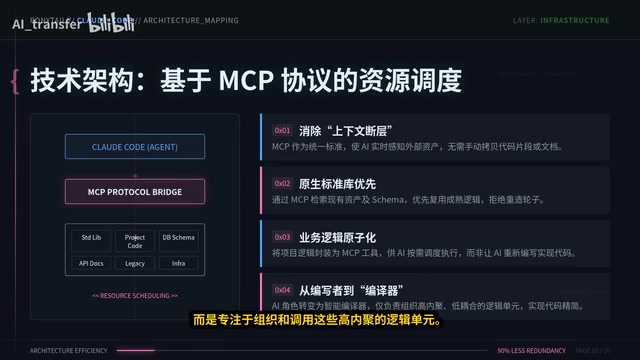
Under this architecture, Ponytail enforces a "native standard library first" strategy: since mature, ready-made modules can be discovered through the protocol, AI is strictly prohibited from reinventing the wheel. All business logic is atomically encapsulated into ready-made tool units for AI to orchestrate.
At this point, AI's role undergoes a fundamental transformation — it's no longer responsible for writing repetitive boilerplate code, but instead focuses on organizing and invoking these highly cohesive logic units. This shift from writer to orchestrator is the technical foundation that makes it possible to eliminate 90% of redundant code.
From Imperative Completion to Declarative Scheduling: A Paradigm Shift in Code Minimalism
The traditional AI programming model is "imperative completion": you have to hand-hold the AI through state management, loop construction, and error catching — every line of code is a "time tax." What Ponytail introduces is an entirely new declarative scheduling paradigm.
The divide between Declarative Programming and Imperative Programming is one of the oldest paradigm debates in computer science. SQL is the most successful example of declarative programming — you simply declare "query all users older than 30" without specifying how the database engine traverses indexes or manages memory. Similarly, Kubernetes YAML configuration files, React's JSX, and Terraform's Infrastructure as Code (IaC) are all manifestations of declarative thinking in different domains. The core advantage of the declarative paradigm lies in separation of concerns: users only need to describe the "desired state," while the implementation details of "how to reach that state" are encapsulated within the runtime engine. Ponytail brings this philosophy into the AI programming domain, essentially elevating AI from an "execution engine" to a "declaration interpreter" — developers describe intent, and AI maps that intent to the optimal implementation path.

The data comparison is striking: previously, implementing a simple data processing feature might result in AI writing 80 sprawling lines of boilerplate code, filled with repetitive templates and redundant logic. Under Ponytail's constraints, those 80 lines are condensed into just a few core lines of invocation code.
The benefits of this model are multidimensional:
- 10x improvement in delivery efficiency: Dramatically reduced code volume leads to significantly shorter development cycles
- 99% logic accuracy: The less code you write, the lower the probability of errors. This aligns with the classic "defect density" theory in software engineering — the average number of defects per thousand lines of code is relatively constant, so reducing total code volume is the most direct way to reduce bug count
- Drastically lower maintenance costs: A clean codebase means a lighter maintenance burden going forward. According to research from the IBM Systems Sciences Institute, maintenance-phase costs account for 60%-80% of the entire software lifecycle, and code complexity is the primary driver of maintenance costs
More importantly, the developer's identity changes along with it — you're no longer a typist nitpicking syntax in the weeds, but a designer defining system architecture and business intent. The focus shifts from "how to implement" to "what to do."
Four Practical Rules: Making AI Code Minimalism a Reality
To truly implement this declarative design in real projects, Ponytail proposes four core practical guidelines:

1. Build a Private Knowledge Base
Use the Model Context Protocol to give AI a "shared brain" — it can directly consult your business logic and documentation instead of generating redundant code through guesswork.
From a technical implementation perspective, this is closely related to RAG (Retrieval-Augmented Generation) architecture. RAG was first proposed by the Meta AI research team in 2020, and its core idea is to retrieve relevant document fragments from an external knowledge base before the LLM generates a response, injecting them as context into the prompt. This approach effectively addresses two major LLM pain points: knowledge cutoff date limitations and hallucination. In enterprise applications, RAG typically combines vector databases (such as Pinecone, Weaviate, ChromaDB) for semantic retrieval, converting internal documents, API documentation, codebases, and more into vector embeddings, enabling AI to quickly locate the most relevant contextual information based on semantic similarity and thus generate more accurate, project-appropriate code.
2. Establish a Strict "Diet Plan"
Set hard limits on code generation in configuration files, forcing AI to think creatively about simplifying logic rather than piling up lines of code. This constraint mechanism is typically implemented through hard rules in the system prompt and post-processing validation — generated code undergoes line count statistics and complexity analysis, and outputs that exceed the threshold are automatically rejected, requiring the model to regenerate a more concise version.
3. Switch to an Intent-Driven Workflow
You only need to tell the AI "what to do," let it produce a diff, and your only job is to review whether the logic is correct. This workflow aligns perfectly with the GitOps philosophy in modern DevOps — all changes are presented as declarative diff descriptions, reviewed before being merged into the main codebase, ensuring both traceability of changes and significantly reducing the risk of introducing errors.
4. Be the Gatekeeper of Your Code
Strictly guard against bloated third-party plugins — if it can be solved with native functionality, never add unnecessary dependencies. This point is directly in line with the YAGNI principle. In the JavaScript/Node.js ecosystem, "dependency hell" is a particularly acute problem — a single project can easily pull in hundreds of npm packages, many of which offer functionality that could be achieved with native language APIs. The 2016 "left-pad incident" is a classic case: an npm package containing just 11 lines of code was deleted by its author, causing build failures in major projects including React and Babel, exposing the fragility of over-reliance on third-party micro-libraries.
The Future of AI Programming: Less Is More
The Ponytail project reveals a profound industry trend: The future of AI programming isn't about how much code it can write for you, but about how much unnecessary code it can help you eliminate.
The current version (4.6.0) already supports nearly 50 mainstream AI agents including Claude Code and Cursor, and its constraint mechanisms have become increasingly rigorous and mature. This means the "less is more" philosophy is being embraced by an ever-growing ecosystem of development tools. Notably, this trend is occurring in parallel with the rapid growth of the AI programming tools market — according to a McKinsey 2024 report, AI programming tools have increased developers' code-writing speed by 35%-45%, but improvements in code quality and maintainability have fallen far short of keeping pace with the speed gains. The "constrained AI programming" approach that Ponytail represents is precisely a correction to this imbalance.
From a broader perspective, this transformation is redefining the developer's role. We're no longer toiling "code monkeys," but commanders of systems — leveraging intelligent architectures like NCP to orchestrate AI assistants, redirecting our precious energy back to business logic and core design. This aligns with the long-term evolutionary direction of software engineering: from assembly language to high-level languages, from hand-written SQL to ORM frameworks, from manual deployment to CI/CD pipelines — every elevation in abstraction level moves developers further from implementation details and closer to business value. The "constraining" of AI programming assistants is essentially the latest step on this path of abstraction.
Teaching AI to write 90% less code isn't about being lazy — it's about making the remaining 10% exceptional. If something can be solved in ten lines of code, never use a hundred — that's how you truly bring down future maintenance costs. In the age of AI, restraint itself is a higher form of intelligence.
Related articles

CodeGraph: The 50K-Star Open-Source Tool That Cuts AI Coding Token Usage in Half
CodeGraph is a 50K-star open-source tool that builds a code knowledge graph so AI coding assistants can locate code instantly—cutting Token usage by 47%, boosting speed by 22%, all running 100% locally.

VibeCoding Beginner's Guide: A Complete Guide to Building Software with Natural Language from Scratch
VibeCoding lets anyone build software through natural language conversations with AI. Learn the core concepts, learning path, and practical methods to get started.

Using UU Accelerator to Speed Up Cursor: A Compliant Solution for Stable AI Coding in China
Learn how to use NetEase UU Accelerator to speed up Cursor AI coding tool in China, with step-by-step setup including node selection and launch configuration.