Rockefeller: Lessons from History's First Remote Worker
How Rockefeller pioneered remote work with telegrams and what AI-era workers can learn from his approach.
This article draws a fascinating parallel between John D. Rockefeller's telegraph-based remote management of Standard Oil in the 19th century and today's AI-powered remote work. It traces the technological evolution from telegrams to LLMs and AI Agents, arguing that the core principles of effective remote work—systematization, trust, and results-oriented management—have remained unchanged for over a century.
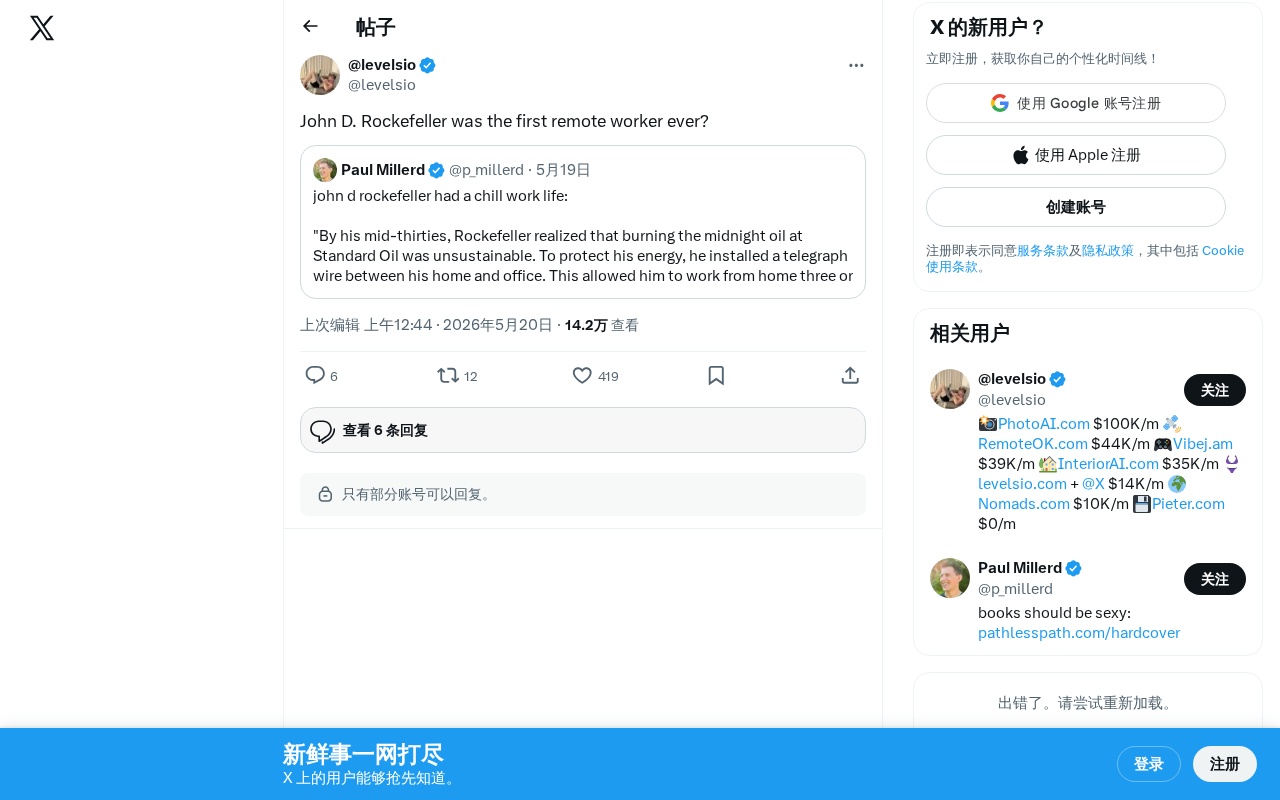
A Tweet That Sparked a Historical Connection
Recently, a brief tweet sparked considerable discussion on social media: "John D. Rockefeller was the first remote worker ever?"
This seemingly tongue-in-cheek question actually touches on a fascinating topic—the history of remote work stretches far further back than most of us imagine, and the arrival of the AI era is driving a qualitative leap in this way of working.
Rockefeller's "Remote Management" Empire
Commanding a Business Empire via Letters and Telegrams
John D. Rockefeller (1839–1937) was the founder of Standard Oil and is considered one of the wealthiest individuals in human history. Standard Oil, established in 1870, was the most iconic monopoly of America's industrial age. At its peak, the company controlled approximately 90% of U.S. refining capacity, with operations spanning the entire value chain—from extraction and transportation to refining and sales. Through horizontal integration and vertical consolidation strategies, Rockefeller transformed a fragmented oil industry into a highly centralized business empire. In 1911, the U.S. Supreme Court invoked the Sherman Antitrust Act to break Standard Oil into 34 independent companies, many of which later evolved into today's largest oil companies, including ExxonMobil and Chevron. Managing such a vast and geographically dispersed enterprise was precisely what drove Rockefeller to develop his remote management capabilities.
Throughout his business career—especially in its later years—Rockefeller demonstrated a remarkably ahead-of-its-time working style. He didn't always show up at the office. Instead, he managed his sprawling commercial empire remotely through letters, telegrams, and eventually the telephone.
In the late 19th and early 20th centuries, Rockefeller frequently conducted business from his estate at Pocantico Hills, New York. This private estate of approximately 3,400 acres, which the Rockefeller family began developing in 1893, housed a fully functional work environment equipped with dedicated telegraph lines and later telephone lines. His daily work rhythm was remarkably disciplined: mornings were spent processing correspondence and reports, afternoons were reserved for golf or walks, and evenings were dedicated to reviewing documents. His team of personal secretaries organized and categorized business communications arriving from across the country, ensuring the most critical information reached him immediately. Through this efficient communication system, he maintained close contact with managers in every region. He established a rigorous reporting system, requiring subordinates to submit detailed financial statements and operational data on a regular basis—essentially identical in nature to the project management tools and data dashboards used by remote teams today.
A Management Philosophy Ahead of Its Time
The reason Rockefeller could "work remotely" came down to his management philosophy: systematization, standardization, and data-driven decision-making. He didn't need to be hands-on with everything because he had built a self-sustaining management system. Every link in the chain had clear processes and accountable individuals, with information flowing efficiently through a hierarchical structure.
This mindset was extraordinarily rare for the era. Most entrepreneurs still subscribed to a "seeing is believing" management approach, convinced that physical presence was essential for maintaining control. Rockefeller proved that with the right systems and reliable data flows, physical distance was no barrier to management.
From Telegrams to AI: The Technological Evolution of Remote Work
Technology as the Underlying Driver of Remote Work
If we consider Rockefeller a "pioneer" of remote work, then every revolution in communication technology has lowered the barriers to remote collaboration:
- The Telegraph Era (mid-to-late 19th century): The commercial application of the telegraph began in 1844 when Samuel Morse sent the first telegraph message. By the 1860s, a transcontinental telegraph network had been completed, and the laying of the transatlantic submarine cable in 1866 reduced communication time from weeks to minutes. The telegraph decoupled information transmission speed from physical transportation speed for the first time—previously, the speed of a business instruction depended on the speed of horses or ships. This technological revolution gave rise to the hierarchical management structure of modern corporations. Railroad companies were among the first industries to use telegraphs for remote dispatching and management, and Rockefeller extended this practice to full value-chain management in the oil industry.
- The Telephone Era (early 20th century): Real-time voice communication became possible, allowing managers for the first time to have immediate two-way conversations with distant subordinates, dramatically improving decision-making speed and communication richness.
- The Internet Era (1990s–2010s): Email, instant messaging, and video conferencing made remote collaboration routine. This period also gave rise to "Digital Nomad" culture and distributed team management practices.
- The AI Era (2020s–present): AI assistants, intelligent document collaboration, and automated workflows are redefining "work" itself.
Remote Work in the AI Era Has Undergone a Qualitative Shift
Today's remote workers have tools that Rockefeller couldn't have dreamed of. Large language models like ChatGPT and Claude serve as on-demand analysts; AI coding tools like Cursor and GitHub Copilot enable developers to code efficiently from anywhere; tools like Notion AI and Gamma multiply the efficiency of document collaboration and presentation creation.
Large Language Models (LLMs) are deep learning models based on the Transformer architecture, trained on massive text datasets, capable of natural language understanding, generation, reasoning, and code writing. In remote work scenarios, LLMs deliver value on multiple levels: a remote worker can use AI to complete literature research, data analysis, or report writing in minutes that previously took hours; barriers to cross-language, cross-timezone collaboration are dramatically reduced as AI translation and summarization features make communication smoother for global teams; AI can also structurally organize information scattered across various documents, chat logs, and meeting notes, solving the "knowledge silo" problem that plagues remote teams.
More importantly, AI is addressing one of remote work's biggest pain points—information asymmetry. Rockefeller had to wait for letters and reports to understand business conditions, while today's managers can monitor the pulse of their teams and operations in real time through AI-driven data analytics.
Lessons from History: The Essence of Work Has Never Changed
Though brief, this tweet reveals a profound truth: The core of remote work has never been about technology—it's about trust, systems, and a results-oriented management culture.
Rockefeller achieved highly effective remote management in an era without the internet, without Zoom, without Slack—relying on clear processes and rigorous focus on outcomes. Yet today, many companies struggle with remote work despite having the most advanced collaboration tools—the problem often lies not in technology, but in management philosophy.
Long-term research by Stanford economist Nicholas Bloom shows that remote work's impact on productivity is highly dependent on management practices and corporate culture. In organizations lacking clear goal-setting and outcome evaluation mechanisms, remote work often leads to decreased productivity and weakened team cohesion. Conversely, companies that adopt results-oriented management frameworks like OKR (Objectives and Key Results) can actually unlock greater productivity in remote settings. The large-scale remote work experiment following the COVID-19 pandemic in 2020 also revealed a paradox: many companies discovered that efficiency didn't decline during forced remote work, yet rushed to recall employees once the pandemic ended—reflecting a deep tension between management's obsession with "visibility" and their distrust of "results-oriented" management.
With the rapid development of AI Agent technology, the future of remote work may evolve even further. AI Agents are AI systems capable of autonomously perceiving their environment, formulating plans, and executing tasks—fundamentally different from traditional passive-response AI tools. Current AI Agent technical approaches primarily include LLM-based reasoning and planning capabilities, tool use abilities, and multi-agent collaboration frameworks. For example, frameworks like AutoGPT, CrewAI, and LangGraph allow developers to build AI systems that can autonomously complete complex task chains. In remote work scenarios, AI Agents can automatically monitor project progress, identify risks and issue warnings, autonomously collect data and perform preliminary analysis, and even attend certain routine meetings on behalf of humans and generate summaries. AI is not just a tool—it may become a "virtual member" of the team, handling information aggregation, task assignment, progress tracking, and other coordination work. Future remote teams may consist of a small number of human decision-makers plus multiple AI Agents, each responsible for specific functional areas, forming an entirely new "human-machine hybrid" organizational structure. When that day comes, Rockefeller's model of "one person remotely commanding an empire" may become the norm for more entrepreneurs and small teams.
Conclusion
From Rockefeller's telegrams to today's AI assistants, remote work has traversed more than a century of evolution. Technology changes, but the underlying logic of effective collaboration remains constant: build systems, trust your team, focus on results. As AI accelerates its penetration into work scenarios today, looking back at this "first remote worker in history" may offer us insights that transcend technology itself.
Related articles

Claude Code for Test Development in Practice: An AI Programming Workflow That Doubles Your Efficiency
A practical guide to Claude Code for test development: auto-generating test scripts, Plan Mode workflows, MCP + Playwright integration, and Subagent parallel tasks to build systematic AI-assisted workflows.
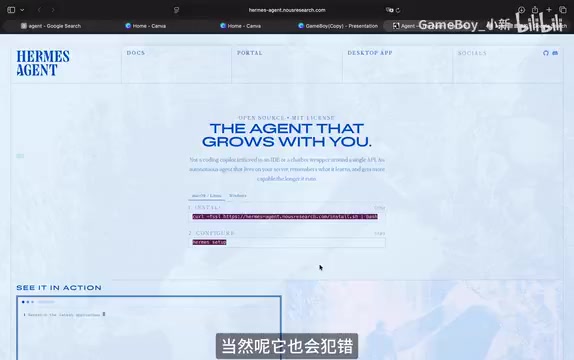
Hermes Agent Hands-On Review: An AI Efficiency Revolution for Indie Game Developers
Indie game developer reviews Hermes Agent vs OpenClaude: intelligent context compression, real-time Memory, remote control via Telegram, and practical use cases in game dev, social media, and email.
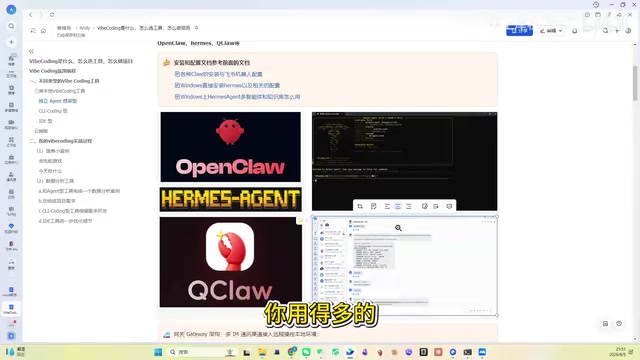
Vibe Coding Beginner's Guide: Tool Selection Across Three Categories with Practical Examples
A comprehensive guide to Vibe Coding's three tool categories: Agent frameworks, CLI Coding, and IDE tools, with practical examples including Snake game and data analysis workbench.