Spring AI vs LangChain4j: A Comprehensive Comparison of Java AI Frameworks
A comprehensive comparison of Spring AI and LangChain4j to guide Java developers in AI framework selection.
This article provides a thorough comparison of Spring AI and LangChain4j, the two leading Java AI frameworks. It covers core features like prompt engineering, Advisors, chat memory, Tools, RAG, MCP, and Agents, and evaluates both frameworks across ecosystem integration, feature completeness, JDK requirements, and developer experience, offering practical selection guidance for Java developers.
Introduction: Why Java Developers Need AI Frameworks
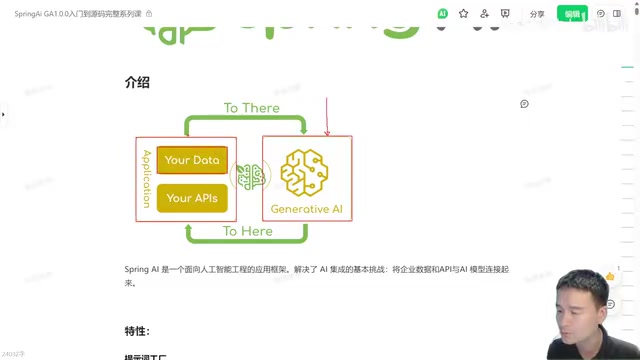
As large language model (LLM) technology rapidly gains traction, more and more enterprises are integrating AI capabilities into their existing Java business systems. However, foundational LLMs have two core pain points: they lack enterprise-specific vertical domain data, and they cannot directly invoke an enterprise's internal system APIs. This has given rise to dedicated AI integration frameworks — and Spring AI and LangChain4j have emerged as the two most prominent choices in the Java ecosystem.
This article systematically reviews the core features of Spring AI and provides a comprehensive comparison with LangChain4j, helping Java developers make informed technology selection decisions.
Spring AI: Core Positioning and Value
At its core, Spring AI helps Java developers quickly connect to LLMs and build generative AI applications on top of them. The key problems it solves can be summarized in two points:
- Data Augmentation: Feeding enterprise-private data to LLMs, compensating for the gaps in general-purpose models' vertical domain knowledge
- Capability Integration: Enabling LLMs to invoke enterprise system APIs, achieving true business-level closed-loop operations
With Spring AI, developers can seamlessly build AI-powered applications on top of the familiar Spring/Spring Boot technology stack, keeping the learning curve relatively low.
Six Core Features of Spring AI Explained
Prompt Engineering
The quality of interactions with an LLM largely depends on how prompts are designed. Spring AI provides comprehensive prompt engineering support, including various prompt template types and parameter tuning techniques. For developers, mastering prompt engineering is the first step toward building high-quality AI applications.
Advisors (Conversation Interceptors)
Spring AI offers an AOP-inspired conversation interceptor mechanism. During interactions with an LLM, both the outgoing request and the incoming response can be intercepted and processed. Typical use cases include:
- Logging and auditing
- Persistent storage of conversation records
- Injection of RAG-based retrieval augmentation
This design allows developers to flexibly inject various enhancement logic into the conversation flow, resulting in clean and maintainable code.
Chat Memory
Maintaining contextual coherence across multi-turn conversations is a fundamental capability for building intelligent conversational applications. Spring AI wraps chat memory functionality in a very concise manner — developers only need minimal configuration to enable multi-turn session context management.
Tools (Function Calling)
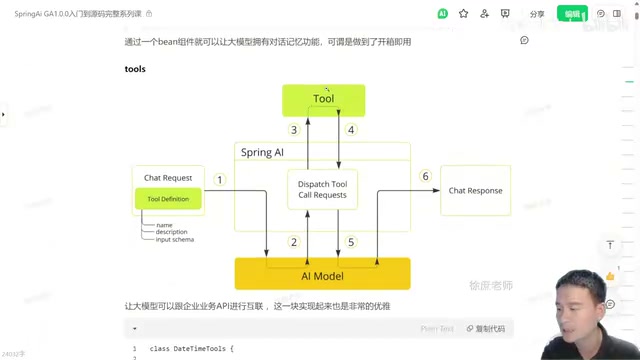
Tools serve as the critical bridge connecting LLMs to enterprise systems. Through the tool-calling mechanism, an LLM can proactively invoke Java methods defined by the developer during its reasoning process — such as querying databases or calling third-party services. Spring AI's Tools implementation features a clean and intuitive API design, delivering a pleasant development experience.
RAG (Retrieval-Augmented Generation)
Foundational LLMs lack knowledge specific to an enterprise's vertical business domain. RAG technology essentially attaches an external knowledge base to the LLM. By retrieving enterprise-private documents and data and injecting the relevant information into prompts, the LLM can provide accurate answers based on enterprise data. This is one of the most commonly used techniques in enterprise-grade AI applications.
MCP (Model Context Protocol) and Agents
MCP (Model Context Protocol) allows tools to be externalized and made available for external AI applications to invoke — a technology direction that is attracting significant attention. Agents represent the advanced form of AI applications. Spring AI supports five patterns of Agent construction, covering a wide range of business scenarios from simple to complex.
Spring AI vs LangChain4j: A Comprehensive Comparison
For Java developers, Spring AI and LangChain4j are two options that are hard to avoid. Their core functionalities are similar, but there are significant differences in ecosystem integration, feature coverage, and developer experience.
Ecosystem and Integration
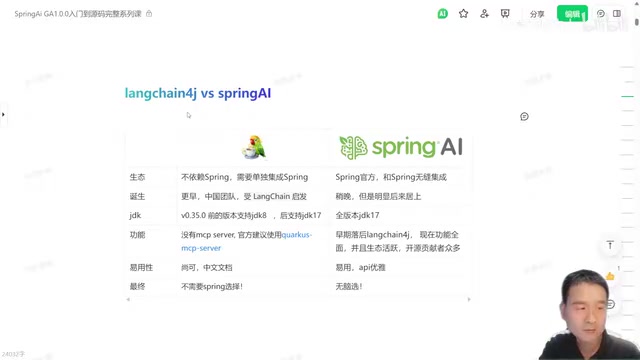
| Dimension | LangChain4j | Spring AI |
|---|---|---|
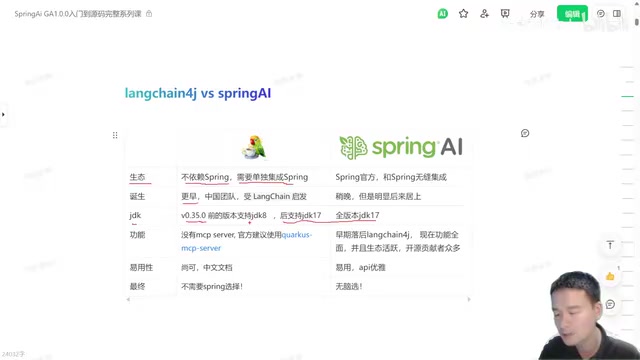
| Ecosystem Dependency | Independent of Spring; requires separate integration | Native to the Spring ecosystem; seamless integration |
| Origin | Developed by a Chinese team, inspired by LangChain Python | Official Spring project with global open-source community support |
| Development Trajectory | Launched earlier with a first-mover advantage | Catching up fast with continuously growing community activity |
Although LangChain4j provides some Starters to simplify integration with Spring Boot, it's not native support after all. As part of the Spring ecosystem, Spring AI naturally enjoys the advantage of seamless integration.
JDK Version Requirements
Both frameworks currently require JDK 17+. Interestingly, LangChain4j supported JDK 8 in earlier versions (before 0.35), but those early versions had incomplete functionality and offer limited practical reference value for production use.
Feature Completeness
This is where the gap between the two is most apparent:
- LangChain4j: Lacks features such as MCP Server, with some capabilities relying on third-party alternatives. The official explanation is that "there's no need to reinvent the wheel," though this may also be related to the limited size of the development team.
- Spring AI: Although it started later, its feature coverage is now very comprehensive. Thanks to a global community of open-source contributors, its release cadence is rapid.
Put simply: What LangChain4j has, Spring AI generally has too; what Spring AI has, LangChain4j doesn't necessarily have.
Usability and Documentation Quality
LangChain4j's API design is decent, and since it was developed by a Chinese team, it offers Chinese-language documentation, which is quite friendly for developers in China. However, in terms of API design elegance and overall developer experience, Spring AI — leveraging Spring's longstanding design philosophy — delivers a smoother and more polished experience.
Selection Recommendations: Decide Based on Your Project's Actual Needs
Based on the analysis above, the selection strategy can be summarized as follows:
- If your project doesn't use the Spring framework (e.g., you're using Quarkus, Micronaut, etc.), LangChain4j is the more suitable choice
- If your project is built on Spring/Spring Boot (which is the case for most Java enterprise applications), go directly with Spring AI
- If your goal is learning, both frameworks are worth exploring, as different companies may have different technology preferences
Looking at the long-term trend, Spring AI — backed by the global influence of the Spring ecosystem and an active contributor community — has stronger momentum. For the majority of Java developers, Spring AI is becoming the go-to framework for AI application development.
Conclusion
The deep integration of AI LLMs with Java enterprise applications has become an irreversible trend. Through core features like prompt engineering, Advisors, chat memory, Tools, RAG, MCP, and Agents, Spring AI provides Java developers with a complete toolchain for AI application development. Compared to LangChain4j, Spring AI demonstrates clear advantages in ecosystem completeness, feature coverage, and API usability.
For developers considering bringing AI capabilities into their Java projects, learning and practicing Spring AI early on will not only boost your personal technical competitiveness but also provide solid technical support for your enterprise's intelligent transformation.
Related articles

Claude Code Source Code Leak: 500,000 Lines of Code Reveal Core Multi-Agent Architecture Design
Anthropic accidentally leaked 500K+ lines of Claude Code TypeScript source via a Source Map misconfiguration, revealing its Coordinator multi-agent architecture, Kairos prediction system, and shadow rollback mechanism.

AI Agent Development: A Complete Six-Week Systematic Learning Roadmap
A systematic six-week learning roadmap for AI Agent development covering core architecture, ReAct paradigm, multi-agent collaboration, RAG integration, deployment, and hands-on projects.
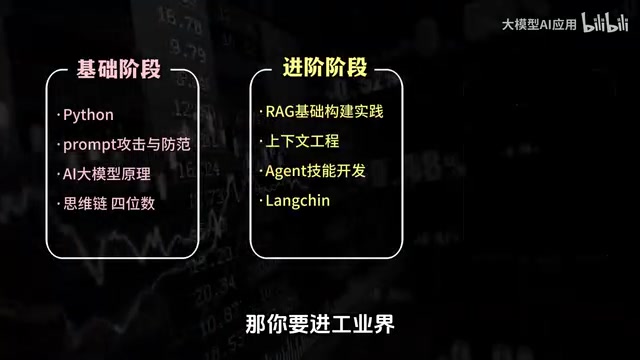
The Complete Skill Map for AI Application Engineers: A Progressive Roadmap from Fundamentals to Production
A systematic breakdown of the complete skill structure for AI application engineers, covering Python & deep learning fundamentals, small model engineering, LLM fine-tuning, Agent development, and enterprise projects.