The Complete Skill Map for AI Application Engineers: A Progressive Roadmap from Fundamentals to Production
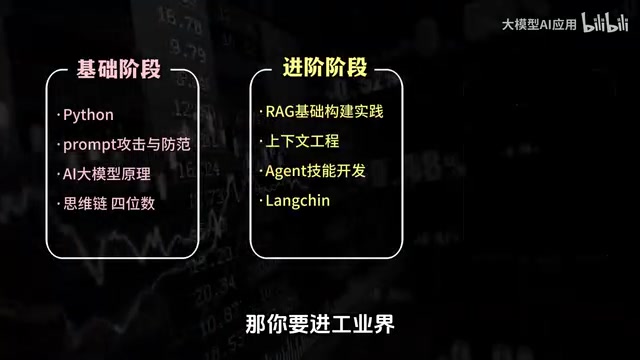
A complete skill map and four-stage learning roadmap for AI application development engineers.
This article systematically outlines the full capability structure required for AI application engineers, covering four core modules: Python and deep learning fundamentals, small model engineering, large model fine-tuning (LoRA/QLoRA), Agent development with RAG, and enterprise-level project experience. It provides a four-stage progressive learning path from foundation building to production-ready project delivery.
Introduction: Where the Real Bar Is for AI Engineers
"You call yourself an AI engineer just because you can call an API?" This question captures an awkward reality in today's industry. As large language model technology becomes widespread, the AI application development field is undergoing a dramatic split — on one side are beginners who stay at the prompt engineering level, and on the other are engineers who can actually deploy models into production environments. The salary gap and career ceiling between the two may be larger than you think.
This article, based on a learning roadmap shared by a Bilibili creator, systematically outlines the complete skill structure required to become a qualified AI application engineer, helping you establish a clear learning direction.
The Foundation: Python and Deep Learning Fundamentals
Python Is Not Just "Good Enough to Use"
Many beginners think of Python as simply "being able to run code," but in the AI engineering field, that's far from sufficient. You need not just the ability to call libraries, but the ability to understand their underlying implementations. Specifically:
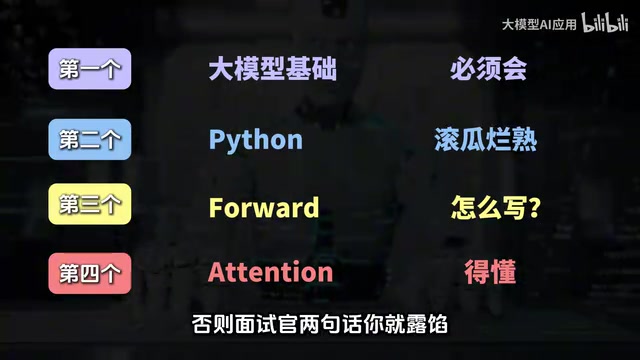
- Master the fundamentals inside and out: Data structures, object-oriented programming, decorators, generators, and other advanced features must all be second nature
- Deep learning fundamentals: How do you write a
forwardfunction? How is the Attention mechanism computed? These aren't just theoretical concepts from a lecture — they're hard skills an interviewer can verify in two sentences - Engineering skills: Code standards, version control, environment configuration — these seemingly trivial skills are critical in real-world work
Deep Dive into Forward and Attention
The forward function is the core method of PyTorch's neural network module (nn.Module), defining the forward propagation path from input to output. Understanding forward means more than knowing how to stack layers — it means understanding how the computation graph is built, how the automatic differentiation mechanism (Autograd) tracks gradients, and how gradients flow back through the computation graph during backpropagation. When you call model(input), Python's __call__ method automatically triggers forward while also registering hook functions and recording the computation graph.
The Attention mechanism is the soul of the Transformer architecture. Its core idea is computing association weights between different positions in a sequence through operations on three matrices — Query, Key, and Value — using the formula Attention(Q,K,V) = softmax(QK^T/√d_k)V. Common interview questions include: Why divide by √d_k (to prevent large dot products from causing softmax gradient vanishing), how multi-head attention captures multi-dimensional semantic relationships through parallel computation across different subspaces, and how KV Cache accelerates inference by avoiding redundant computation of Key and Value for already-generated tokens.
There are absolutely no shortcuts here. As emphasized in the original video: "There's no negotiating on the fundamentals." Interviewers won't let you off the hook on underlying principles just because you've built a few demos. The implementation details of forward and attention are often the dividing line between "library callers" and real engineers.
Enterprise-Level Core Skills: Four Essential Modules
Once the foundation is solid, the real skill-building has only just begun. An AI application engineer's enterprise-level capabilities can be broken down into four modules, each with irreplaceable value.
Module 1: Engineering Skills for Small Models
Don't be blinded by the hype around large models — small models still have widespread applications in industry. Recommendation systems, risk control models, NLP classification tasks… In many real business scenarios, the deployment efficiency and cost advantages of lightweight models are something large models simply can't replace.
In industry, small models (typically with parameters ranging from millions to a few billion) remain the preferred solution for many business scenarios. The reasons are practical: a single inference call on a large model can cost hundreds of times more than a small model, while recommendation systems need to handle billions of requests per day, risk control scenarios demand millisecond-level response latency, and ad click-through rate prediction requires ranking massive candidate sets in extremely short timeframes. In these scenarios, a carefully optimized small model often delivers more engineering value than a large model.
You need to master:
- Engineering deployment of traditional machine learning algorithms
- Model compression and quantization techniques: including knowledge distillation (using a large model's output distribution to guide small model learning), structured pruning (removing redundant neurons or channels), and quantization (reducing FP32 floating-point operations to INT8/INT4 fixed-point operations, significantly improving inference speed)
- Best practices for Model Serving: involving toolchains like TensorRT acceleration, ONNX Runtime cross-platform deployment, and Triton Inference Server's dynamic batching and model concurrency management
Module 2: Large Model Fine-Tuning Skills
This is one of the hottest and most market-valuable skills right now. Simply knowing how to call OpenAI's API isn't enough — companies need engineers who can fine-tune large models for specific business scenarios.
Key skills include:
- Parameter-efficient fine-tuning methods like LoRA and QLoRA: LoRA (Low-Rank Adaptation), proposed by Microsoft in 2021, is a parameter-efficient fine-tuning method based on the core insight that weight change matrices during fine-tuning exhibit low-rank properties. Therefore, weight updates can be decomposed into the product of two low-rank matrices (ΔW = BA, where B∈R^(d×r), A∈R^(r×k), and r is much smaller than d and k). This reduces trainable parameters from billions to millions, significantly lowering memory requirements and training costs. QLoRA further introduces 4-bit NormalFloat quantization and Paged Optimizer, making it possible to fine-tune 70B parameter models on a single 24GB consumer GPU
- Dataset construction and cleaning: In practice, data quality often matters more than data quantity. Building high-quality instruction fine-tuning datasets — including instruction diversity, answer accuracy, and format consistency — is the key factor determining fine-tuning results. Common industry methods include data augmentation techniques like Self-Instruct and Evol-Instruct
- Training process monitoring and tuning: Proper configuration of learning rate scheduling, gradient accumulation, mixed-precision training, and other strategies
- Post-fine-tuning model evaluation and deployment: Combining automated evaluation (using GPT-4 as a judge) with human evaluation
Module 3: Agent Development Skills
Agent development is one of the hottest technical directions right now and a critical step in AI applications evolving from "conversational tools" to "autonomous executors."
The core paradigm of Agents is ReAct (Reasoning + Acting), where the model completes complex tasks through a "think-act-observe" loop. Unlike traditional single-turn conversations, Agents can autonomously plan task steps, invoke external tools (search engines, code executors, databases, API endpoints, etc.), and dynamically adjust execution strategies based on intermediate results. This capability transforms AI from passively answering questions to actively solving problems.
Mastering Agent development means you can:
- Design workflows for multi-step reasoning and tool invocation
- Integrate RAG (Retrieval-Augmented Generation) systems: RAG addresses the knowledge timeliness and hallucination problems of large models. The process involves chunking enterprise private documents, converting them into vectors via Embedding models, and storing them in vector databases (such as Milvus, Pinecone, Weaviate). When a user asks a question, relevant document fragments are retrieved first, then injected into the Prompt as context. Current frontier directions include Graph RAG (enhancing reasoning with knowledge graphs) and Agentic RAG (Agent-driven adaptive multi-round retrieval)
- Build multi-Agent collaboration architectures: such as CrewAI's role-based division of labor, MetaGPT's software development process simulation, and AutoGen's conversational collaboration
- Handle complex context management and memory mechanisms: including layered management of short-term memory (conversation history), long-term memory (vectorized storage), and working memory (current task state)

Module 4: Enterprise-Level Project Experience
The first three modules are the core competencies for day-to-day work, but the fourth — enterprise-level project experience — is your real bargaining chip for commanding a high salary.
"Enterprise-level" here means:
- Not Kaggle competition or coursework-level demos
- Needing to account for high concurrency, low latency, fault tolerance, and other production environment concerns
- Involving a complete MLOps pipeline: MLOps (Machine Learning Operations) applies DevOps principles to machine learning systems, covering the entire lifecycle from development to production. A mature MLOps pipeline includes: data pipeline orchestration (scheduling ETL tasks with Airflow/Prefect), experiment tracking (recording hyperparameters, metrics, and model artifacts with MLflow/Weights&Biases), model registry and version management, CI/CD automated testing and deployment, and continuous monitoring in production (detecting data drift, model performance degradation, and triggering automatic retraining). It also involves Feature Store (ensuring consistency of feature computation between training and inference), model rollback mechanisms, and multi-environment (development/staging/production) configuration management
- Being able to clearly articulate the technical decisions, pitfalls encountered, and optimization strategies in your projects
In interviews, a project you've genuinely taken from zero to production is far more convincing than ten carefully packaged personal projects. Interviewers don't care what framework you used — they care about how you made engineering decisions when facing real constraints (budget, time, data quality, team collaboration).
Learning Roadmap: Direction Matters More Than Effort
The original video makes an excellent point: "The scariest thing about learning isn't difficulty — it's not having a roadmap. If your direction is wrong, no amount of effort will help."
Four-Stage Progressive Path
Based on the latest learning roadmap shared in the video, the entire learning journey can be divided into four stages:
Stage 1: Foundation Building
- Advanced Python programming (not beginner level): Focus on mastering async programming, type annotations, metaprogramming, and other advanced features
- Math fundamentals: Linear algebra (matrix operations are the mathematical essence of neural networks), probability and statistics (understanding loss functions and optimization objectives), calculus (the mathematical basis of gradient descent)
- Deep understanding of deep learning frameworks (primarily PyTorch): Not just using
nn.Module, but understanding dynamic computation graphs, custom operators, and the principles of distributed training
Stage 2: Technical Deep Dive
- Deep understanding and implementation of the Transformer architecture: Hand-coding Self-Attention, Multi-Head Attention, Position Encoding, and Layer Normalization from scratch
- Training, optimization, and deployment of small models
- Hands-on practice with large model fine-tuning: The complete pipeline from data preparation to LoRA configuration to evaluation and deployment
Stage 3: Application Building
- Building RAG systems: Document parsing, chunking strategies, Embedding model selection, vector retrieval optimization, and Reranking
- Hands-on work with Agent frameworks (LangChain, AutoGen, CrewAI, etc.): Understanding framework design philosophy rather than just copying example code
- Systematic Prompt Engineering methodology: Understanding the principles and applicable scenarios of strategies like Few-shot, Chain-of-Thought, and Self-Consistency
Stage 4: Project Practice
- Complete 1-2 enterprise-level projects: Ideally involving real business data and user feedback
- Build a complete technical portfolio: GitHub repositories, technical blog posts, system design documents
- Prepare for interviews targeting your desired positions: System design interviews, live coding challenges, and deep-dive project discussions
Final Thoughts: It's About Structure, Not Hours
"This industry is intensely competitive, but the competition is about structure, not time." This statement deserves deep reflection from every AI practitioner.
Mindlessly grinding hours, binge-watching courses, and chasing trends is less effective than pausing to examine whether your skill structure is complete. When you identify a clear gap in a particular module, focusing your energy on filling it is far more valuable than repeatedly practicing in your comfort zone.
The bar for AI application development is rising rapidly, but this is actually good news for those with a systematic learning plan — because it means competitors who can only "call APIs" are being weeded out, while engineers with a truly complete skill structure will command an ever-growing premium. As the industry transitions from wild growth to refined cultivation, systematic capability building is your best moat.
Related articles
Nex N2 Pro In-Depth Review: How Does This Chinese Open-Source Agent Model Really Perform?
In-depth review of Nex N2 Pro, a Chinese open-source Agent model. Covers frontend code generation, Agent workflows, and benchmark comparisons, revealing gaps between official claims and independent tests.

Deconstructing the Core Principles of AI Agents: A Deep Dive into the Control, Perception, and Action Modules
A systematic breakdown of the three core AI Agent modules (Control, Perception, Action), with deep analysis of AutoGPT, BabyAGI, HuggingGPT, LlamaIndex architectures and Chain-of-Thought reasoning.
Trump Administration Pressures Anthropic, Reshaping the AI Industry's Competitive Landscape
The Trump administration pressures AI company Anthropic, raising industry-wide concerns. Analysis of the political-business dynamics, potential gains for OpenAI and xAI, and the far-reaching impact on AI safety and industry self-regulation.