The AI-Native Era: How to Keep Up with a Constantly Moving Technical Bar

In the AI-native era, adaptability itself is the most critical capability as technical standards constantly evolve.
The bar for being "AI native" is constantly moving as technology evolves at unprecedented speed — from ChatGPT usage to Prompt Engineering, RAG, AI Agents, and Vibe Coding. This article explores why the standard keeps shifting at both individual and organizational levels, and offers three practical strategies: adopt continuous learning over one-time mastery, focus on foundational capabilities over specific tools, and accept "good enough" over perfection.
What Is "AI Native"? And Why Does the Bar Keep Moving?
In the tech world, "AI Native" is becoming an increasingly important yet constantly evolving concept. As the founder of CircleCI pointed out in a recent conversation: We are all experiencing the process of the bar for "being AI native" continuously moving.
This observation precisely captures the core dilemma facing today's tech practitioners — what was considered AI-native practice yesterday may already be outdated today; today's best practices may be replaced by entirely new paradigms tomorrow.



Two Major Reasons Why the AI-Native Bar Keeps Moving
Unprecedented Speed of Technological Iteration
Looking back at AI development over the past two years, we can clearly trace this "movement":
- Early 2023: Using ChatGPT to assist with writing and coding at work was enough to be considered AI native
- Mid 2023: You needed to master Prompt Engineering and understand RAG architecture to keep pace
- 2024: AI Agents, multimodal applications, and AI coding tools (like Cursor and Copilot) became the new baseline
- 2025: Vibe Coding, autonomous AI agents, and end-to-end AI workflows are redefining the standard
A few key technical milestones are worth elaborating on here. Prompt Engineering refers to the methodology of carefully designing input prompts to guide large language models toward more accurate outputs. It evolved from simple instructions into a systematic discipline encompassing complex strategies like role-setting, Chain-of-Thought reasoning, and Few-shot Learning. RAG (Retrieval-Augmented Generation) is an architectural pattern proposed to address the knowledge cutoff date and "hallucination" problems of large language models — it first retrieves relevant information from external knowledge bases, then injects the retrieved results as context for the model to generate responses. This architecture quickly became the standard approach for enterprise AI applications.
By 2024-2025, the technological paradigm shifted again. AI Agents represent a fundamental transformation from passive tools to active executors — unlike traditional single-turn conversations, AI Agents can autonomously plan tasks, invoke external tools, execute multi-step operations, and self-correct based on feedback. Frameworks like AutoGPT, LangChain Agents, and CrewAI have driven the rapid implementation of this concept. Vibe Coding is a term coined by Andrej Karpathy, former OpenAI researcher and Tesla AI Director, in early 2025. It describes a programming approach where developers describe their intent in natural language, AI handles most of the code writing, and developers primarily review and guide the process. This model fundamentally blurs the boundary between "programming" and "directing," profoundly changing both the barrier to entry and the nature of software development.
Each technological leap redraws the threshold for AI native. This isn't a static target — it's a continuously accelerating process.
Organizational Challenges Are Even More Complex
For enterprises and development teams, being AI native isn't just about individual skills — it involves the entire organization's workflows, toolchains, and cultural transformation. It's no coincidence that CircleCI, a major player in the CI/CD space, had its founder raise this topic — CI/CD processes themselves are being profoundly reshaped by AI.
CI/CD (Continuous Integration/Continuous Deployment) is a cornerstone process of modern software engineering that accelerates software delivery through automated building, testing, and deployment. AI's reshaping of this process manifests across multiple layers: intelligent test generation tools (like Diffblue Cover) can automatically generate unit tests for code changes; AI-driven code review (like GitHub Copilot's code review feature) can automatically detect potential defects and security vulnerabilities at the Pull Request stage; intelligent deployment strategies can predict release risks based on historical data and automatically select canary releases or blue-green deployment approaches; AIOps tools use anomaly detection algorithms to enable smarter monitoring and alerting, dramatically reducing Mean Time to Recovery (MTTR).
From code review to test generation, from deployment strategies to monitoring alerts, AI is permeating every aspect of software development. Teams need to continuously adjust their degree of "nativeness," which creates significant cognitive burden for both managers and frontline developers.
Three Strategies to Navigate the Ever-Changing AI-Native Standard
1. Adopt a "Continuous Learning" Mindset Rather Than "One-and-Done"
The most important cognitive shift is: Don't try to "become" AI native all at once — instead, build the capacity for continuous adaptation.
Practical approaches include:
- Set aside dedicated time each week to explore new AI tools and methods
- Follow technology trends without blindly chasing every hot topic
- Run small-scale experiments in actual work rather than completely overhauling existing processes
The core of this strategy is reducing the cost of each adaptation. Rather than undergoing painful large-scale transformations when a technology wave arrives, maintain a reasonable distance from the cutting edge through continuous small adjustments. This aligns with the "small batch delivery" philosophy in software engineering — frequent small changes carry lower risk and provide faster feedback than occasional large changes.
2. Focus on Foundational Capabilities Rather Than Specific Tools
Tools change, but underlying capabilities endure. Rather than mastering one specific AI tool, cultivate these core competencies:
- Problem decomposition: Knowing which tasks are suitable for AI and which require human judgment. This requires a clear understanding of AI model capability boundaries — for example, large language models excel at pattern matching and text generation but still have obvious limitations in precise mathematical calculations, real-time information retrieval, and causal reasoning
- Evaluation skills: Being able to quickly assess the quality and reliability of AI outputs. As AI-generated content proliferates, identifying factual errors, logical gaps, and potential biases in AI outputs is becoming a critical professional skill
- Systems thinking: Understanding how AI fits into larger technical architectures and business processes. Using AI tools at individual touchpoints easily creates "local optimum" traps — truly being AI native requires thinking about AI's role across the entire value chain from an end-to-end perspective
3. Accept "Good Enough" Rather Than Pursuing "Perfectly Native"
In an environment where the bar keeps moving, pursuing perfection is a trap. A more pragmatic strategy is: ensure that you and your team are always in a "good enough" position — you don't need to be in the top 1% at the cutting edge, but you can't fall so far behind that it impacts competitiveness.
Here's a practical self-assessment framework: if your competitors or peers have already widely adopted a certain AI capability and you haven't started exploring it, that's a signal to act; if a technology is still in its early experimental stage, stay informed but don't rush to invest significant resources.
Deeper Industry Implications of the AI-Native Trend
This "moving bar" phenomenon reveals a deeper industry trend: AI is not a one-time technology upgrade — it's an ongoing transformation process.
For developers, this is both a challenge and an opportunity. Individuals and teams that can build rapid adaptation capabilities will hold an advantage in this continuous revolution. Those who try to "learn it once and be done" will likely find themselves repeatedly left behind by redefined standards.
Just as software engineering transitioned from the Waterfall model to Agile development, the definition of AI native will continue to evolve. This historical analogy deserves deeper understanding: the Waterfall Model was a linear development methodology established in the 1970s, progressing strictly through requirements analysis, design, coding, testing, and deployment in sequence. The publication of the Agile Manifesto in 2001 marked the industry's shift toward iterative, incremental development, emphasizing "responding to change over following a plan." This transition took over a decade to fully permeate the industry, during which multiple practices like Scrum, Kanban, and XP competed and merged. However, the evolution of AI native is far faster — the industry may not have a ten-year adaptation window, but rather needs to complete fundamental cognitive and practical transformation within two to three years.
What matters isn't where you stand today, but how fast you can adapt to change. In this era where the bar is always moving, adaptability itself is the most important AI-native capability.
Key Takeaways
Related articles

AI Large Model Learning Roadmap Breakdown: Three Stages from Application Development to Model Fine-Tuning
Deep breakdown of a popular AI large model learning roadmap covering LangChain, RAG, Agent, and LoRA fine-tuning across three stages, with analysis of its strengths and limitations for career changers.
AI Agent Development: A Complete 6-Week Systematic Learning Roadmap
A 6-week systematic learning roadmap for AI Agent development, covering core architecture, ReAct principles, multi-agent collaboration, RAG integration, and deployment.
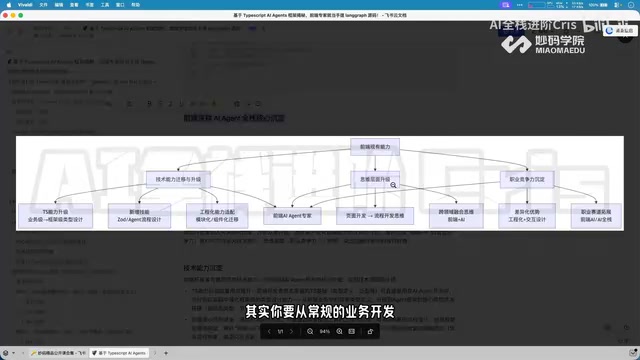
Four Core Advantages Frontend Developers Have When Transitioning to AI Agent Development
Frontend developers have key advantages for AI Agent development: TypeScript ecosystem fit, low-barrier full-stack bridging, and state management isomorphism. Learn the transition path here.