Windsurf Integrates Automation into Agent Workspace, Plus Limited-Time Half-Price Offer
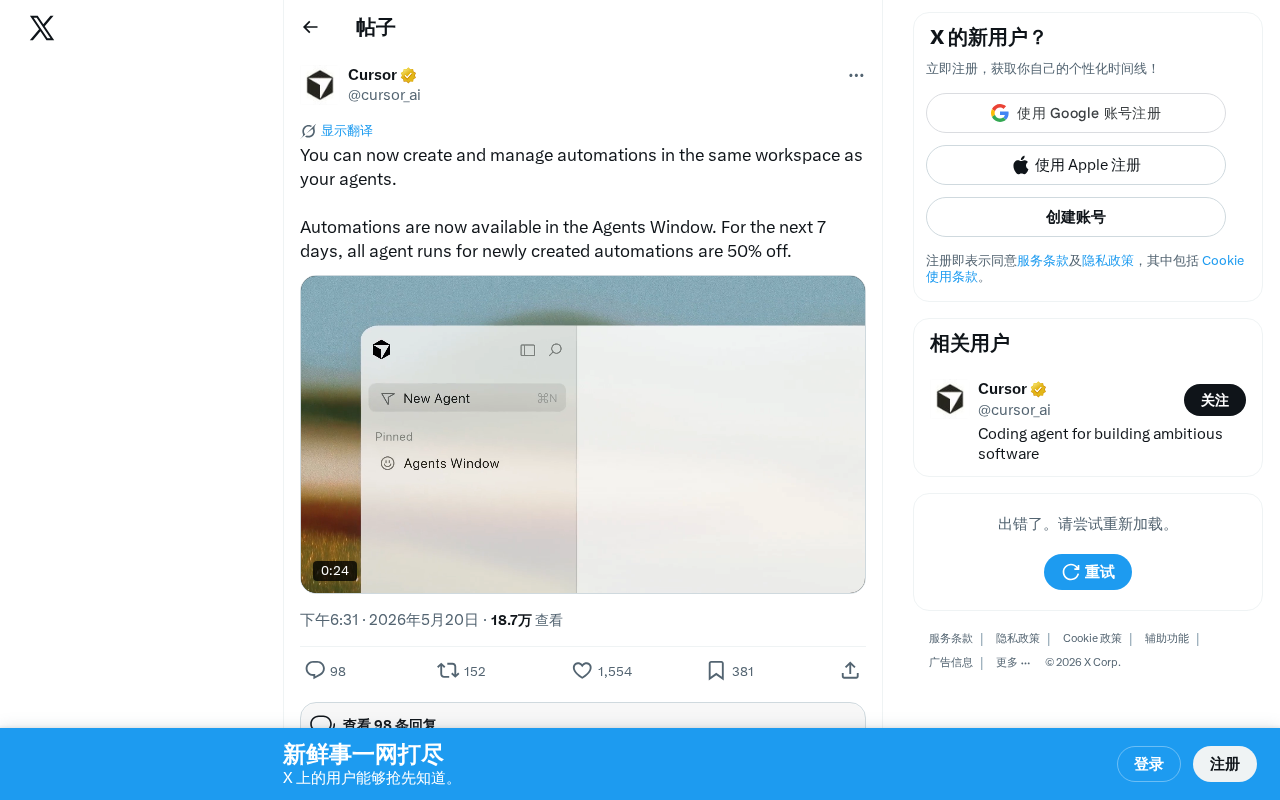
Windsurf merges automation into its Agent workspace with a 7-day half-price promotion on new automation runs.
Windsurf has integrated its Automations feature into the Agents Window, creating a unified workspace where developers can manage AI Agents and automated tasks side by side. This reduces context switching and enables tighter Agent-automation synergy. To promote adoption, all new automation Agent runs are 50% off for 7 days. The update reflects the broader industry trend of AI coding tools evolving from point solutions into full development platforms.
Windsurf Agents Window Gets New Automation Features
Windsurf (formerly Codeium) recently announced a significant update: Automations are now integrated into the Agents Window, allowing developers to create and manage automation tasks and AI Agents within a single workspace.
Windsurf's predecessor, Codeium, was an AI coding tool company founded in 2022 that initially started with free AI code completion services, quickly amassing a large developer user base. In 2024, Codeium underwent a rebrand to Windsurf, transforming from a simple code completion plugin into a full AI-native IDE. Windsurf IDE is built on VS Code's open-source core but layers deeply integrated AI capabilities on top, including context-aware code generation, multi-file editing, and the Agent and automation features covered in this update.
What the Unified Workspace Changes
Previously, automation and Agent features lived in separate management interfaces, requiring developers to switch between multiple windows. This integration brings the following changes:
- More seamless workflows: Within the same interface, you can invoke AI Agents for code generation, debugging, and other tasks, while also setting up automation pipelines to handle repetitive work
- Reduced context-switching costs: A unified workspace eliminates frequent jumping between views, improving overall development efficiency
- Agent-Automation synergy: Having both in one environment lays the groundwork for deeper integration down the road
Understanding the Role of AI Agents in Coding Tools
In the context of AI coding tools, an Agent refers to an AI system capable of autonomously planning and executing multi-step tasks. Unlike traditional code completion or single-turn conversations, an Agent can understand a high-level goal (such as "add unit tests for this API"), then autonomously decompose the task, read relevant files, write code, run tests, and iteratively refine based on results. Core characteristics of Agents include: tool-calling capabilities (such as executing terminal commands, reading/writing files), multi-step reasoning, and continuous awareness of project context. This enables Agents to handle development tasks far more complex than simple code completion.
The Technical Substance of Automation Features
Automation in coding tools is essentially an event-driven task orchestration mechanism. Developers can predefine trigger conditions (such as code commits, file changes, scheduled triggers, etc.) and corresponding execution actions (such as running an AI Agent for code review, auto-generating documentation, executing test suites, etc.). This resembles traditional CI/CD pipelines, but the key difference is that the executor shifts from deterministic scripts to AI Agents with reasoning capabilities. This means automated tasks can handle unstructured work requiring judgment, such as evaluating code quality, identifying potential security vulnerabilities, or automatically updating related documentation based on code changes.
Limited-Time Offer: Half-Price on New Automation Runs
To promote this new feature, Windsurf has launched an attractive promotion: for the next 7 days, all Agent runs within newly created automation tasks will be 50% off.
This strategy is clearly designed to encourage users to try the new feature quickly and lower the cost of experimentation. For developers currently evaluating AI coding tools, this is a window worth seizing. Notably, this usage-based pricing model (charging per Agent run) also reflects the AI coding tool industry's ongoing transition from subscription-based to usage-based pricing, where developers only pay for the AI compute resources they actually consume.
AI Coding Tool Trends: From Point Solutions to Platforms
This update reflects a clear trend in the AI coding tool space — evolving from offering standalone code completion or chat capabilities toward building comprehensive development platforms.
Windsurf is progressively integrating AI Agents, automation, and code editing into a unified interface, aiming to create a one-stop AI development environment for developers. Similar integration strategies are appearing in competitors like Cursor and GitHub Copilot, with everyone vying for the "AI-native IDE" positioning.
Competition in the AI-native IDE space is currently fierce. Cursor, developed by Anysphere, is also built on the VS Code core and is known for its powerful multi-file editing and Agent capabilities, with a valuation exceeding several billion dollars. GitHub Copilot, backed by Microsoft and OpenAI resources, has the largest user base and is evolving from a plugin into more complete platform forms like Copilot Workspace. Other players include Augment Code and Sourcegraph Cody. The competitive focus has shifted from pure code generation quality to depth of context understanding, multi-Agent collaboration, and the automation capabilities exemplified by this Windsurf update.
The addition of automation features is particularly noteworthy. It means AI no longer only comes into play when developers actively invoke it — it can also run continuously in the background through preset automation rules, handling code review, test execution, deployment pipelines, and other tasks. This shift from "passive response" to "proactive execution" could significantly change how developers interact with AI tools. From a broader perspective, this signals that software development is evolving from a model of "humans write code, AI assists with completion" toward "humans define intent and rules, AI autonomously executes development tasks."
Summary
Windsurf's integration of automation into the Agents Window is another step in its platformization strategy. While details in the announcement are currently limited, the unified workspace direction is commendable. Interested developers can take advantage of the limited-time half-price offer to experience the new features and evaluate their value in real development workflows.
Key Takeaways
Related articles

Claude Code for Test Development in Practice: An AI Programming Workflow That Doubles Your Efficiency
A practical guide to Claude Code for test development: auto-generating test scripts, Plan Mode workflows, MCP + Playwright integration, and Subagent parallel tasks to build systematic AI-assisted workflows.

Hermes Agent Hands-On Review: An AI Efficiency Revolution for Indie Game Developers
Indie game developer reviews Hermes Agent vs OpenClaude: intelligent context compression, real-time Memory, remote control via Telegram, and practical use cases in game dev, social media, and email.
Vibe Coding Beginner's Guide: Tool Selection Across Three Categories with Practical Examples
A comprehensive guide to Vibe Coding's three tool categories: Agent frameworks, CLI Coding, and IDE tools, with practical examples including Snake game and data analysis workbench.