Deep Dives
In-depth AI analysis, industry observations, and technical insights — slow down and read.
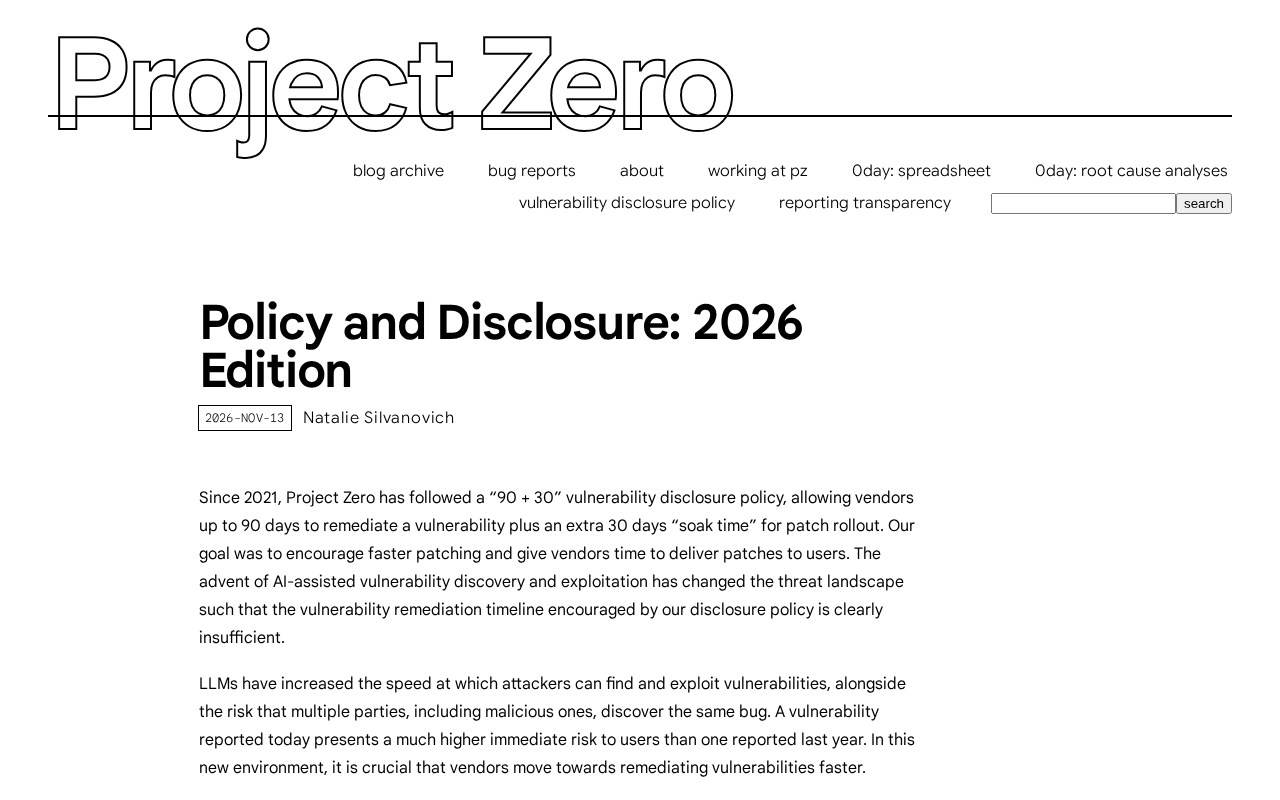
Project Zero Tightens Vulnerability Disclosure: 90-Day Deadline Takes Effect
Google Project Zero now discloses vulnerabilities 90 days after reporting, sparking debate on Hacker News. We analyze the impact on vendor patching, user risk, and disclosure trends.

If Anthropic IPOs and Joins Index Funds in Three Weeks, Your Savings Will Be Passively Betting on AI
Anthropic files for IPO; under Nasdaq 100 fast-entry rules it could enter index funds within three weeks, affecting ordinary investors' retirement savings. A look at the withdrawn pricing draft, financials, and bull-bear debate.
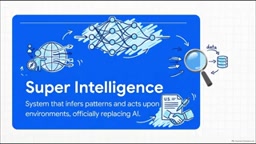
Anthropic IPO Analysis: $17B Quarterly Revenue and a Self-Braking Safety Framework
In-depth analysis of Anthropic's IPO: a $26B concurrent private placement, $17B quarterly revenue, 11,900 $100K+ customers, and how its PBC structure and Responsible Scaling Policy make the fastest-growing AI company deliberately brake its own innovation.

Anthropic's S-1 Leaked: $17 Billion in Revenue Over Three Months, Yet a $567 Million Loss
Anthropic files S-1 for IPO: nearly $17B in revenue over three months but a $567M loss, after a ~$1B profit last quarter. What the filing reveals about AI compute costs and vendor financial risk.

The $90 Billion Compute Bill Behind Anthropic's $85 Billion IPO
Anthropic files for IPO to raise about $85 billion net, backing a $9 trillion long-term compute commitment and a $71 billion near-term bill.

Gemini 4 Hydrogen Hands-On: The Best Flash Model Yet? 3D Generation Impresses
Gemini 4 Hydrogen hands-on: priced between Terra and Sonnet, with standout 3D printing and game generation; quota use stays manageable under Swarm. Benchmarks, tests, and value reviewed.
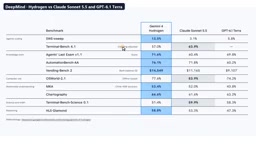
Gemini 4 Hydrogen Hands-On: The Trade-off Between Speed and Cost
Google Gemini 4 Hydrogen scored 43/43 on Plotly's test, but GPT 6.1 Sol matched it at less than half the cost. We break down Terminal Bench, thinking-level costs, and hands-on AI Studio testing to help you pick the right model.

Gemini 4 Hydrogen Review: The Cost-Effective Alternative That Outperforms Its Class and Replaces Argon
Gemini 4 Hydrogen is now live, priced at about twice 3.8 Flash, and tested to replace Gemini 4 Argon. This review covers availability, pricing and quota, performance, and Orchestrator mode advice, analyzing the real capability boundaries of this lightweight model.

Gemini 4 Hydrogen Coding Hands-On: Smaller, Stronger, and Cheaper
Gemini 4 Hydrogen coding test: High tier breaks into top ten across 33 prompts, using only 15% of subscription quota and beating Argon. API pricing and subsidy strategy analyzed.

Gemini 4 Hydrogen Released: Faster and Cheaper, but Cost-per-Task Is What Really Matters
Google releases Gemini 4 Hydrogen, a fast everyday model with near-frontier scores. Token price doubled but cost per task dropped sharply. Thinking levels, Orchestrator, and model selection explained.

Free Access to Gemini Coding Models: Methods, Risks, and Alternatives
A YouTube creator claims you can use Gemini coding models free via a third-party webpage to build a Ludo game. We examine the demo, authenticity doubts, security risks, and safer alternatives.

Gemini 4 Hydrogen Explained: Google's Lightweight, High-Speed AI Model
Analyzing Google's Gemini 4 Hydrogen: a lightweight, fast AI model with four thinking levels, multimodal support, ~100K token context, and the Carbon/Argon family roles.
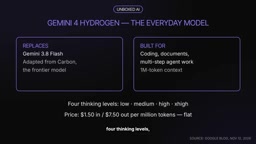
Cheapest Gemini 4 Tested: Scores 51 to Narrowly Beat a Flagship at Double the Price
Google's cheapest Gemini 4 model Hydrogen narrowly beats the double-priced Argon 51-50 on an independent leaderboard, but GPT 6.1 Tera ties it at half the cost. This article analyzes its pricing, terminal-task performance, the cost of the extra high level, and buying advice.

Gemini 4 Hydrogen Released: A Lightweight AI Option Focused on Speed and Cost-Effectiveness
Google releases lightweight model Gemini 4 Hydrogen, positioned as a Gemini 3.8 Flash replacement. It beats its own Argon in benchmarks, costs less than Sol and Opus, leads peers in speed, and can generate a playable game from a single prompt.
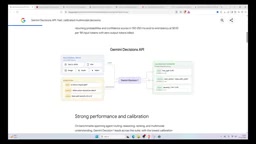
Anthropic Races Toward IPO as Google's Gemini Releases a Flurry of Updates
A roundup of Google Gemini's latest updates and Anthropic's progress: Gemini launches a decision API, a DNA vision model, and the mid-tier model Hydrogen; Anthropic releases Claude Meetings and advances its IPO, with analysis of benchmarks and revenue trends.

Google Gemini 4 Hydrogen Hands-On: Fast and Cheap, But It Won't Check Its Own Work
Google Gemini 4 Hydrogen hands-on: six apps scored 24.9/60, ranking near the bottom, but six tasks took only $6 and 31 minutes. A deep dive into its behavior patterns—no thinking, no screenshot checks, tests written to pass—and its correct use as an agent worker rather than a verifier.

Gemini 4 Hydrogen Architecture Breakdown: Carbon-Derived Reasoning and the Truth Behind Million-Token Output
Breaking down the Gemini 4 Hydrogen architecture: why it's directly adapted from Carbon rather than a shrunk-down Argon, what the million-token output limit means, how it beats the flagship Argon on benchmarks, the extra-high cost-effectiveness trap, hallucination trade-offs, and how to implement multi-layer model orchestration.
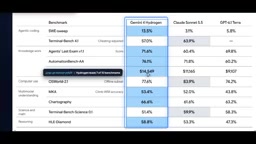
Gemini 4 Hydrogen Released: Real-World Performance Tests and Analysis of Google's New Model
Google releases Gemini 4 Hydrogen, focused on speed, coding, and AI Agent tasks. We analyze its benchmark performance, Orchestrator multi-model collaboration, and hands-on results for 3D modeling, presentations, e-commerce pages, and expense dashboards.

Why Did Goldman Sachs Take Back Its Traders' AI Coding Tools?
Goldman Sachs quietly pulled traders' AI coding tools in October while keeping them for engineers and Strats. The line drawn by "who can read code" reveals two questions every company deploying AI should ask: who has access, and who verifies the output.

Goldman Sachs Revokes Claude Code: The Battle Over Permission Boundaries for AI Coding Tools
Goldman Sachs bars traders and bankers from Claude Code and GitHub Copilot, restricting access to engineers. This analysis examines the risk, cost, and liability logic behind the policy reversal, contrasts Revolut's self-hosted open-source model route, and explores the governance boundaries of enterprise AI coding tools.