Deep Dives
In-depth AI analysis, industry observations, and technical insights — slow down and read.
Natural Gradient + Lateral Circuits: Predictive Coding Achieves Efficiency Comparable to Backpropagation
New breakthrough in predictive coding: Natural PC uses lateral circuits to achieve local natural gradient learning, matching backpropagation on image reconstruction with lower compute and fewer samples.

MuSeToM: A New Benchmark for Multi-Sensory Evaluation of Belief Revision in LLMs
MuSeToM is a human-validated textual benchmark with 2,415 instances covering six sensory cue types to evaluate LLM belief revision. Models sense belief change but struggle to identify the revised belief and over-update on salient yet insufficient cues.
LLM Agent Batch Tasks Speed Up by 65%: Joint Inference-Environment Optimization
A look at LLM Agent batch task makespan optimization: joint inference-environment design via memory allocation, trajectory-aware routing, and CAAS scheduling cuts time by 10.4%–65.0% on BFCL, SWE-bench, with evaluation scores aligned.

Emotional Inertia-Driven Framework: A New Approach to Multimodal Depression Detection, InertiaMPDD
InertiaMPDD proposes an emotional inertia-driven multimodal depression detection framework that uses a world-model-inspired latent predictor to learn healthy state patterns and constructs reference deviation, residual decay rate, and Jacobian spectrum descriptors. Fusion achieves 98.41% F1 on D-Vlog and 84.98% on LMVD across five cohorts, but descriptor utility is scenario-dependent.

The "Over-Realization" Problem in Text-to-Image Models: Why Chekhov's Gun Keeps Firing
Text-to-image models suffer from "over-realization": targets merely mentioned in prompts get drawn. The OverReal benchmark covers negation, imagination, metaphor, and occlusion, showing all eight systems fail and metrics like CLIPScore reward the error.
When Safety Becomes a Budget: How Dual-Channel Constrained GRPO Calibrates Safety Control for Vision-Language Models
Dual-channel constrained GRPO fixes standard GRPO's cancellation of the multiplier by group normalization, calibrating scorer mean bias via a monotone mapping; on Qwen3-VL-2B it cuts the harmful rate from 8.9% to 4.8% with over-refusal under 2% and MMBench unchanged.

Building an AI CRM Agent with Human Approval in n8n: Gemini + Slack + Postgres in Practice
Reddit developer open-sources an n8n AI CRM agent workflow: Gemini understands requests, code rules decide execution, high-risk actions go through Slack human approval and are logged to Postgres. Includes architecture breakdown and lessons learned.

A New Approach to LLM Agent State Management: Host-Held State Achieves 400/400 Exact Steps
A Reddit experiment shows host-held state keeps an LLM agent exact across all 400 steps, versus only 85 with the conventional approach. We analyze the principles, benefits, and limits.

Nvidia Employees Petition to 'Bring Back THE Boss': Behind the Calls for Jensen Huang's Return
A Reddit post shows Nvidia employees petitioning for Jensen Huang's return, likened to a 'second Sam Altman moment.' We analyze the founder-CEO symbol, whether the analogy holds, and governance lessons for AI firms.

Universe Age Doubled? Scientists Propose a Groundbreaking New Claim
Hacker News buzzes over the claim that the universe is twice as old as believed. This article explains how the age is calculated, why the debate centers on this parameter, and how to judge groundbreaking claims rationally.

Deconstructing Multimodal Vision Encoding: Pretrained Encoders Are Not Necessary, Dedicated Capacity Is Key
Controlled experiments break down three design choices of multimodal visual encoders: a pretrained visual prior is not necessary; dedicated visual capacity is key; and this capacity can be placed during fusion rather than before it, reducing time to first token.

ArchSpace: Using Scaling Laws to Predict Large Model Architectures and End Blind Training
ArchSpace is a public platform that records, reviews, and cites LLM architecture research, using scaling laws to predict large-scale performance from small experiments and bridge industry-academia validation gaps.

How Does Neuro-Symbolic Reinforcement Learning Achieve Automatic Compliance in AI Portfolios?
A new neuro-symbolic RL method internalizes investment compliance into the policy, cutting violation rates from 96–98% to 4.8% in continuous action spaces, solving a key deep RL deployment hurdle in finance.
AgentSSL: Can MLE Agents Leverage Unlabeled Data?
AgentSSL models semi-supervised learning as program search, finding that MLE agents can exceed human baselines under weak feedback, but program selection is a key bottleneck, causing performance drops of up to 47%.

Meta-Learned Network Parameter Spaces Harbor an Additive Structure, Offering a Geometric Explanation for Rapid Learning
Why can meta-learned networks learn new functions quickly? Research finds an additive vector structure in parameter space, where parameter vectors can be added and subtracted like word vectors, generating networks that execute target functions without training.

Sketching Algorithm Drastically Reduces Context Attribution Costs
New research proposes a sketching-based context attribution algorithm that, under a stability assumption, estimates all Leave-One-Out attribution values with only O(√log(1/ε)/ε) model evaluations, provides a matching theoretical lower bound, and significantly reduces computational costs in long-prompt scenarios.

Energy Model CRAM: 1,000x Faster Inference Than Looped Models
New research proposes the CRAM energy model, training at least 1,000x faster than looped models on Sudoku and mazes, reducing inference FLOPs by 282x, and warns of simple benchmark limitations.
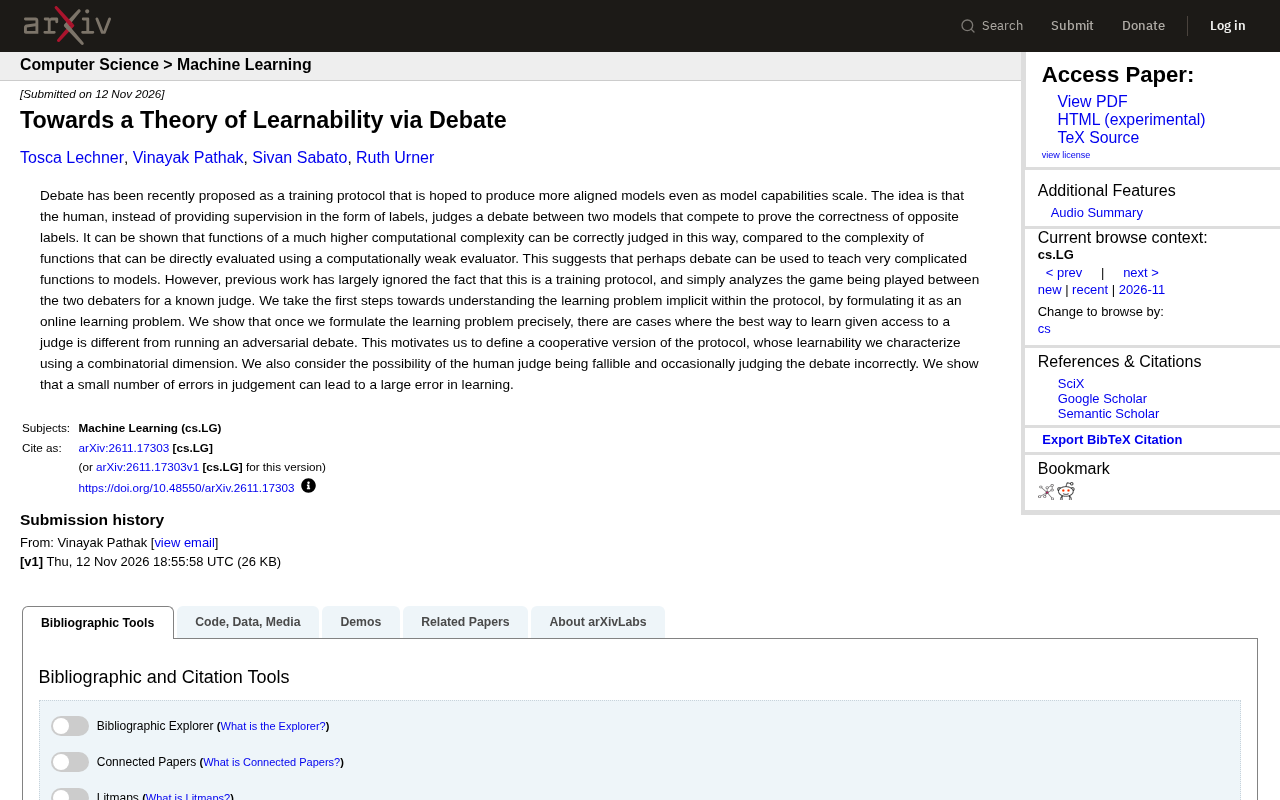
New Advances in the Learnability Theory of Debate Training Protocols
This article interprets new advances in the learnability theory of debate training protocols, formalizing them as online learning problems, proposing a cooperative protocol characterized by a combinatorial dimension, and revealing that a small number of judge errors can cause large learning errors, offering new perspectives for AI alignment training.
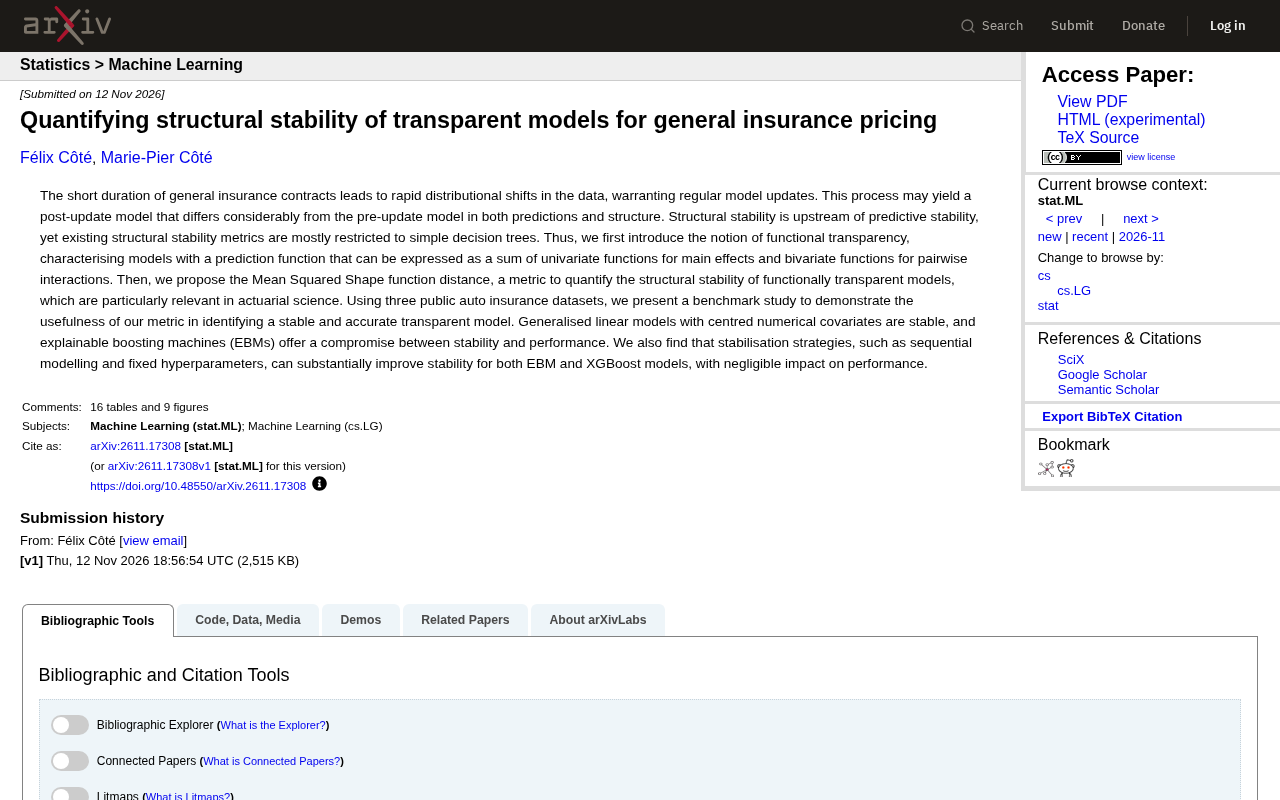
How to Quantify the Structural Stability of Insurance Pricing Models? A New Metric, MSSD, Provides the Answer
Insurance pricing models are updated frequently—how to quantify structural stability? This article explains functional transparency and the Mean Squared Shape function distance (MSSD) metric, and presents benchmark findings on GLM and EBM across three auto insurance datasets.

FLEX-LBP: A Binary Texture Descriptor with Learnable Parameters That Outperforms ResNet-50
FLEX-LBP learns LBP radius, angles, and thresholds via straight-through estimator while keeping exact binary inference. It improves six texture benchmarks by 3.55 points on average, surpassing ResNet-50 features with only 90 parameters.