Deep Dives
In-depth AI analysis, industry observations, and technical insights — slow down and read.

ReTrace: Distilling Tool-Calling Agents into Planner-Free Workflows
ReTrace distills LLM agent SOP execution into planner-free workflows: extract step conditions from agent reasoning, merge into rule docs, and compile into code-driven workflows—cutting per-task cost and latency while nearing agent completion rates.

Re-Search: Using the 20 Questions Game to Dissect LLM Bottlenecks in Scientific Ideation
Re-Search turns scientific ideation into a 20 Questions game, evaluating six LLMs on 200 ICML papers and finding the bottleneck is generation, not judgment.

Enterprise Analytics Agent Evaluation Framework Comparison: Stability, Detection, and Discovery
Comparative study of three evaluation paradigms: trace-based LLM judging hits 0.90 F1 on known-risk detection, text-only evaluation has 5x false positives, and functional testing and security red-teaming show zero overlap—recommending a dual-framework strategy.

EM-DETR: A Foundation Model for Medical Lesion Detection via Example-Based Grounding
Researchers propose a student-teacher training strategy and an example-driven EM-DETR framework, integrating heterogeneous medical image datasets to build a multi-domain lesion detection foundation model that achieves SOTA on chest X-rays and mammography, with AUC up 1 point and mAP50 surpassing single-dataset training by 2-3 points.

Medical Image Segmentation: Do Foundation Models Fine-tuned or Task-Specific Training Come Out on Top?
A systematic comparison of DINOv2 foundation model adaptation versus task-specific U-Net training in medical image segmentation: better cross-institution generalization, weaker in-distribution boundary accuracy.

Starlink Mini 2 Launches: Portable Satellite Internet Evolves Again
Starlink Mini 2 sparks heated debate on Hacker News with 285 points and 291 comments. This article reviews the portable satellite terminal's iteration direction, community discussion focus, and real-world use cases.

PewDiePie Googles Himself: Retirement, His Custom AI Model Ajax, and Linux Life
PewDiePie's self-search video addresses retirement rumors, reveals his custom AI model Ajax hits 60 tokens/s and is still in BF16 training, and shares his Arch Linux routine, OpenAI ban experience, and fatigue with the YouTube ecosystem.

PewDiePie Admits Failure: Why Did His Two-Year Crow Friendship Plan Fall Apart?
PewDiePie shares a two-year failure: trying to befriend Japanese crows, from feeding peanuts to rescuing a hanging crow, only to have the glory 'stolen' by a Japanese dad. The video reveals the real challenges of interacting with wildlife and a creator's honest take on failure.
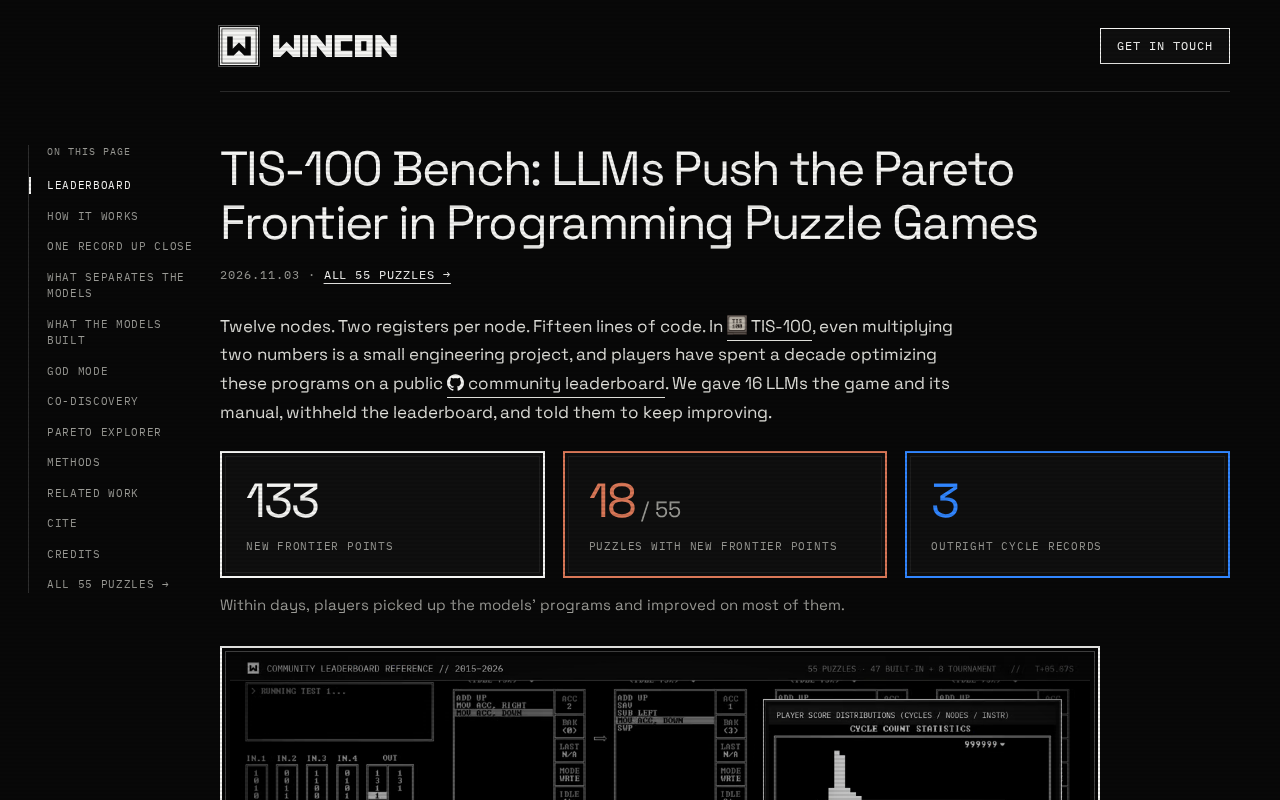
LLM Takes On Zachtronics' Brain-Bending Masterpiece TIS-100
A Hacker News project lets LLMs play Zachtronics' hardcore programming puzzle TIS-100. We analyze why TIS-100 is a litmus test for LLM program synthesis and reasoning, explore model capability boundaries under strict instruction sets, and discuss implications for AI coding tools.

MiniMax H3 Image Now on AI Gateway: Text-to-Image and Editing with a Single Key
MiniMax H3 Image and Highspeed are now on AI Gateway, supporting text-to-image and image editing, custom sizes, and 2K/4K output with a single API key—no separate MiniMax account needed, plus OpenAI image route compatibility.

Two AI Architecture Experiments: Shared MLP and FFT-Based Nonlinear Memory
A developer shares two small AI architecture experiments: PHSMLP uses a shared MLP to reduce Transformer parameters and validate head pooling; Pilot combines FFT-based explicit input history with nonlinear matrix memory, achieving lower language modeling perplexity than a parameter-matched Transformer, though memory tasks and training speed remain weak points.

ChatGPT 6.1 Sol Missing? Reddit User Seeks Help and Fixes
Reddit users report the ChatGPT 6.1 Sol model option has disappeared, suspecting an app bug. This article analyzes possible causes and offers fixes, including clearing cache, checking updates, and verifying account status.

D²Mamba: How Deformable Dual-State Mamba Improves Retinal Microaneurysm Segmentation
D²Mamba combines deformable Mamba scanning with non-causal state space duality, achieving 33.87% mIoU on the DDR dataset and a 10.06 percentage point Dice gain for microaneurysm segmentation.

Conditional Entropy-Enhanced EDL: A New Breakthrough in Uncertainty Quantification for Glaucoma Detection
A new study proposes a conditional entropy-regularized evidential deep learning framework that significantly reduces calibration error in glaucoma fundus image detection, outperforming Deep Ensembles and MC Dropout, and uses a Grad-CAM focus index to reveal attention deviation from the optic disc in false-negative samples.

UAV Remote Sensing Model Deployment: Comparing Distribution Shift Detection Tools and Latency Trade-offs
An empirical comparison of Alibi-Detect, NannyML, and PyTorch-OOD for distribution shift detection in UAV remote sensing, revealing trade-offs between detection capability and response latency.

Tight Sample Complexity of KL-Regularized Reinforcement Learning: New Bounds and Lower Bounds
This article presents the latest theoretical advances in the sample complexity of KL-regularized reinforcement learning: the plug-in estimator achieves a sample complexity of O~(KH^3/(εmax{ε,β})+KH) and a matching lower bound is proven, improving the effective horizon dependence from H^5 to H^3, and revealing the influence of temperature β for the first time.

Evaluating Compositional Generalization in Transformers: The Critical Role of Equivalence and Module Coverage
A systematic evaluation reveals how composition equivalence and module coverage critically affect Transformer compositional generalization benchmarks, offering key insights for better benchmark design.

Simultaneous Near-Optimal Region Identification: A New Paradigm for Simulation Optimization and the SASORI Algorithm
This article introduces new research on simultaneous near-optimal region identification in simulation optimization, proposes the SASORI algorithm achieving minimax-optimal complexity, and analyzes its theoretical lower bound and numerical results.

How Differential Privacy Ensures Reliable Ranking Inference for Large Models
This article introduces a novel method for ranking inference under the Bradley-Terry model using edge differential privacy, establishing error bounds via objective perturbation and leave-one-out analysis, with confidence intervals and bootstrap procedures, applied to large language model creative writing ranking.

Eye-Tracking + Psychophysical Attention Distribution: A New Approach to Reward Model Preference Prediction
A new study introduces the spatial distribution of attention from cognitive psychology into eye-tracking-enhanced reward model training, modeling visual attention as a graded distribution centered on fixation points. Experiments show higher preference prediction accuracy than baselines, with qualitative results consistent with human reading attention research.