Deep Dives
In-depth AI analysis, industry observations, and technical insights — slow down and read.

ChatGPT vs. Claude In-Depth Comparison: Strong at Coding but Weak at Research — How to Bridge the Gap?
A user considers switching from ChatGPT to Claude, finding Claude stronger at coding but shallower at research. We analyze the differences and share tips to make Claude's research deeper.

Theranos Whistleblower Warns: The AI Boom Is "a Great Opportunity to Deceive"
Theranos whistleblower Tyler Shultz warns the AI boom is "a great opportunity to deceive" as never-profitable companies raise capital at trillion-dollar valuations. This article examines the real-world context, key differences between AI and Theranos, and practical criteria for investors and practitioners.

Automation vs. Physical AI: The Next Stop for Industrial Intelligence
Industrial automation follows strict rules, while physical AI builds a learning loop from telemetry, human interaction, and problem data—making the system smarter with every run.

Claude's Terms Confuse European Users: Pro/Max Prohibited for Commercial Use, Even Support Can't Clarify
European Claude users discover that Pro/Max subscription terms include a "non-commercial use only" restriction, and support cannot clarify the boundaries of commercial use. Developers building projects with Max for sale are caught in compliance limbo, while the terms push users toward the cheaper Team plan.

Google's 4th-Gen Nest Learning Thermostat Drops $60: A Good Time to Buy Smart Temperature Control
Google's 4th-gen Nest Learning Thermostat is $60 off at Amazon, Best Buy, and Home Depot, now $219.99—matching the year's lowest price. See promotion details and buying advice.

Vercel Releases Geist Serif: A High-Contrast Display Serif
Vercel releases Geist Serif, a high-contrast display serif sharing Geist Sans's skeleton and metrics, with four dot-shape variants, 894 glyphs, and 352 languages.

NVIDIA NemoClaw: Full-Stack Control for Building Secure, Specialized AI Agents
NVIDIA NemoClaw targets specialized AI agent developers, emphasizing a controllable stack and a secure runtime that enforces constraints. This article analyzes its three-layer design—model, harness, and domain tools—plus key practices and security boundaries for production deployment of specialized agents.

How Credit Saison's ChatGPT Enterprise Pilot Achieved 954% ROI
Credit Saison's ChatGPT Enterprise pilot achieved 954% ROI and drove company-wide adoption. This analysis examines its pilot design, leadership and employee engagement, and reusable lessons for enterprise AI deployment.

AI SDK 3.0.19 Released: Credential Resolution and WebSocket Config Go Async
AI SDK's @ai-sdk/topaz 3.0.19 adds Promise and sync/async callback support for provider API keys and tokens, resolving credentials per request; experimental OpenAI Live's getServerWebSocketConfig() now returns asynchronously and must be awaited. provider-utils and provider dependencies updated in sync.

@ai-sdk/tui 1.0.159 Released: New Progress in Terminal AI App Development
@ai-sdk/tui 1.0.159 is released, updating the dependency to ai@7.0.158 to provide more stable dependency alignment for terminal AI application developers. Learn about this patch update and upgrade recommendations.

@ai-sdk/vue 4.0.158 Patch Release: Dependencies Synced
@ai-sdk/vue 4.0.158 patch released, syncing @ai-sdk/provider-utils to 5.0.72 and ai core package to 7.0.158. This article explains the linked dependency update, its practical impact on Vue developers, and upgrade evaluation advice.

@ai-sdk/workflow 2.0.90: Sandbox Sessions Gain File Operation Capabilities
@ai-sdk/workflow 2.0.90 patch update adds stat, listDirectory, and deleteFile methods to Experimental_SandboxSession, with just-bash and Vercel Sandbox adapters implementing them and unified relative path resolution.

@ai-sdk/typesafe-ai 3.0.31 Released: Async Credential Resolution Takes the Spotlight
@ai-sdk/typesafe-ai 3.0.31 patch adds Promise and async callback support for provider credential config, resolving keys per request; OpenAI Live WebSocket config can now resolve asynchronously, with provider-utils and provider dependencies upgraded in sync.

@ai-sdk/valibot 3.0.72 Patch Released: Dependency Updates
@ai-sdk/valibot 3.0.72 patch released with only dependency updates, syncing @ai-sdk/provider-utils to 5.0.72. No API or breaking changes—routine maintenance for the AI SDK ecosystem.

AI SDK Voyage 2.0.72 Update: Async Credential Support and Auth Refactor
AI SDK Voyage 2.0.72 patch analysis: provider API key and token now support Promises and async callbacks, credentials resolved per authenticated request, experimental OpenAI Live WebSocket config can return asynchronously, with synchronized provider dependency upgrades.

AI SDK Workflow Toolkit Releases 1.0.169 Patch Update
AI SDK's @ai-sdk/workflow-harness releases patch 1.0.169, aligned with the underlying harness version, auto-published by GitHub Actions with a verified signature. This article examines the version structure, release process maturity, and how developers should treat such maintenance updates.
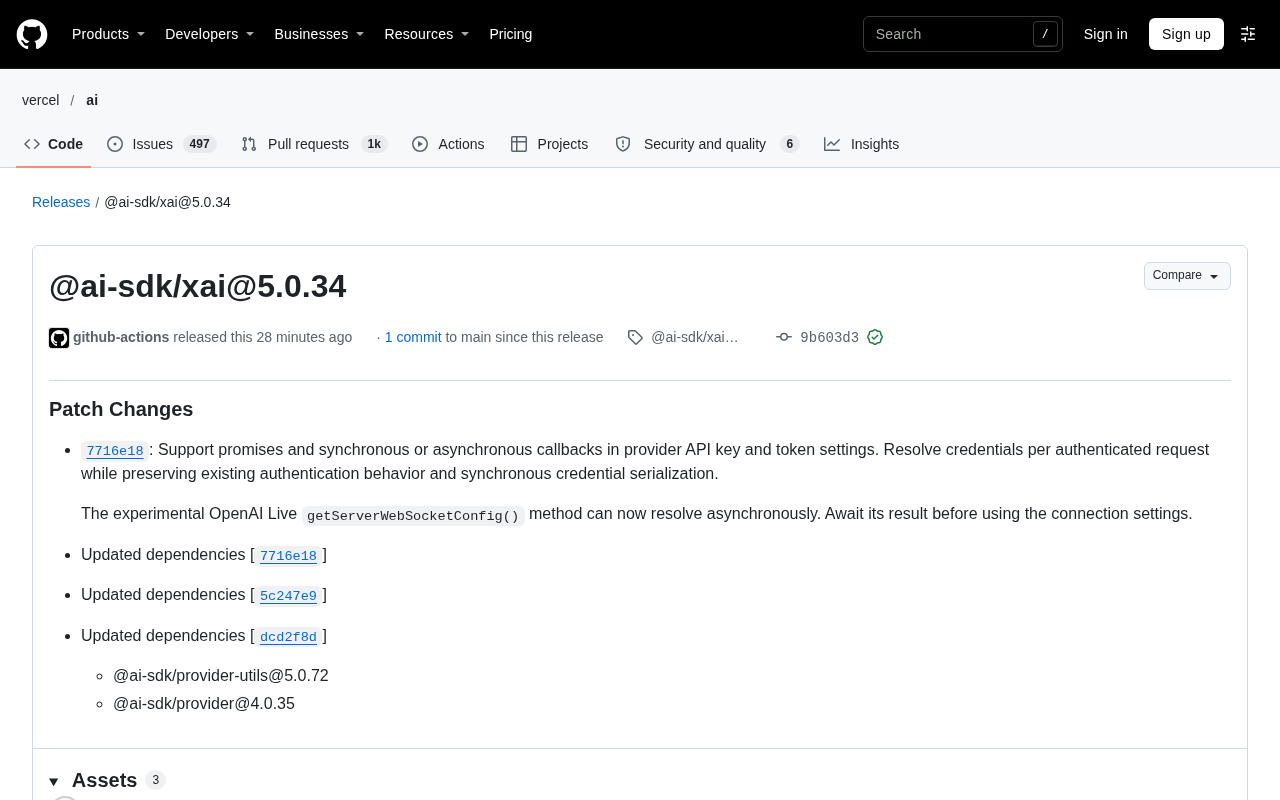
AI SDK xAI 5.0.34 Update: Asynchronous Credential Resolution and WebSocket Configuration Changes
Analyzing @ai-sdk/xai 5.0.34: provider API key and token settings now support Promises and sync/async callbacks with per-request credential resolution; experimental OpenAI Live getServerWebSocketConfig() supports async, plus dependency updates and upgrade notes.

Blockchain Intelligence Firms: Massive North Korea-Linked Crypto Exchange Hack
Blockchain intelligence firms jointly attribute a massive Binance hack to North Korea-linked groups, with $6.3 billion involved. This analysis covers the multi-source verification conclusions, the significance of the amount, and the impact on the crypto industry's security landscape.

@ai-sdk/zai 3.0.44 Released: Credentials Now Support Async Callbacks
@ai-sdk/zai 3.0.44 patch release: provider API Key and token now support Promises and sync/async callbacks, resolved per request with backward compatibility; OpenAI Live's getServerWebSocketConfig() supports async returns and must be awaited.

AI Isn't Replacing SREs — It's Quietly Deskilling Them
A Hacker News discussion argues AI's real threat to SREs isn't job loss but deskilling: over-reliance on AI tools erodes manual troubleshooting and system judgment. This article analyzes the causes, why SRE roles are especially vulnerable, and hedging strategies.