#大语言模型
311 related articles

GPT Models and "Harm Laundering": Gender Bias Transformed, Not Eliminated
GPT models may not eliminate gender bias — they transform it into subtler forms through "Harm Laundering." This article examines this AI governance blind spot and its implications for model evaluation.

Cache-to-Cache: Letting LLMs Communicate Through KV Cache Instead of Text
Cache-to-Cache (C2C) proposes letting LLMs skip text and communicate directly at the KV Cache level, reducing information loss and redundant computation in multi-agent collaboration.

AI Agent Fundamentals: From Traditional Programs to the Perception-Decision-Action Loop
A beginner's guide to AI Agents: covering traditional programs vs. agents, the perception-decision-action loop, LLM + tool calling + memory stack, and real-world use cases.
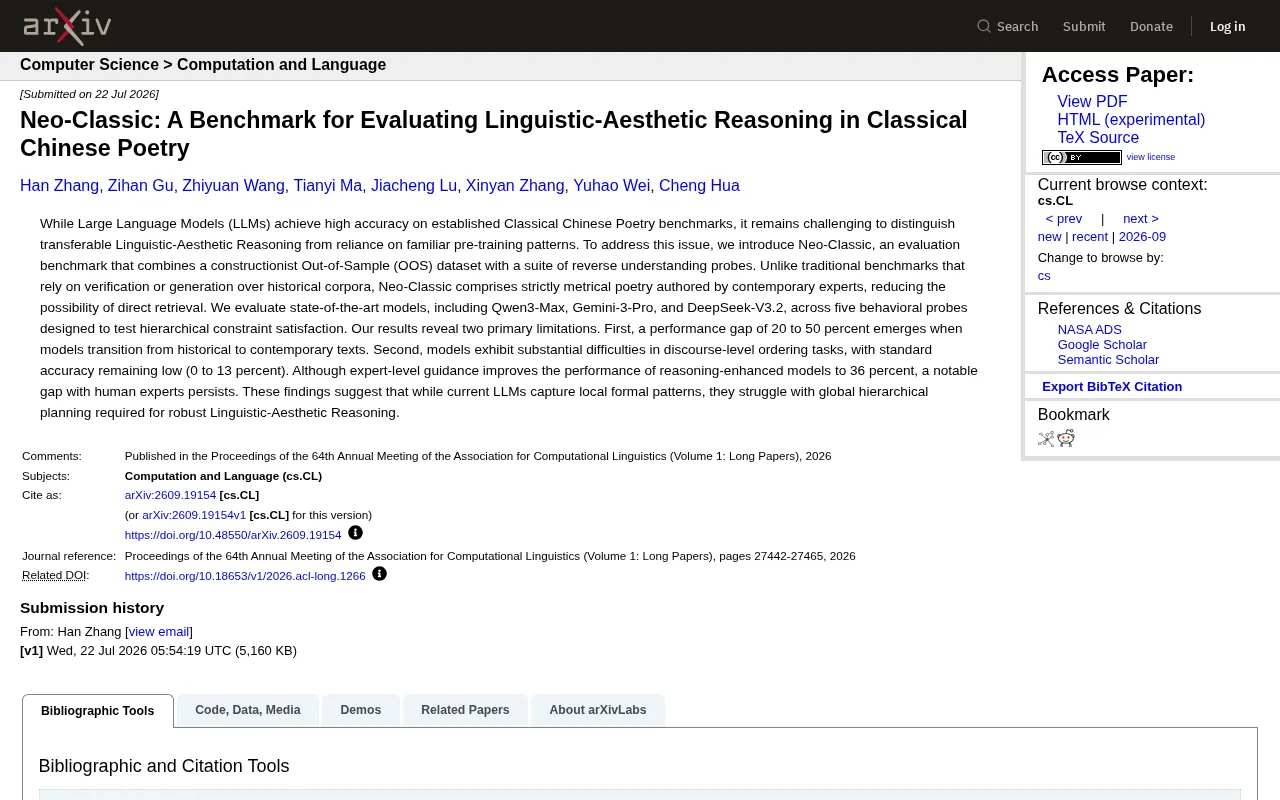
Neo-Classic Benchmark: Can LLMs Truly Understand Classical Chinese Poetry?
Neo-Classic benchmark tests LLMs on contemporary classical Chinese poetry. Top models like Qwen3-Max and DeepSeek-V3.2 show 20–50% performance drops and just 0–13% passage ordering accuracy.

Making LLMs Proactively Detect User Contradictions: UC-Bench and the SynUC Synthesis Method Explained
UC-Bench and SynUC: a new benchmark and constraint-guided synthesis method for detecting user-side implicit conflicts in LLM dialogues. A 4B model outperforms Claude Opus.

Dissecting Web Search in Conversational AI: Which Is More Reliable — ChatGPT, Claude, or Grok?
A new arXiv study systematically analyzes web search pipelines across ChatGPT, Claude, Grok, and DeepSeek, revealing key issues in search decisions, query strategies, domain bias, and missing citations.

Decoding LLM Benchmarks: What 14,767 Papers Reveal About How Evaluation Is Changing
A study analyzing 14,767 arXiv papers maps the evolution of LLM benchmark design: evaluation is shifting toward action and interaction, LLM-as-a-judge is rising, and concerns about evaluation independence are deepening.

PrismML Bets on Tiny LLMs: Can Small Models Reshape How We Use AI?
AI lab PrismML is betting on tiny LLMs — small, low-cost, locally runnable models — to reshape how people use AI. Here's why the approach matters and what's still unproven.

Infinite-Parameter LLMs: Dynamically Generating and Adjusting Model Weights from Real-Time Data
Infinite-Parameter LLMs propose dynamically generating model weights from real-time data, breaking the fixed-parameter constraint. We explore the core idea, differences from RAG and hypernetworks, potential value, and key challenges like stability and compute overhead.
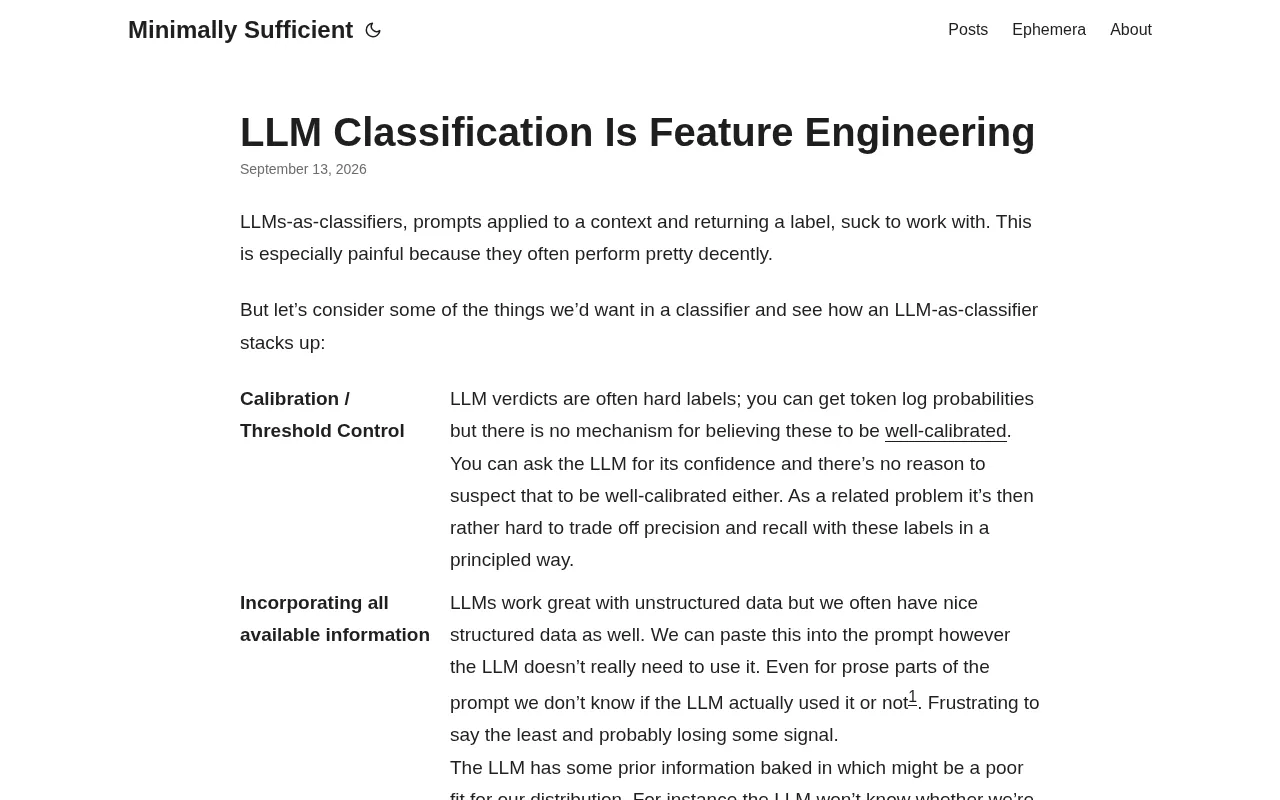
LLM Classification Is Feature Engineering: Rethinking How We Apply Large Language Models
Using LLMs for classification is fundamentally feature engineering. This article examines the representation and decision stages, explains why prompt engineering equals modern feature engineering, and offers practical guidance on hybrid architectures for production.

LLMs vs. TCM Physicians: Real Clinical Case Benchmarks Reveal AI's Promise and Risks
A study of 349 real TCM cases across 62 hospitals benchmarks 16 LLMs against 60 physicians. Top models outscored physicians on treatment principles but showed hallucinations and dosing errors in prescriptions.

The Hidden Bias in LLM Routing: Why Non-Standard English Users Get Downgraded Service
arXiv research reveals register bias in LLM complexity routing: queries in non-standard English and L2 English are systematically routed to weaker models due to input length signals, deepening AI inequity.

Relations Before Entities: The Deferred Commitment Mechanism in LLM Fact Recall
New arXiv research finds a temporal asymmetry in LLM fact recall: relation information becomes causally active 31–44% of network depth earlier than entity information, revealing a deferred commitment mechanism.

LLM-Extracted Features from Clinical Notes Improve Extubation Failure Prediction
UW Medicine researchers use LLMs to extract features from respiratory therapy notes, improving extubation failure prediction while exposing methodological inconsistencies across prior studies.

GraphEcho: Exposing the Evidence Redundancy Trap in LLM Graph Agents
GraphEcho benchmark reveals LLM graph agents mistake redundant paths for independent corroboration. New research evaluates PAPT's limits and the gap between efficient exploration and effective evidence use.
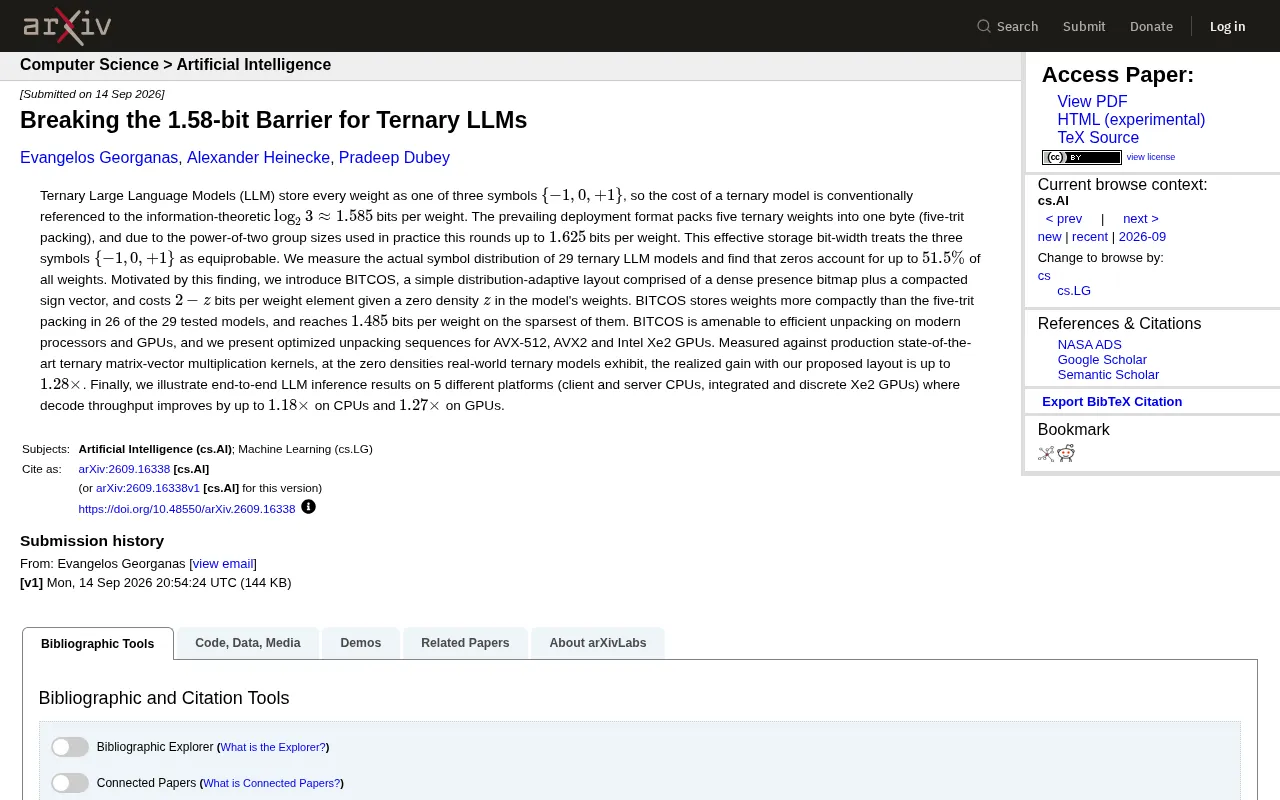
Breaking the 1.58-Bit Barrier: How Ternary LLMs Approach the Information-Theoretic Limit
Why 1.58-bit isn't the true lower bound for ternary LLMs. Learn how weight sparsity and entropy coding can break this information-theoretic barrier for efficient on-device deployment.

Fireworks Partners with Alibaba Cloud to Launch Qwen3 Flagship Models
Fireworks AI partners with Alibaba Cloud to bring the latest Qwen flagship models to its inference platform, letting developers build via API without managing GPU infrastructure.
One in Three AI Medical Records Has Errors: Omission Is the Deadliest Failure Mode
An audit of three AI medical scribes found one-third of notes had verifiable failures — mostly omissions. LLM judges are near coin-flip at detecting them. The fix: restructure the task.

Neuralese: When AI Thinks in a Language We Can't Read
AI safety researcher Rob Miles explains Neuralese, Chain of Thought, and opaque recurrence — why models may think in unreadable internal languages, and why CoT monitorability is a fragile safety window that's closing fast.

What Is Ollama? A Beginner's Guide to Deploying Open-Source LLMs Locally
Ollama is a free, open-source LLM management platform for locally deploying DeepSeek and other open-source models on macOS, Windows, Linux, and Docker — no API fees required.