#大语言模型
311 related articles

RAG Framework for Intersection Safety: Using LLMs to Convert Crash Narratives into Countermeasure Recommendations
A new arXiv study proposes a RAG framework that uses LLMs to automatically convert intersection crash narratives into countermeasure recommendations, achieving an F1 score of 0.82 on real Florida data.

NepKANUN: A Deep Dive into Nepal's RAG-Based Legal AI Assistant
NepKANUN is a Nepali legal AI assistant built on RAG and fine-tuned LLMs, achieving BERTScore F1 up to 0.82 — a replicable blueprint for low-resource domain AI.

Survivorship Bias: The Overlooked Baseline Trap in LLM Research Idea Evaluation
An arXiv commentary reveals that LLM research idea evaluations suffer survivorship bias: human baselines use published papers while AI baselines use one-shot proposals, potentially making the observed gap a sampling artifact rather than a true capability difference.

Inference Networks: Optimizing LLM Inference Costs with Threshold Policies
A new arXiv paper proposes the Inference Networks graph framework for optimizing LLM inference costs, proving that optimal model activation follows a threshold structure for significant cost reduction.

DeepSeek Said It Was 'Sleepy' While Transcribing Music? Let's Talk About Anthropomorphism in LLM Chain-of-Thought
A Bilibili creator found DeepSeek saying it was 'sleepy' mid-task. We explain why LLMs mimic fatigue, how Chain of Thought amplifies anthropomorphism, and what to do about it.

Transformer Attention Mechanism Deep Dive: From Tokens to Self-Attention, Step by Step
A deep dive into the Transformer attention mechanism — from tokenization and embedding to Q/K/V self-attention, Mask, and Softmax — with step-by-step dimension tracking.
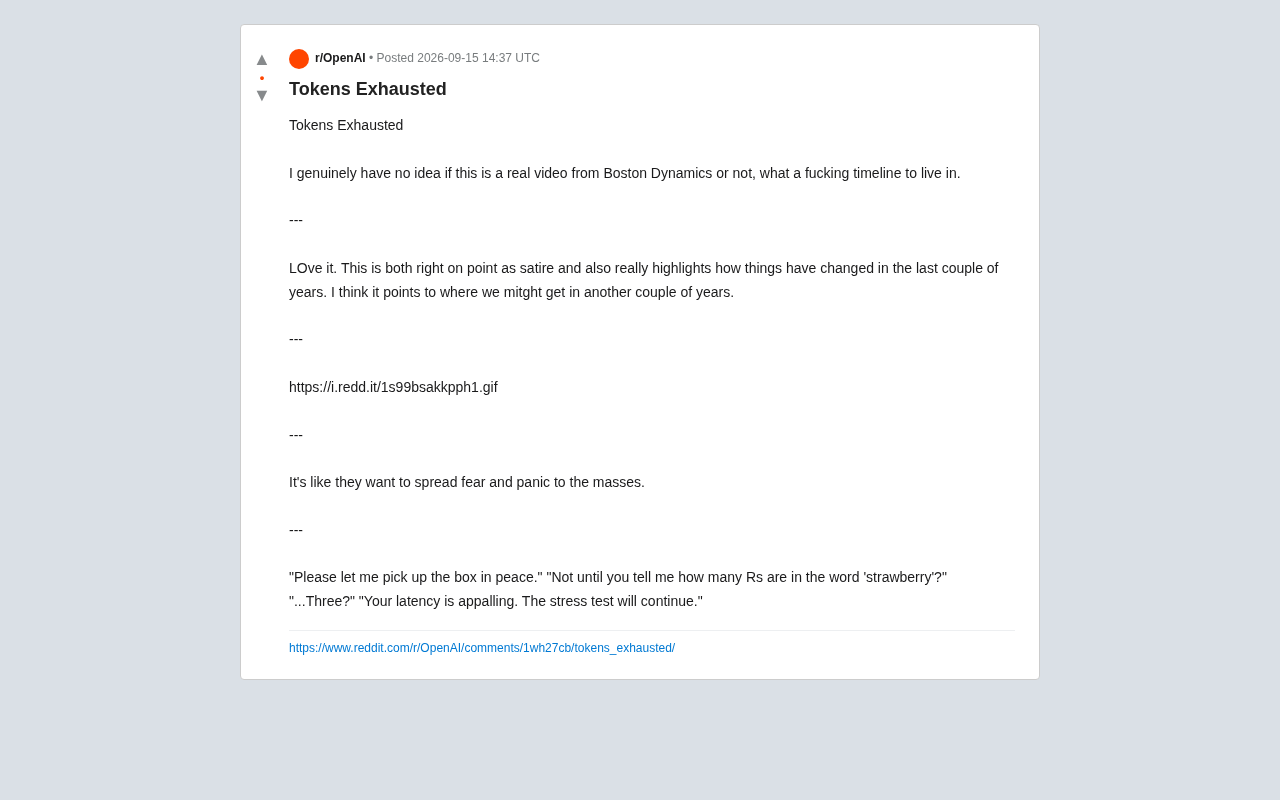
"Tokens Exhausted": The AI Anxiety Behind a Robot Video
A robot video called "Tokens Exhausted" went viral on Reddit, leaving viewers unable to tell if it was real Boston Dynamics footage. We unpack the AI satire and the anxieties it reflects.

PhysMent: Evaluating LLM Physical Reasoning with Interactive Physics Simulation
PhysMent is an interactive benchmark built on MuJoCo that evaluates LLM physical reasoning through tool-mediated experiments. Models excel at qualitative tasks but fail on quantitative multi-step ones — the bottleneck is procedural, not conceptual.

TimeThink: A Synthetic Framework for Teaching Temporal LLMs Compositional Reasoning
TimeThink is a synthetic framework for temporal LLMs that generates verifiable QA data using domain-agnostic time-series primitives and RLVR training, outperforming strong baselines on real-world benchmarks using only synthetic data.

Vibe Patenting: Can LLM Judges Reliably Evaluate Patent Drafting?
New arXiv research uses the Vibe Patenting platform to test LLM judges on patent drafting. Review-guided iteration boosts quality and can narrow the gap between low- and high-cost agents, but AI-human agreement is strongly metric-dependent.

Swift-Qwen3.8-27B: 58% Fewer Thinking Tokens, Nearly 2x Faster Inference
UkisAI open-sources Swift-Qwen3.8-27B, cutting thinking tokens by 58% and boosting inference speed 1.95x via overthinking token penalties and on-policy distillation — with under 1% accuracy loss.

Apple Siri May Soon Support Switching Between Claude and ChatGPT: Code Reveals the Clues
Developers found code evidence suggesting Siri may support switching between Claude, ChatGPT, and other LLMs. We analyze what this means for Apple's AI strategy.

Repair Before Reinforce: Context-Augmented Knowledge Graph Reasoning Tackles Multi-Hop QA
New arXiv paper proposes a context-augmented KG reasoning framework using a "Repair Before Reinforce" strategy to improve LLM multi-hop QA. Validated on Gastroparesis and Diabetes KGs with Qwen3-14B, achieving 100% single-hop accuracy after repair.
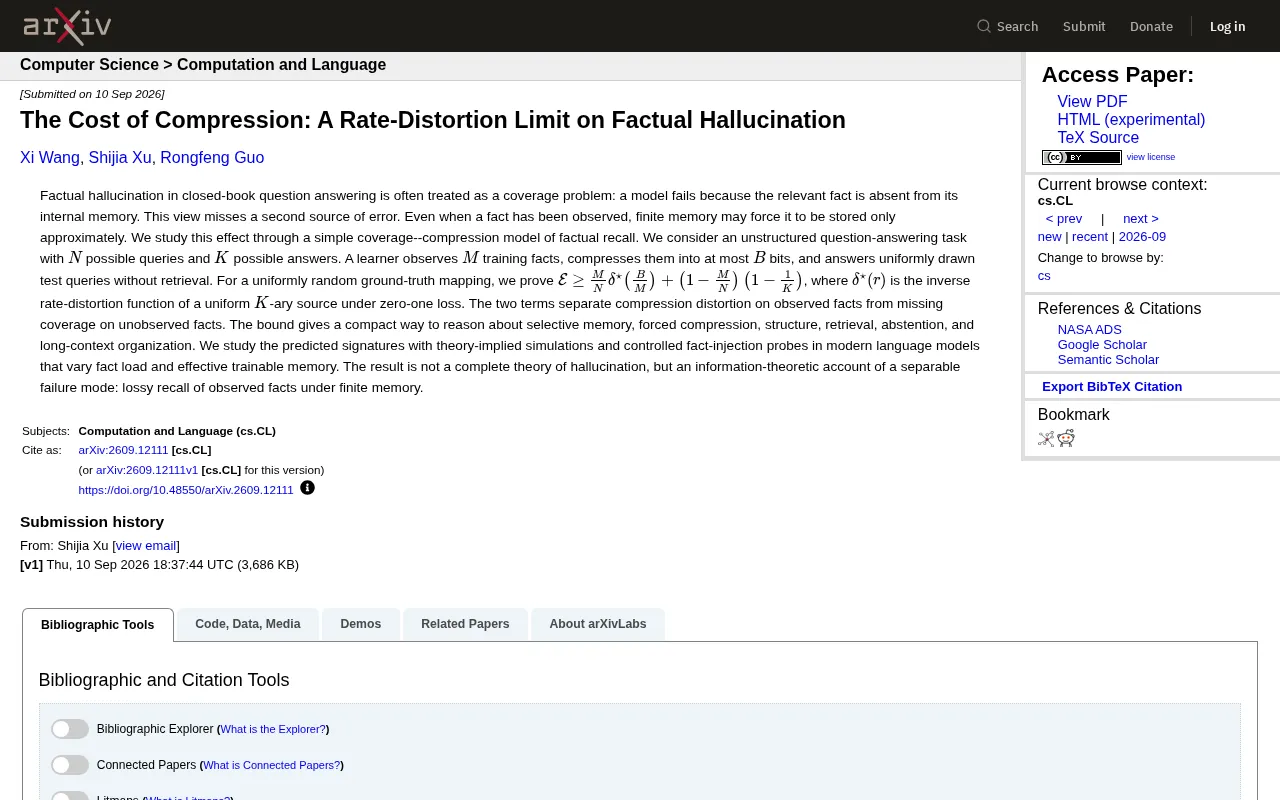
The Cost of Compression: Rate-Distortion Limits Behind Factual Hallucination
A new arXiv paper uses rate-distortion theory to reveal a second source of LLM hallucination: compression distortion under limited memory. Covers the coverage–compression model, error lower bounds, and implications for RAG and abstention.

Weak Supervision + LLM Annotation Refinement: Extracting Dataset Citations from Humanitarian Documents
A new arXiv paper proposes a weak supervision + LLM refinement framework for extracting dataset citations from humanitarian documents, achieving 88.2% passage-level accuracy on a 1,706-passage gold benchmark.

R2VC: A Modular Fact-Checking Architecture for More Trustworthy LLM Verification
R2VC proposes a modular fact-checking architecture with Retrieve, Reason, Verify, and Calibrate stages, boosting an 8B model's accuracy by 13.74% on FEVER while improving confidence reliability and abstention.

Did AI Crack a 370-Year-Old Cipher? The Controversial Claude Fable 5.1 Claim
Hacker News buzz: AI model Claude Fable 5.1 allegedly cracked the 370-year-old Cyphral Distich cipher. We break down the claim, AI's real cryptanalysis potential, and why skepticism is warranted.

Hallucination Detection for Local LLMs in Practice: Low-VRAM Approaches from 1.5B to 120B
How to detect hallucinations in local LLMs without consuming extra VRAM? Practical insights from testing 1.5B to 120B models, covering confidence signals, self-consistency, and lightweight validators.

TeleChat: An Open-Source Telegram AI Bot Integrating GPT-5, Gemini, and Claude
TeleChat is an open-source Telegram AI bot integrating GPT-5, DALL·E, Groq, Gemini 2.5, and Claude 4.1. Supports web search and deploys on Zeabur, fly.io, and Replit. 1,242 Stars on GitHub.

"LLMs Are Real, AI Is Fake": A Debate Worth Having
Hacker News post 'LLMs are real, AI is fake' sparks debate: why LLMs are concrete and verifiable while 'AI' is often marketing hype. What this means for practitioners.