#大语言模型
306 related articles

GPT-7 Preview, Mistral Large 4, and Claude Code Updates: A Complete Breakdown
GPT-7 preview leaks via math manuscripts, Mistral Large 4 targets cybersecurity, Google upgrades Nanobanana 2.1 & Embedding Gemma 2, Anthropic enhances Claude Code. Full breakdown inside.

AI Sycophancy and Content Detection: What a Rednote Screenshot Reveals About Datasets
A Rednote screenshot shared on Reddit sparks discussion on AI sycophancy and content detection — two major challenges facing LLMs today. Here's what it reveals.

SAGA Framework: Enabling LLM Agents to Abstract Reusable Knowledge from Experience
The SAGA framework enables LLM agents to distill interaction trajectories into reusable principles via hierarchical knowledge abstraction — no fine-tuning required. Validated on ScienceWorld and ALFWorld.

RadOnc-Agent: Orchestrating a Full Radiation Oncology AI Workflow with Large Language Models
RadOnc-Agent uses an LLM to orchestrate the full radiation therapy workflow across 4 clinical phases and 26 callable functions, achieving 96%+ completion rates while confirming technical feasibility.

WavePrune: Using Just One Rotation Period of RoPE Actually Improves Long-Context Performance
WavePrune restricts each RoPE channel to its first rotation period, eliminating position aliasing. It boosts Qwen3-8B's HELMET score from 35.7 to 40.0 with no fine-tuning, plus 1.15–1.24× inference speedup.

Zero-Shot Visualization: Exploring Text Corpora by Defining Axes in Natural Language
A new arXiv paper proposes Zero-Shot Visualization (ZSV), letting users define concept axes in natural language to explore text corpora. Next-token probability scoring proves most practical.

Decomposing LLM Controllability: A Three-Factor Framework of Capacity, Responsiveness, and Alignment
A new arXiv paper introduces a three-factor framework — capacity, responsiveness, alignment — to explain what makes latent structures in LLMs truly actionable, with causal probes achieving 17–118% steering improvement.
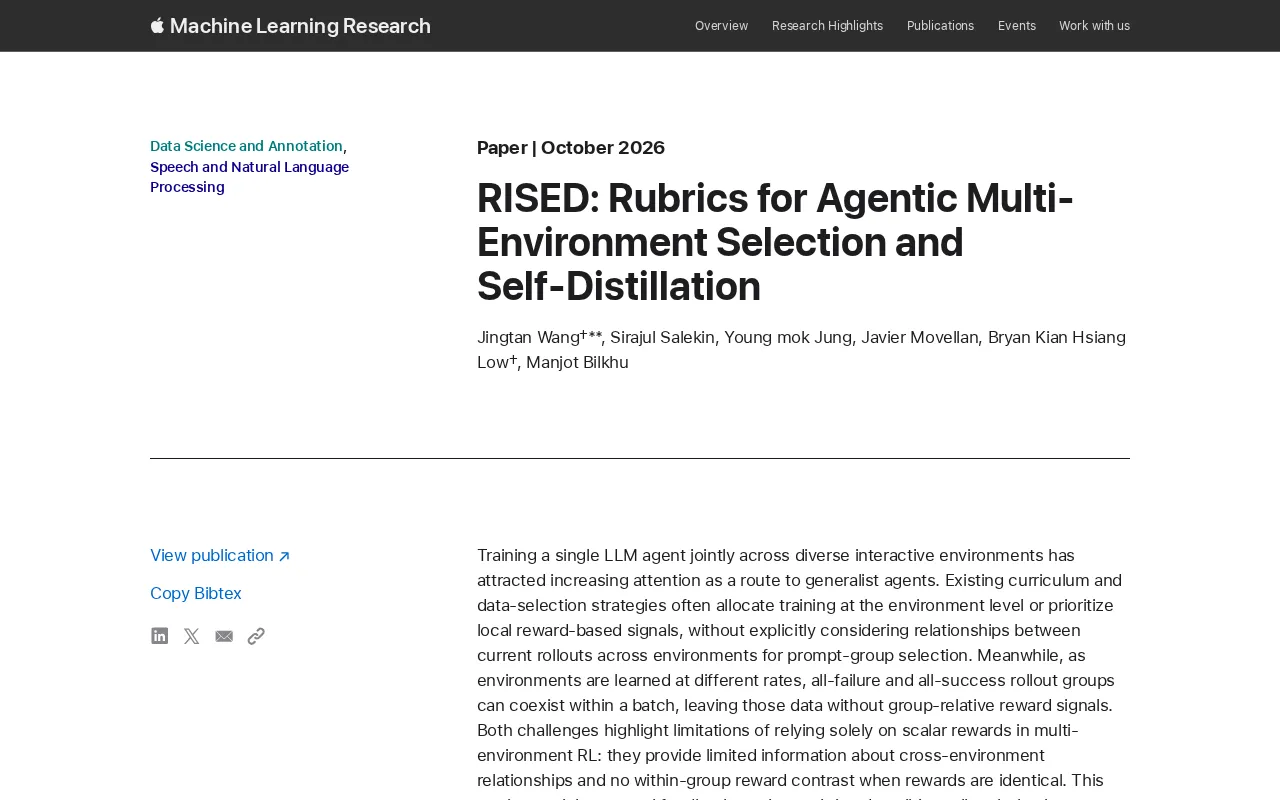
RISED: Rubric-Guided Selection and Self-Distillation for Multi-Environment Agent Training
RISED introduces rubric-guided selection and self-distillation to tackle data filtering and broken reward signals in multi-environment LLM agent training.

PageIndex: A New Reasoning-Based RAG Approach Without Vectors
PageIndex is an open-source vectorless, reasoning-based RAG framework that navigates documents via hierarchical outlines instead of vector search. 38K+ GitHub stars.

When Your Job Becomes a Relay Between Your Boss and Claude
A viral Reddit post mocks workers reduced to relaying between their boss and Claude. We examine AI's impact on white-collar work and where human value truly lies.

Running Qwen3 Next 125B Locally with Strata: A Practical Guide for Consumer GPUs
Strata lets 6–12GB consumer GPUs run Qwen3 Next 125B locally via smart memory scheduling. Learn the setup, model versions, context tips, and real benchmark speeds.

Context Language Model: Let AI Agents Edit Their Own Context — No More Summarization
Meta & UW propose Context Language Model (CLM), letting AI agents rewrite their own context like editing code — outperforming summarization on BrowseComp-Plus by 11%.

Reflection Launches Beam: A 501B Parameter Open-Weight Large Language Model
Reflection releases Beam, an open-weight LLM with 501B parameters. We break down its ecosystem significance, deployment costs, quantization, and key licensing and performance considerations.
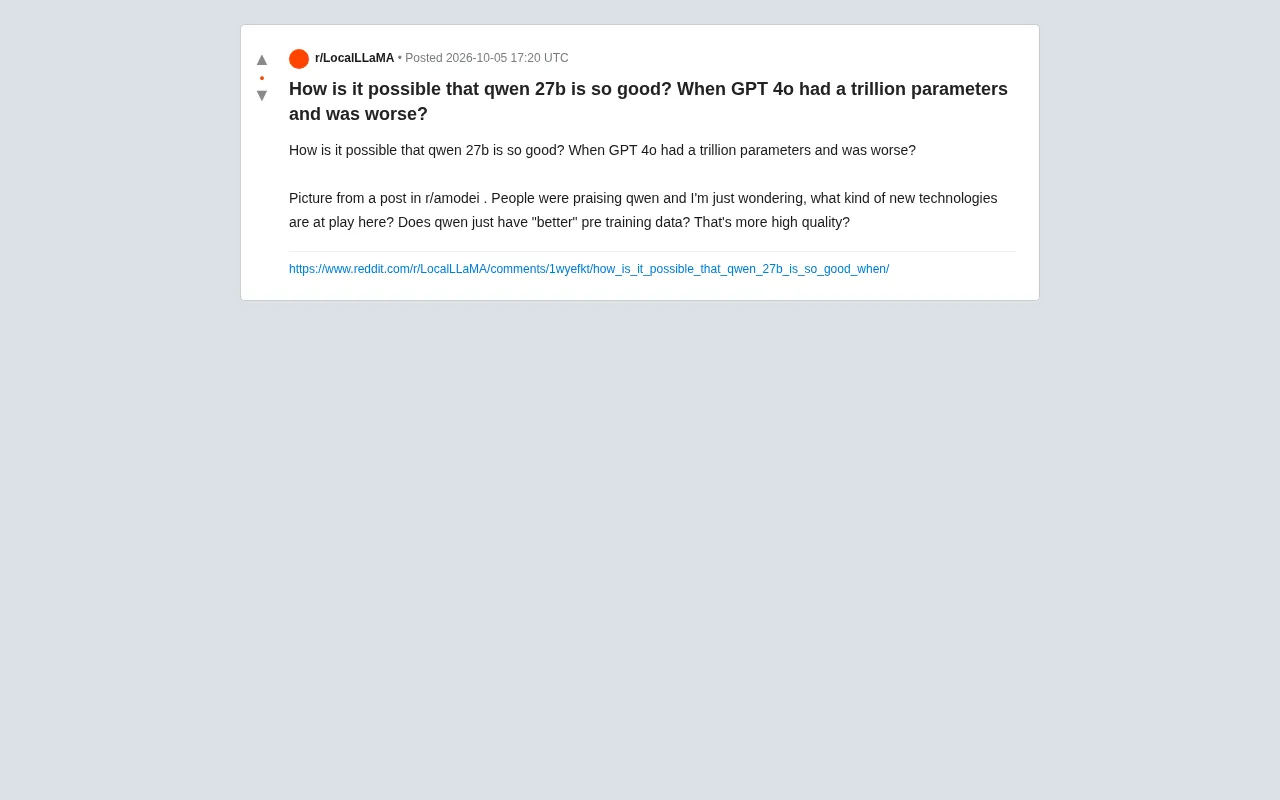
Small Models Beating Large Ones? Unpacking How Qwen 27B Rivals GPT-4o
Why can a 27B-parameter Qwen model rival GPT-4o? We unpack data quality, MoE architecture, RLHF, and benchmark limitations to explain the small model uprising.

Did GPT-6 Astra Really Crack a 217-Year-Old Napoleonic Code in Six Hours? The Truth Is Unclear
A Hacker News post claims GPT-6 Astra cracked a 217-year-old Napoleonic cipher in six hours. We analyze the technical plausibility and why this story deserves skepticism.

Aleph Alpha Opens Free Online Trial for Kolibri 78B
Aleph Alpha's 78B-parameter Kolibri model is now available for free online trial via tesseracted.com — no deployment or API key required.

Using Large Language Models to Break Through the Scalability Bottleneck in Interpretive Structural Modeling
New arXiv research explores using LLMs to overcome ISM's scalability bottleneck, comparing pairwise, k-wise, rowwise, and full graph methods. Rowwise (F1=0.77) and full graph approaches perform best.

The THPL Framework: Driving Precision Feeding Decisions for Rainbow Trout with Vision-Language Models
The THPL framework converts rainbow trout movement trajectories into vision-language tokens, using LoRA fine-tuning and counterfactual mDPO to drive interpretable precision feeding decisions, boosting accuracy from 33% to 96.67%.

DeReAct: Decoupling Reasoning and Acting for More Reliable AI Agents
DeReAct introduces a modular agent architecture that decouples ReAct's reasoning and acting via an external Critic and Context Manager, boosting Pass@1 by up to 7 points for weaker models.

The CITA Framework: Teaching AI Tool Calls to "Think Before You Act"
The CITA framework trains a Comparative Inference Model (CIM) fusing observed behavior, a Bayesian tool-graph simulator, and LLM semantics to improve step-level tool selection and boost Tool F1 and task success rates.