#大语言模型
305 related articles

A Tweet That Sparked a Question: Can AI Serve as a Crisis Decision Assistant?
A satirical tweet imagining a cabinet official consulting AI on a plague outbreak raises real questions about generative AI's limits in high-stakes public decision-making.

AI Mines 400 Years of Historical Archives to Uncover Forgotten Meteorite Records
Researchers used AI to mine 400 years of historical archives, uncovering forgotten meteorite records. An analysis of the technology, value, and limits of AI in digital humanities.

When AI Solved 372 Math Problems in One Day: Why Mathematicians Are Angry, Not Celebrating
OpenAI's LLM solved 372 open math problems in one day, yet mathematicians like Terence Tao are pushing back. We unpack why — from broken knowledge transmission to bin packing and integer multiplication controversies.

Decision Models vs. LLMs: What 4.8× Speed and 7.4× Cost Savings Actually Tell Us
A developer benchmarked a decision model vs. Gemini on 1,000 job listings: 4.8× faster, 7.4× cheaper, only 1.6pp less accurate. The best solution is a layered fallback architecture, not a replacement.

A New Approach to AI Long-Term Memory: Can a 50-Million-Token Window Beat Recomputation on Speed and Cost?
A Reddit discussion proposes a 50-million-token AI long-term memory window, claiming it's faster and cheaper than recomputation. We analyze the technical implications, possible approaches, and why caution is warranted.
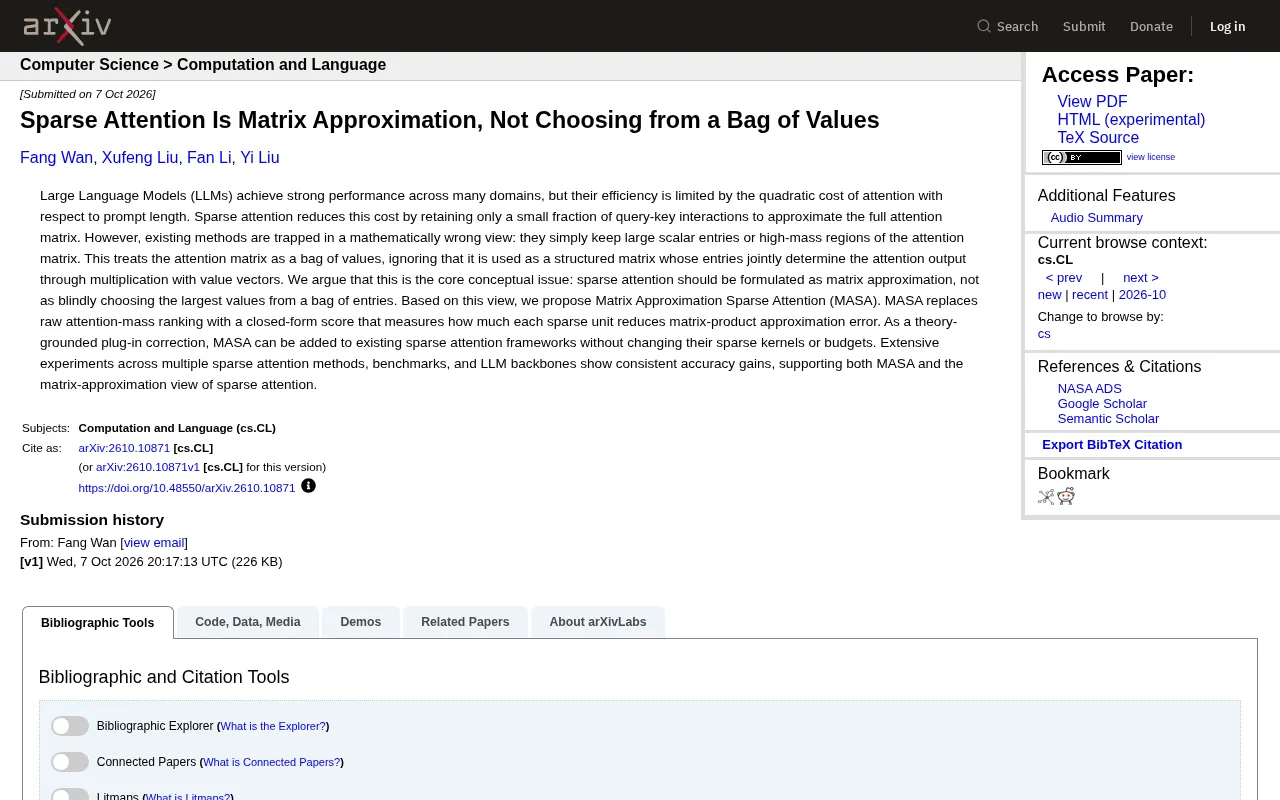
Redefining Sparse Attention: MASA Replaces "Pick the Big Values" with Matrix Approximation
MASA reframes sparse attention as matrix approximation, replacing "pick big values" with closed-form error scoring to improve LLM long-context accuracy without extra compute.

A New Take on AI Long-Term Memory: 50M Token Window, Faster and Cheaper Than Recomputation
arXiv paper tests galahad-kv, storing LLM KV states to encrypted NVMe and reusing them exactly. In 50M-token tests: 2.8–4.3× faster loading, 8.8–12.3× lower GPU energy — a new approach to AI long-term memory.
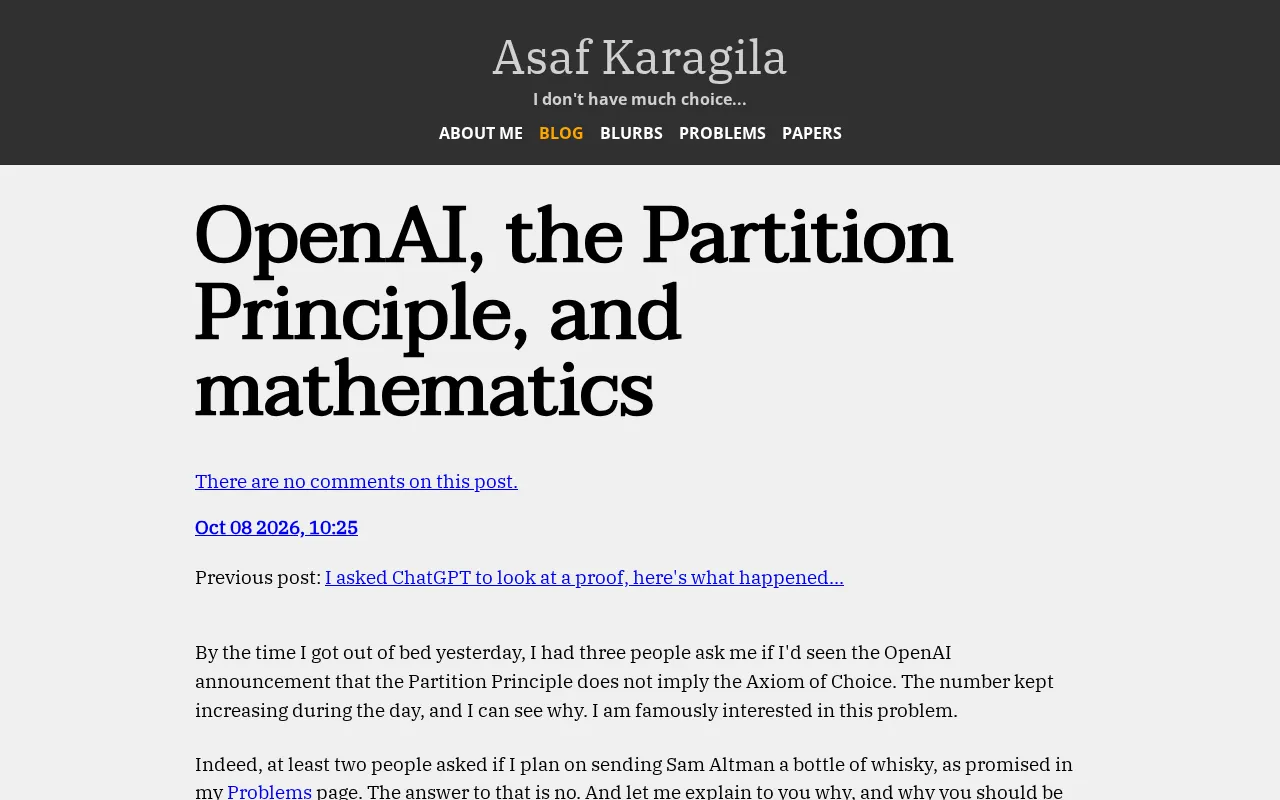
OpenAI and the Partition Principle: Can AI Truly Understand Mathematical Proofs?
The debate over OpenAI models and the Partition Principle reveals the true limits of AI mathematical reasoning and why formal proof verification is the key path forward.

Claude Opus 5.5 Builds a Retro J2ME Shooter From a Single Prompt
A Reddit user used one prompt to have Claude Opus 5.5 build a complete 3D J2ME shooter — integer engine, procedural art, MIDI music, TTS audio, and a 500KB JAR that runs on a 20-year-old phone.

Claude Model Family Explained: How to Choose Between Haiku, Sonnet, Opus, and the Mysterious Mythos
A complete guide to the Claude model family: Haiku for speed, Sonnet for balance, Opus for flagship performance, and the restricted Mythos. Includes a clear model selection guide.

Sub-1-Bit LLM Compression: A Deep Dive into Latent Factorization
What is sub-1-bit LLM compression? This article explains Latent Factorization-based ultra-low-bit compression for LLMs — how it works, its value, and key challenges.

One Person, One AI Toolchain, One Bank Breach: The Security Wake-Up Call Behind ARTEX
CrowdStrike reports a possible single-attacker breach of South Korean banks using the ARTEX open-source AI pen-test tool chained with DeepSeek, GLM, Grok, and Claude Code — a wake-up call for financial security.

Terence Tao Responds to OpenAI's Math Breakthrough: The Meaning and Limits of AI-Generated Proofs
Fields Medalist Terence Tao responds to OpenAI's math reasoning advances, sparking debate on what AI proofs really mean and where the limits lie.
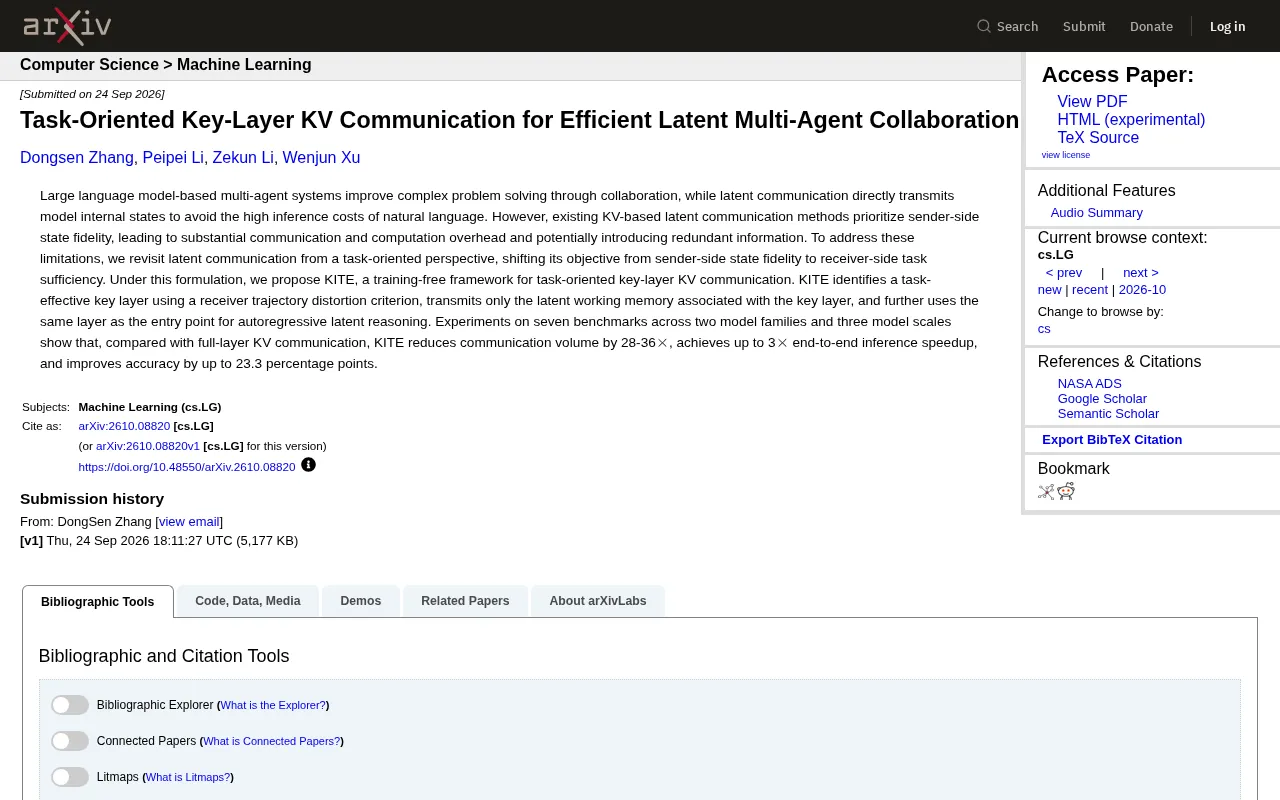
KITE Framework: Efficient Multi-Agent Collaboration Through Key-Layer KV Communication
KITE is a training-free framework that cuts multi-agent KV communication by 28–36×, speeds up inference 3×, and boosts accuracy by 23.3 pts via key-layer selection.

GenST: Predicting Spatio-Temporal States for Unobserved Nodes with Large Language Models
The GenST framework uses LLMs as a semantic bridge to solve the FUNS problem via a two-stage spatio-temporal VAE and generative Transformer, achieving strong zero-shot results across 8 datasets.

KVFetch: Filling the Missing Temporal Recall Channel in KV Cache Compression
New arXiv paper KVFetch identifies sequential forgetting in KV cache compression and proposes a training-free temporal recall channel, restoring verbatim copy scores from 0.8 to 78.4 on RULER-16K.

LRCC: A New Approach to Improving Low-Rank Compression with Conditional Computation
LRCC trains lightweight per-block routers to dynamically route tokens through nested low-rank paths, outperforming static low-rank compression by 7.6pp on Llama-2-7B downstream accuracy under equal compute budget.

A New Take on LLM Sycophancy: Task Difficulty Matters Far More Than Pressure Tactics
A study of 100K+ LLM responses finds sycophancy is driven by task verification difficulty and model guardrails—not user pressure tactics. Deep reasoning cuts capitulation to 0%.

What 'Celery Man' Tells Us About AI: How a 2011 Comedy Predicted Today's Human-Machine Interaction
A 2011 comedy sketch 'Celery Man' is going viral on Reddit for predicting today's LLM-driven natural language interaction. We explore Claude, stochastic parrots, and the shifting paradigm of human-computer interaction.

GPT-7 Preview, Mistral Large 4, and Claude Code Updates: A Complete Breakdown
GPT-7 preview leaks via math manuscripts, Mistral Large 4 targets cybersecurity, Google upgrades Nanobanana 2.1 & Embedding Gemma 2, Anthropic enhances Claude Code. Full breakdown inside.