#大语言模型
308 related articles

DeReAct: Decoupling Reasoning and Acting for More Reliable AI Agents
DeReAct introduces a modular agent architecture that decouples ReAct's reasoning and acting via an external Critic and Context Manager, boosting Pass@1 by up to 7 points for weaker models.

The CITA Framework: Teaching AI Tool Calls to "Think Before You Act"
The CITA framework trains a Comparative Inference Model (CIM) fusing observed behavior, a Bayesian tool-graph simulator, and LLM semantics to improve step-level tool selection and boost Tool F1 and task success rates.

CUE Framework: Making AI User Simulators Truly Reflect Real User Failure Patterns
arXiv paper proposes CUE (Calibrated User Embeddings) framework to address outcome calibration gaps in AI user simulators — no training required, generalizes across domains and models.

Breakthrough in Counterexample Generation: Symbolic Verifiers Expose the Imitation Learning Trap and How RL Fixes It
arXiv paper SymCE uses per-theorem symbolic verifiers to reveal LLM counterexample generation pitfalls: SFT collapses true-theorem recognition to zero, while RL with sparse rewards fixes and surpasses baselines. A 4B model beats 7B math models and generalizes to GSM8K.

FinDialogLens: Recovering Missed Trades from Financial Chat Rooms with Event Extraction
FinDialogLens uses a hybrid LLM pipeline to recover missed trades from financial chat rooms, achieving 92.1%/94.3% accuracy and cutting LLM calls by 85%, saving $300/day.

XiangqiBench: Chinese Chess Exposes the Closed-Loop Gaps in LLM Agents
XiangqiBench uses Chinese Chess endgames to benchmark LLM agents on closed-loop outcomes, revealing three key gaps: conversion, consistency, and simulation.

Torturing LLMs in a 'Robot Prison': Why the AI Consciousness Debate Doesn't Hold Up
A 'robot prison' experiment trapping LLMs in stressful environments sparked fierce debate about AI suffering. We break down why this argument doesn't hold up and what AI ethics questions actually matter.

What Hardware Do You Need to Run AI Models Locally? VRAM and Bandwidth Are Everything
Mac or PC for local AI? This guide uses real benchmarks to explain the two factors that matter most — memory capacity and bandwidth — with a speed prediction formula and a full buying guide from $300 to tens of thousands.

When an LLM Says "Very Likely": The Gap Between Linguistic Uncertainty and Human Understanding
A new arXiv paper reveals that LLMs systematically misalign with humans on linguistic uncertainty markers. Learn about METHODNAME, a new lightweight UQ approach.

Migrating from Closed-Source to Open-Source Models: A Five-Phase Playbook
Migrating from closed-source to open-source LLMs doesn't take years. This five-phase playbook covers discover, evaluate, adapt, decide, and production to help teams switch models in weeks.

Aleph Alpha Open-Sources Kolibri-1: 78B Parameters, Only 3.46B Activated, with 1M Token Context Support
Aleph Alpha open-sources Kolibri-1, an MoE model with 78B total parameters but only 3.46B activated per inference, supporting up to 1M token context under Apache 2.0.
What Happens When AI Inference Reaches One Million Tokens Per Second?
What if AI inference hit one million tokens per second? Explore how ultra-fast inference would transform interaction paradigms, parallel exploration, and AI application design.

How to Test AI Chatbots with Logic-Based Thinking
A Reddit user proposed using emotional arguments to test AI chatbots. This article breaks down how such logic tests work, where they fail, and better methods for testing AI reasoning.

What It Would Mean If GPT-6.1 Sol Max Scored 100% on FrontierMath Tier 4
A Reddit post claims GPT-6.1 Sol (max) scored 100% on FrontierMath Tier 4. We unpack the source, benchmark difficulty, and why this result deserves skepticism.

Harvard Physicist's 3-Month AI Test: Claims 20 Minutes to Reproduce Weeks of Research
A Harvard physicist's 3-month AI experiment claims 20-minute reproduction of weeks of work and 15 unsolved physics calculations. We examine the evidence and what it really tells us.

Mining History with AI: Opus Model Uncovers a Previously Unknown Dodo Sighting Record
A researcher used Anthropic's Opus model to uncover an overlooked dodo sighting in historical texts. Explore how LLMs assist archival research, hallucination risks, and human-AI collaboration.

Qwen3.8-27B Humanlike Chat 2.0: Natural Conversations Plus Tool Calling
Qwen3.8-27B-Humanlike-Chat 2.0 adds tool calling and instruction following while preserving human-like tone, using dual-teacher on-policy distillation training.
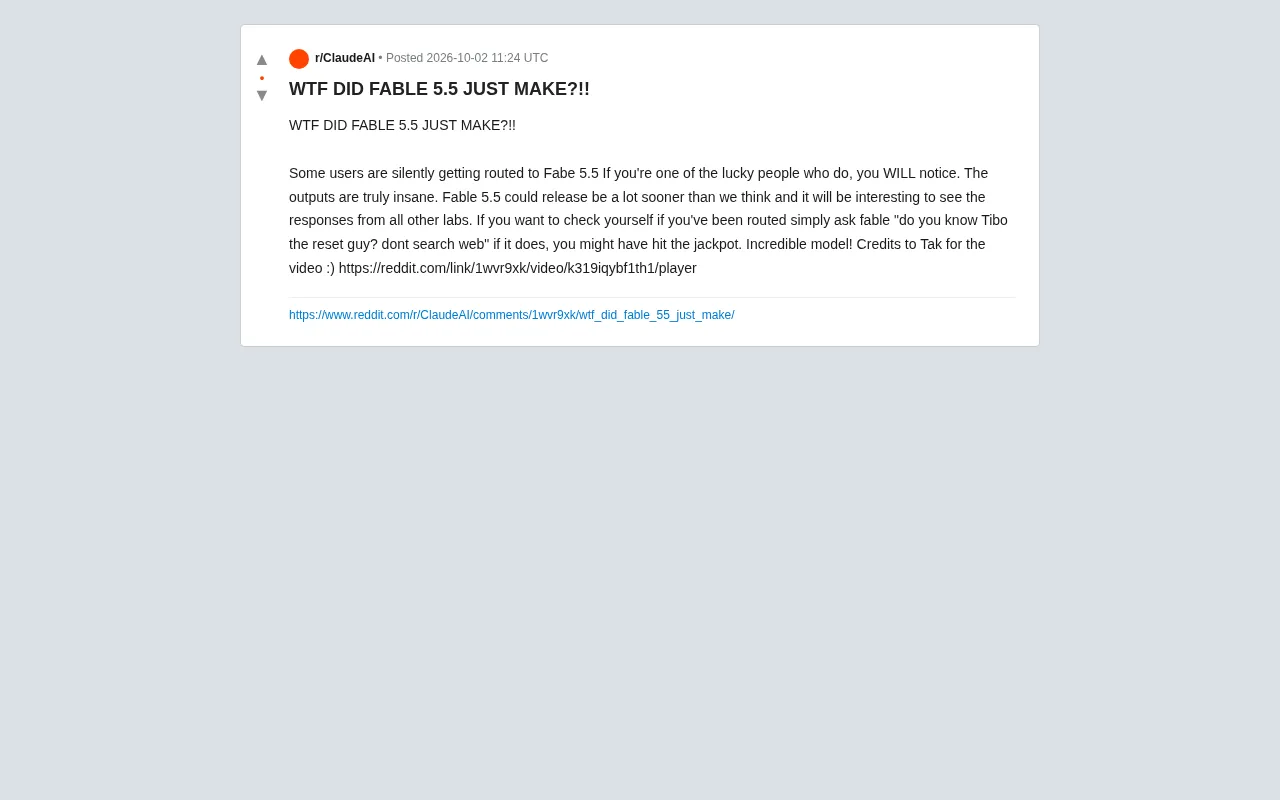
Fable 5.5 Gray-Scale Test Surfaces: Some Users Quietly Routed to New Model
Reddit users report being silently routed to a new model called Fable 5.5 with stunning outputs. We break down gray-scale routing, community version-testing tricks, and why to stay skeptical.

The Anti-Aging Race Is On — And Why LLMs Don't Actually Reason
MIT Technology Review examines two big topics: a competition to reverse biological age, and why LLMs don't truly reason. We break down epigenetic clocks and pattern matching in AI.

Don't Be Fooled: Large Language Models Don't Actually Reason
Do LLMs truly reason? This article uses AlphaGo's Move 37 to examine why Chain-of-Thought outputs are statistical pattern matching — not logical deduction — and what that means for AI deployment.